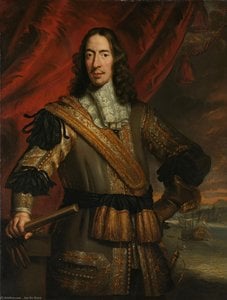
The Elegance of Portraiture in the Dutch Golden Age
Jan de Baen stands as a prominent figure within the illustrious Dutch Golden Age, celebrated for his exquisitely crafted portraits that captured the spirit and dignity of aristocratic subjects. Born in Haarlem on February 20th, 1633, his early life was marked by profound tragedy; the untimely deaths of his parents left him an orphan at just three years old. Taken into the care of his uncle, Hinderk Pyman—a magistrate and painter residing in Emden—de Baen received his first brushstrokes of inspiration from a man who would instill in him an initial appreciation for artistic endeavor. This formative experience propelled de Baentoward formal training, commencing his apprenticeship with the renowned Jacob Adriaensz Backer in Amsterdam in 1645, where he honed his skills alongside one of the era’s most formidable masters.
Backer's influence proved pivotal, shaping de Baen’s stylistic sensibilities and establishing a foundation for his future artistic pursuits. As he matured, de Baen developed a unique ability to navigate the complex social hierarchies of the seventeenth century through his art. He became a painter who understood the subtle language of status, bringing a specific kind of elegance and flattery to his work that was highly preferred by his wealthy patrons. This knack for making his subjects appear both real and remarkably distinguished allowed him to rise quickly in prominence, eventually leading him to serve the exiled Charles II of England during the monarch's time in Holland.
A Legacy of Royal and Political Grandeur
The trajectory of de Baen’s career was intimately tied to the shifting political tides of Europe. Following the Restoration of 1660, while he had opportunities to accompany the English court back to London, he opted instead for a settled life in The Hague. It was here that his reputation reached its zenith. His artistic output spanned diverse genres, yet portraits remained his dominating oeuvre, reflecting the multifaceted interests of the period. He gained renown for his depictions of influential figures such as Cornelis de Witt and Johan de Witt, brothers who held positions of considerable power within Dutch governance. In these works, he captured their likenesses with remarkable accuracy, conveying a sense of solemn grandeur that immortalized their political weight.
Beyond the Dutch political elite, de Baen’s brush touched the very pinnacle of European royalty. He famously captured the likeness of King William III of England, cementing his reputation as a portraitist capable of elevating subjects to iconic status. His ability to blend meticulous realism with a flattering aesthetic made him one of the most popular portrait painters between 1665 and 1700. While history often remembers the heavy shadows of Rembrandt or the bravado of Frans Hals, de Baen offered a different, more polished vision—one of light, refinement, and the sophisticated grace of the Hague's upper echelons.
Technique, Personal Life, and Final Years
Beyond meticulous realism, de Baen’s technique distinguished him through its ability to satisfy the era's craving for prestige. He mastered the art of presenting textures—the sheen of silk, the weight of velvet, and the intricate details of lace—in a way that spoke directly to the wealth of his sitters. His work was not merely about documentation but about the creation of an idealized persona. This skill is perhaps most intimately seen in his 1674 Self-portrait with his wife, Maria de Kinderen, where he displays both his painterly attributes and a tender connection to his family, reminding us that behind the grand portraits of kings lay a man deeply rooted in his own domestic reality.
De Baen’s life was one of both professional triumph and personal continuity. He married Maria de Kinderen in 1665, and together they raised a large family, including at least eight children, one of whom, Jacobus, followed in his father's footsteps to become a painter himself. This cycle of artistic lineage is a testament to the enduring nature of the Dutch tradition. Jan de Baen passed away in The Hague on March 8, 1702, leaving behind a body of work that remains a vital window into the splendor, the politics, and the refined elegance of the Dutch Golden Age.
Frågor och svar
Hur många konstverk av Jan de Baen finns tillgängliga att bläddra bland?
Du kan bläddra bland 38 konstverk verk av Jan de Baen på sidan Samtliga konstverk.
Under vilken historisk period verkade Jan de Baen?
Jan de Baen verkade under perioden Early Modern, vilket placerar konstnärens gärning i ett historiskt sammanhang.
I vilken stad och vilket land föddes Jan de Baen?
Jan de Baen föddes i Haarlem, i Netherlands.