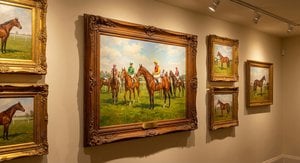
James Coutts Michie: A Master of Highland Light and Rural Life
Born in 1859 amidst the rugged beauty of Marywell, near Aboyne in Scotland’s Cairngorms, James Coutts Michie’s life was inextricably linked to the landscapes he so passionately captured on canvas. His early years were steeped in the traditions of a merchant family, yet his artistic inclinations led him down an unconventional path, one shaped by rigorous training and extensive travel – experiences that profoundly influenced his distinctive style. Michie wasn't merely a painter; he was a keen observer, meticulously studying light, color, and composition to translate the essence of Highland life onto paper.
Michie’s artistic journey began with instruction under Joseph Farquharson at the Trustee Academy in Edinburgh, providing him with a foundational understanding of technique. However, it was his subsequent sojourn in Paris, where he studied under the renowned Carolus-Duran, that truly ignited his creative spirit. Duran's emphasis on capturing fleeting moments and utilizing broken brushstrokes proved pivotal, shaping Michie’s approach to depicting atmospheric effects – particularly the ethereal quality of Highland light. This Parisian influence is evident in his later works, where a subtle Impressionistic touch blends seamlessly with his distinctly Scottish sensibility.
Following his time in Paris, Michie embarked on a period of extensive travel throughout Europe and North Africa, immersing himself in diverse artistic traditions. He spent several years living in Tangier, Morocco, absorbing the vibrant colors and dramatic light of the region. This experience broadened his palette and introduced him to new compositional techniques, contributing to the richness and complexity of his later landscapes. The influence of Moroccan color palettes can be seen subtly in the warm hues and atmospheric perspective found in works like “Autumn Landscape.”
A Highland Vision: Themes and Techniques
Michie’s artistic focus centered predominantly on capturing the beauty of the Scottish Highlands, particularly the rolling hills, lochs, and dramatic skies. However, he wasn't simply documenting these landscapes; he was striving to evoke a specific mood – one of tranquility, solitude, and connection with nature. His paintings are characterized by a remarkable sensitivity to light, meticulously rendered through delicate brushwork and subtle color variations. He frequently employed a technique known as ‘atmospheric perspective,’ creating the illusion of depth and distance by subtly diminishing colors and details in the background.
Beyond landscapes, Michie also produced a significant body of portraiture, often depicting members of the landed gentry and local communities. These portraits are notable for their understated elegance and psychological insight. He skillfully captured not only physical likeness but also the character and spirit of his subjects, imbuing them with a sense of dignity and humanity. His ability to portray both external appearance and inner emotion is particularly evident in works like “Portrait of Mrs. George McCulloch.”
Michie’s artistic style evolved considerably throughout his career. Early works often exhibited a more formal, academic approach, reflecting the influence of his training under Farquharson. However, as he gained experience and developed his own unique vision, his paintings became increasingly loose and expressive, characterized by a vibrant palette and a dynamic sense of movement. The shift towards looser brushwork and greater emphasis on capturing fleeting moments is particularly noticeable in his later landscapes.
Recognition and Legacy
James Coutts Michie’s artistic talent was quickly recognized within Scotland, earning him membership in both the Aberdeen Artist's Society and the Society of Scottish Artists. He exhibited extensively throughout his career, gaining critical acclaim for his evocative depictions of Highland life. His works are now held in prominent collections across the UK, including the Aberdeen Art Gallery, Nottingham City Museums & Galleries, and the Walker Art Gallery.
Michie’s influence extends beyond his own artistic output. He played a significant role in promoting Scottish art both domestically and internationally. His involvement with the Franco-British Exhibition of 1908 further cemented his reputation as a leading figure in the British art world. His legacy is one of quiet brilliance, a testament to the power of observation, sensitivity, and a deep connection to the natural world.
Personal Life and Later Years
Beyond his artistic pursuits, Michie led a relatively private life. He married Mary McCulloch in 1908, and they built a country house named Oak Hall near Haslemere in Surrey. This home became a haven for art collecting and served as a gathering place for artists and intellectuals. The couple’s collection of Scottish paintings was particularly notable, showcasing the works of several prominent Scottish artists.
James Coutts Michie passed away on December 18th, 1919, in Haslemere, Surrey. His death marked the end of an era for Scottish art, but his legacy continues to inspire artists and art lovers alike. His paintings remain a poignant reminder of the beauty and tranquility of the Highland landscape – a testament to the enduring power of observation and artistic vision.
Frågor & svar
Kan jag bläddra i James Coutts Michies verk efter stämning?
Känslomässigt rum för James Coutts Michie är en sida som sorterar konstnärens verk efter stämning.
Var kan jag hitta statistik om James Coutts Michies verk?
Sidan Statistik för James Coutts Michie presenterar statistik beräknad utifrån konstnärens verk som finns listade på denna webbplats.
Under vilken historisk period verkade James Coutts Michie?
James Coutts Michie verkade under perioden 19th Century. Perioden placerar konstnärens verksamhet i ett historiskt sammanhang.
Kan jag sortera James Coutts Michies konstverk efter färg?
Färgindex för James Coutts Michie är en sida som organiserar konstnärens verk efter deras färger.
Hur är James Coutts Michies karriär uppdelad i olika perioder?
Kronologi för James Coutts Michie är en rullningsbar tidslinje som presenterar konstnärens verk i kronologisk ordning, uppdelade i kapitel efter olika karriärperioder.
Hur kan jag följa James Coutts Michies verk år för år?
James Coutts Michies konstverk kan ses i kronologisk ordning på artistens Tidslinje för konstverk-sida.
Var finns James Coutts Michies konstverk grupperade efter färgpalett?
Sidan Efter färgpalett grupperar James Coutts Michies konstverk efter deras färgpaletter.
Vilka andra namn eller alias använder sig James Coutts Michie av?
James Coutts Michie är även känd som Harry Michie, Elizabeth Coutts, George Mcculloch, Mary Agnes Mayger, Mary Coutts Michie.