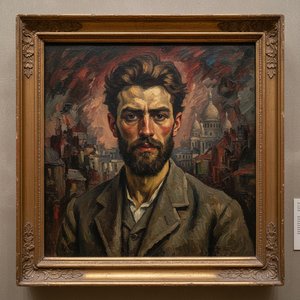
Early Life and Artistic Beginnings
Isaac Lazarus Israëls was born into a family deeply rooted in the Dutch art world. He was the son of Jozef Israëls, a prominent painter associated with the Hague School, and Aleida Schaap. This artistic heritage fostered an early appreciation for painting within Isaac, who displayed remarkable talent from a young age. Between 1880 and 1882, he studied at the Royal Academy of Art in The Hague, where he met George Hendrik Breitner, forming a lifelong friendship that would significantly influence his artistic trajectory. At just sixteen years old, Israëls achieved early recognition when he sold “Bugle Practice” to artist and collector Hendrik Willem Mesdag even before it was fully completed. Portraits of his grandmother and a family friend, created in the same year, demonstrated his already considerable technical skill.The Amsterdam Impressionist
Israëls became a leading figure within the Amsterdam Impressionism movement. Influenced by the philosophy of the Tachtigers—a group of writers and artists advocating for style to reflect content and emotionally charged subjects represented through intense technique—he shifted his focus towards capturing the vibrant scenes of everyday life in Amsterdam. He frequently spent summers with his father in Scheveningen, painting colorful seaside landscapes. His work reflected a desire to portray the bustling streets, cafes, and cabarets of Amsterdam, moving away from the more traditional subject matter favored by earlier Dutch masters.Travels and Artistic Evolution
In 1904, Israëls relocated to Paris, establishing a studio and embracing the city’s unique motifs. He further explored his interest in fashion by studying at Paquin and Drecoll fashion houses. The outbreak of World War I prompted his return to Holland, where he primarily focused on portraiture. Following the war, he embarked on extensive travels throughout Europe and Asia, including two years spent sketching and painting in India and the Dutch East Indies. These experiences broadened his artistic horizons, introducing him to new subjects and perspectives that enriched his later work.Legacy and Recognition
Isaac Lazarus Israëls left behind a significant body of work celebrated for its vibrant colors, loose brushwork, and insightful portrayals of everyday life. His paintings are now housed in prestigious museums worldwide, including the Van Gogh Museum and the Mauritshuis. He achieved international recognition, notably winning a Gold Medal at the 1928 Olympic Games for his painting "Red Rider." Israëls' legacy lies not only in his artistic achievements but also in his contribution to the development of Amsterdam Impressionism, solidifying his place as one of the most important Dutch painters of his era.Frågor och svar
Var kan jag se alla konstverk av Isaac Israels?
Alla verk av Isaac Israels på denna webbplats kan utforskas via artistens Samtliga konstverk-sida.
Hur hittar jag alla verk av Isaac Israels sorterade efter teknik?
För att hitta alla verk av Isaac Israels inom ett visst medium, besök artistens Alla tekniker-sida.
Var och när föddes Isaac Israels?
Isaac Israels föddes i Amsterdam år 1865.