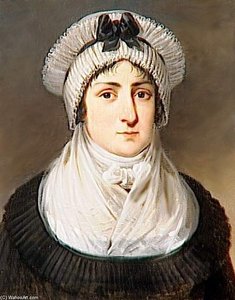
A Life Captured in Light and Shadow
The story of Hortense Haudebourt-Lescot is one of profound observation and the courage to find beauty in the overlooked. Born Antoinette Cécile Hortense Viel in Paris in 1784, her journey from the daughter of a perfumer to a celebrated figure of the French Romantic era was paved with an extraordinary dedication to the nuances of human existence. Her early years were shaped by a precocious talent that caught the eye of the renowned history painter Guillaume Guillon-Lethière. Under his mentorship, she did not merely learn the mechanics of oil on canvas; she inherited a passion for the dramatic interplay of light and shadow, a technique that would later become her signature. This formative bond was more than academic; it was a gateway to the wider world, leading her to the Eternal City when Lethière was appointed director of the French Academy in Rome.
It was within the sun-drenched landscapes and vibrant streets of Italy, between 1808 and 1816, that Haudebourt-Lescot truly discovered her artistic soul. While many of her contemporaries sought the grandeur of mythological epics or the stiff formality of aristocratic portraiture, she found herself drawn to the rhythmic pulse of rural life. She became a chronicler of the Italian peasantry, capturing the intricate textures of their costumes, the warmth of their domestic rituals, and the quiet dignity of their daily labors. This period of immersion allowed her to develop a style that blended classical rigor with a burgeoning realism, transforming simple genre scenes into profound studies of human character.
The Mastery of Genre and Detail
As she returned to Paris, Haudebourt-Lescot began to make her mark on the prestigious Salon, exhibiting works that commanded attention for their psychological depth and technical brilliance. Her ability to employ chiaroscuro—the dramatic contrast between light and dark—served to illuminate not just the physical features of her subjects, but their very essence. In her celebrated self-portraits, such as the one from 1825, she presents an enigmatic gaze that invites the viewer into a silent dialogue, revealing an artist who was as much a philosopher of sight as she was a painter of form.
Her oeuvre is characterized by several defining elements:
- Meticulous Realism: A profound devotion to capturing the tactile reality of fabrics, skin, and domestic environments.
- Humanist Perspective: An empathetic approach to genre painting that elevated the lives of common people to the level of high art.
- Technical Sophistication: The seamless integration of classical composition with the emotive, atmospheric qualities of the Romantic movement.
Beyond her individual canvases, Haudebourt-Lescot’s influence extended into the very fabric of the Parisian art scene. Her home became a vibrant salon, a gathering place for the intellectual and artistic elite of the 19th century. As a teacher, she passed her rigorous standards of observation to a new generation of women artists, including Herminie Déhérain and Marie-Ernestine Serret, ensuring that her legacy of precision and empathy would endure.
A Lasting Legacy in French Art
The historical significance of Hortense Haudebourt-Lescot lies in her role as a pioneer. At a time when the boundaries for women in the fine arts were often strictly circumscribed, she navigated the complexities of the art world with grace and distinction. Her recognition by the Duchess of Berry, who appointed her as her personal painter, serves as a testament to her standing within the highest echelons of French society. Yet, despite this proximity to power, her heart remained tethered to the authentic, the rustic, and the real.
Today, her works reside in some of the world's most esteemed institutions, including the Louvre Museum, serving as enduring reminders of her ability to find the extraordinary within the ordinary. She remains a vital figure for anyone seeking to understand the transition from Neoclassicism to Romanticism, and her life stands as a testament to the power of the artist's eye to transform the fleeting moments of life into eternal masterpieces.