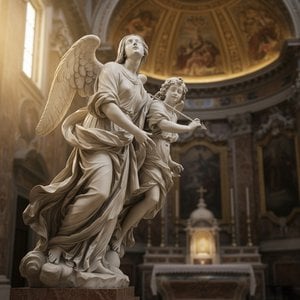
Giovanni Battista Caccini: Sculptor of Roman Echoes
Giovanni Battista Caccini, born in Montopoli in Val d’Arno between Florence and Pisa in 1556 and passing away in Rome in 1613, was a pivotal figure in the late Mannerist and early Baroque sculpture scene. More than simply a sculptor, he was an interpreter of antiquity, a meticulous restorer, and a skilled craftsman who brought the ghosts of Roman art to life within the vibrant context of 16th-century Florence and beyond. His work reveals a deep fascination with classical forms, coupled with a pragmatic approach to his craft that earned him both admiration and, occasionally, accusations of clever imitation.
Caccini’s artistic journey began under the tutelage of Giovanni Antonio Dosio, a sculptor-architect renowned for his accurate renderings of Roman antiquities. This early training instilled in Caccini a profound respect for the past, shaping his approach to sculpture as an act of careful reconstruction and informed interpretation. Dosio's emphasis on drawing from Roman models provided Caccini with a crucial foundation – a detailed understanding of proportion, anatomy, and the expressive potential of classical forms. However, Caccini’s work wasn’t merely a slavish reproduction; he infused these influences with his own artistic sensibility, creating sculptures that possessed a distinctly Mannerist quality—characterized by elongated figures, dramatic poses, and an emphasis on emotional intensity. The inescapable influence of Giambologna and his circle is readily apparent in Caccini's bronze statuettes, particularly their dynamic compositions and theatrical gestures.
Restoration and Imitation: A Sculptor’s Dual Role
Caccini’s reputation as a knowledgeable antiquarian stemmed largely from his extensive work restoring fragmentary Roman sculptures. He wasn’t simply repairing damaged pieces; he meticulously pieced together broken fragments, often supplementing them with his own creative additions to reconstruct lost works of art. This practice, while undeniably skillful, also led to accusations of “counterfeiting the antique,” a charge reflecting the growing collector's desire for complete and idealized representations of antiquity. As biographer Raffaello Borghini noted in 1730, Caccini possessed "remarkable skill in diligently putting together pieces, and counterfeiting, the Antique." This ability to convincingly recreate lost forms was highly valued by wealthy patrons eager to display their collections as embodiments of classical perfection.
Despite this reputation for imitation, Caccini’s own original works demonstrate a remarkable artistic vision. Notable examples include his evocative depiction of Saint John the Baptist at Badia di Passignano, showcasing a powerful and contemplative figure; the serene head of Christ in Rijksmuseum, demonstrating an understanding of classical portraiture; and the allegorical sculptures adorning the Boboli Gardens in Florence, which are characterized by bold silhouettes and dramatic gestures. His work for the Ponte Santa Trinita – four figures representing the seasons – stands as a testament to his ability to translate antique ideals into dynamic and engaging forms.
Collaboration and Architectural Ventures
Caccini’s career was marked by significant collaborations, most notably with Pietro Tacca and the other pupils of Giambologna during the protracted effort to create bronze doors for Pisa Cathedral. This project demanded not only technical skill but also a deep understanding of collaborative artistic processes – a crucial element in the Mannerist workshop environment. Beyond sculpture, Caccini ventured into architecture, leaving behind his architectural mark on the portico of the Santissima Annunziata in Florence (1601), a structure that reflects both classical principles and the stylistic trends of the time.
Key Works and Legacy
Caccini’s artistic output encompasses a diverse range of subjects, from religious figures to mythological themes. Among his most celebrated works are the Bacchus and Ampelos in the Uffizi Gallery – once attributed to Michelangelo—a testament to Caccini's ability to capture the essence of classical mythology; the fragmentary Apollo Sauroctonos restored at the Uffizi, demonstrating his skill in reconstructing lost forms; and numerous allegorical statues within the Boboli Gardens. His contributions to Florentine art are significant, bridging the gap between the Renaissance ideals of antiquity and the evolving stylistic concerns of the late 16th century.
A Brother’s Influence
It is important to acknowledge Caccini's connection to his brother, Giulio Caccini, a renowned composer, teacher, singer, instrumentalist, and writer of the very late Renaissance and early Baroque eras. While their artistic paths diverged – one a sculptor, the other a musician – they shared a common heritage and likely benefited from each other’s intellectual and creative environments. Giulio's musical legacy stands as a powerful counterpoint to Giovanni Battista’s sculptural achievements, highlighting the rich cultural tapestry of the Caccini family.