George Hyde Chambers (1803–1840): A Pioneer of Maritime Impressionism
George Hyde Chambers was born on June 14, 1803, in Whitby, Yorkshire—a town steeped in seafaring tradition and renowned for its rich artistic heritage. He descended from a family with deep roots in the maritime world; his father, George Chambers senior (1803–1840), was a seaman who had travelled extensively throughout Europe and America, fostering within young George an early fascination for the ocean and its dramatic landscapes. Despite facing considerable hardship during his formative years—growing up in a poverty-stricken sharecropping household—Chambers possessed an unwavering determination to pursue artistic excellence, fueled by a lifelong passion for drawing and painting.
Early Life & Artistic Beginnings
Chambers's formative years were marked by a profound connection to the sea—a fascination instilled in him by his father’s seafaring vocation. He honed his artistic skills through self-directed study and observation, absorbing influences from artists such as Eugène Delacroix and JMW Turner—artists whose expressive techniques resonated deeply with his sensibilities. At the age of 8 years, he was working on the coal sloops in the town harbour. He took art classes in Whitby, the town of his birth and subsequently moved to London where he became famous for his paintings of naval battles.
Marriage & Family
In 1852 Chambers married Susanna Warrell in London—establishing a family life that would nurture his artistic pursuits. He had four children—two sons and two daughters—who brought joy and companionship to his daily existence. His father’s seafaring vocation instilled in young George an early fascination for the ocean and its dramatic landscapes.
London Years & Artistic Exhibitions
Chambers resided at various changing London addresses, securing commissions from prominent patrons and showcasing his work at prestigious institutions—including the Royal Academy and the British Institution. He quickly established himself as a respected artist, attracting commissions from prominent patrons and exhibiting his work at the Royal Academy and the British Institution. His artistic output spanned a diverse range of subjects—from maritime scenes to landscapes—reflecting his unwavering commitment to portraying natural beauty with poetic sensitivity.
Notable Paintings & Artistic Achievements
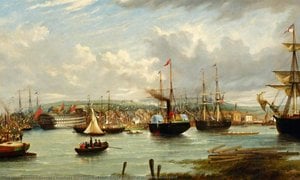
Among Chambers’s most celebrated achievements were his monumental depictions of naval battles—particularly “The Bombardment of Algiers” (1816)—which showcased his mastery of composition, perspective, and tonal modulation—demonstrating his ability to convey the drama and intensity of a historical event with remarkable precision. His landscapes—characterized by luminous color palettes and loose brushwork—captured the sublime grandeur of the Yorkshire countryside—reflecting his unwavering commitment to portraying natural beauty with poetic sensitivity. Chambers’s paintings consistently explored themes related to the sea—investigating its moods, textures, and transformative power—demonstrating his profound understanding of atmospheric phenomena and their influence on visual perception. He was a talented draughtsman and watercolourist and an accomplished painter in oils, often working with fluent, colourful bravura in such views as *A Fresh Breeze off Cowes* and *A Dutch Boier in a Fresh Breeze*.
Historical Significance & Artistic Legacy
Chambers’s artistic style—characterized by luminous color palettes and loose brushwork—represented a decisive departure from Romantic conventions—embracing the principles of spontaneity, immediacy, and subjective perception that underpinned the Impressionist movement. His connection to Whitby—a town steeped in seafaring tradition and renowned for its rich artistic heritage—served as an inspiration for his paintings—reflecting the broader cultural landscape of Victorian England. Chambers achieved enduring artistic renown—leaving behind a legacy of evocative landscapes and masterful depictions of naval battles that continue to inspire admiration and scholarly inquiry—solidifying his place among Britain’s most revered painters. Alan Russett eloquently summarized Chambers’s contribution to British art—observing “George Jnr’s are usually larger and his handling of the paint more free, the attention to detail and figures being less rigorous. His watercolours can be of sufficient quality to be confused with those of his father but the subject matter or other non-stylistic criteria usually provide the key.” Chambers’s paintings—characterized by luminous color palettes and loose brushwork—embodied the stylistic hallmarks of Impressionism—a movement that championed spontaneity, immediacy, and subjective perception—forever shaping the course of British art history.