Carstian Luyckx: The Monogrammist of Mortality
Carstian Luyckx (c. 1623 – 1657), a Flemish painter hailing from Antwerp, stands as a pivotal figure in the burgeoning Baroque landscape of Northern Europe. Often referred to as “the monogrammist,” Luyckx gained renown for his meticulously crafted floral still lifes and haunting vanitas compositions—a genre deeply rooted in Renaissance humanist contemplation yet powerfully infused with anxieties surrounding death and decay. His artistic journey began amidst the vibrant intellectual ferment of Antwerp’s Golden Age, where he absorbed influences from masters like Jan Brueghel the Elder and Peter Paul Rubens, establishing a distinctive style characterized by luminous color palettes and an unparalleled sensitivity to textural detail.
- Early Life & Training: Born in Antwerp around 1623, Luyckx’s formative years were spent honing his skills under the tutelage of Abraham van Beijeren, a respected Antwerp painter known for his landscapes and portraits. This apprenticeship instilled in him a foundational understanding of perspective and compositional balance—elements that would become hallmarks of his oeuvre.
- Floral Still Life & The Antwerp Garland Tradition: Luyckx’s reputation solidified through his mastery of the Antwerp garland tradition, pioneered by Jan Brueghel the Elder and Cardinal Federico Borromeo. These elaborate floral arrangements weren't merely decorative; they served as vehicles for conveying profound philosophical ideas—specifically, the ephemeral beauty of earthly existence juxtaposed against the inevitability of mortality. Consider “Still Life of Roses, Peonies and Passion Flowers,” where Luyckx captures a breathtaking tableau of blossoms suspended from a ribbon, accompanied by fluttering butterflies and ladybirds – an exquisite embodiment of fleeting splendor.
Vanitas: Reflections on Human Frailty
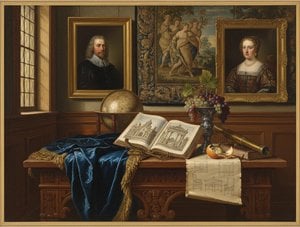
Luyckx’s contribution to the vanitas genre transcends mere stylistic imitation; he imbued it with psychological depth and symbolic resonance. Unlike earlier depictions of death as a solemn procession, Luyckx's vanitas scenes—such as “Still life with a Terrestrial Globe, a Book, Shells, a Snake and Butterflies”—present death not as an endpoint but as a catalyst for introspection. The inclusion of objects like a terrestrial globe (representing worldly ambition), a book (symbolizing knowledge and spiritual enlightenment), seashells (evoking the transience of earthly pleasures), and a snake (representing temptation and decay)—all converge to underscore the futility of striving for permanence in a universe governed by cyclical change. His masterful use of chiaroscuro—the dramatic interplay between light and shadow—further amplifies this sense of melancholy, drawing viewers into a contemplative gaze upon the fragility of human existence.
- Hunting Scenes & Flemish Specialists: Influenced by Frans Snyders and Jan Fyt, Luyckx ventured beyond floral still lifes into the realm of hunting scenes—a genre favored by Flemish specialists during the Baroque period. “Still life of pink, yellow and white roses hanging from a blue ribbon with a red admiral and a cabbage white” exemplifies his meticulous attention to detail and his ability to convey dynamism within a static composition. The inclusion of animals like partridges and hounds reflects not only artistic convention but also broader cultural attitudes toward nobility and prowess.
Notable Works & Legacy
Among Luyckx’s most celebrated achievements is “The Kremer Collection,” featuring a striking depiction of birds attacked by a fox—a testament to his technical virtuosity and his profound understanding of animal anatomy. His work has been attributed to Abraham van Beijeren or followers of Alexander Adriaenssen, demonstrating the difficulty inherent in definitively establishing authorship within artistic circles.
- Historical Significance: Luyckx’s oeuvre occupies a crucial position in art history—marking a transitional phase between Antwerp and French Baroque styles. His exploration of mortality and his masterful execution of floral compositions continue to inspire artists today, cementing his legacy as one of the foremost practitioners of Northern European painting during its golden age.
Further Exploration
For more information on Carstian Luyckx’s artistic life and oeuvre, consult scholarly publications dedicated to Flemish Baroque art. Explore online databases featuring high-resolution images of his paintings—a captivating journey into the heart of a singular artistic vision.