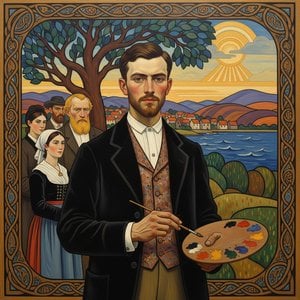
Émile Bernard: A Post-Impressionist Pioneer
Émile Henri Bernard (1868–1941) was a French painter and writer, who had artistic friendships with Vincent van Gogh, Paul Gauguin and Eugène Boch, 1 and at a later time, Paul Cézanne. Most of his notable work was accomplished at a young age, in the years 1886 through 1897. He is also associated with Cloisonnism and Synthetism, two late 19th-century art movements. Less known is Bernard's literary work, comprising plays, poetry, and art criticism as well as art historical statements that contain first-hand information on the crucial period of modern art to which Bernard had contributed.
### Early Life and Education
Émile Henri Bernard was born in Lille, France, in 1868. As in his younger years his sister was sick, Émile was unable to receive much attention from his parents; he therefore stayed with his grandmother, who owned a laundry in Lille, employing more than twenty people. She was one of the greatest supporters of his art. The family moved to Paris in 1878, where Bernard attended the Collège Sainte-Barbe. He began formal art studies at the École des Arts Décoratifs and later joined the Atelier Cormon in 1884. Here, he experimented with Impressionism and Pointillism. His expressive tendencies led to a suspension from the École des Beaux-Arts, prompting a formative journey through Brittany on foot.
### Artistic Development and Influences
Bernard’s artistic development was significantly influenced by his travels in Brittany, where he encountered local traditions and landscapes that deeply resonated with him. A pivotal moment came in August 1886 when he met Paul Gauguin in Pont-Aven. This encounter sparked a close artistic friendship and profoundly impacted both artists’ styles. Bernard's style played a crucial role in shaping Gauguin’s mature work, particularly his exploration of symbolism and flattened forms. He also associated with Vincent van Gogh, forming part of the “School of Petit-Boulevard” alongside Anquetin and Toulouse-Lautrec.
### Key Artistic Movements
Bernard is considered a pioneer of Cloisonnism, a style characterized by bold, flat shapes separated by dark contours – reminiscent of stained glass. He also played a key role in the development of Synthetism, which emphasized the creation of art based on subjective experience and symbolic meaning rather than direct observation of nature. These movements represented a departure from Impressionism, focusing instead on structure, symbolism, and emotional expression.
### Notable Works
Bernard’s most iconic piece is “La Grandmère” (1887), a poignant portrait of his grandmother, showcasing the artist’s early mastery of expressive form and color. Numerous Breton landscapes capture the essence of rural life in Brittany. Religious works such as “The Adoration of the Shepherds” demonstrate his exploration of symbolic themes.
### Literary Contributions and Historical Significance
Beyond painting, Bernard was a prolific writer, producing plays, poetry, and art criticism. His writings provide valuable first-hand insights into the development of modern art during his time. He died in 1941, leaving behind a body of work that continues to be celebrated for its originality and artistic innovation. His legacy extends beyond individual paintings; he fundamentally reshaped the visual language of his era, paving the way for Fauvism and Expressionism and inspiring generations of artists to prioritize emotional resonance over photographic realism.