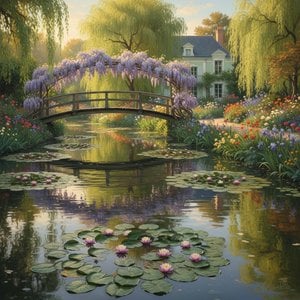
The Luminous Legacy of Beatrice Emma Parsons
In the delicate interplay of light and shadow found within the English garden, one finds the very soul of Beatrice Emma Parsons. Born in 1869, this remarkable British painter possessed a rare ability to translate the ephemeral beauty of the natural world into enduring watercolor masterpieces. While her early life saw her navigating the artistic circles of London and studying at the prestigious Royal Academy Schools, it was her profound connection to the verdant landscapes of Devon, Cornwall, and Somerset that truly defined her creative spirit. Her journey was not merely one of technical mastery but a deep, emotional pilgrimage through the botanical wonders of the British Isles, capturing a sense of tranquility that resonated far beyond the borders of her homeland.
Parsons’ artistic evolution is a fascinating study in the transition from meticulous observation to atmospheric expression. In her formative years, she demonstrated a remarkable proficiency in more conventional genres, including portraiture and historical scenes. However, as the turn of the century approached, a singular passion began to take hold: the garden. This was not a pursuit of mere botanical accuracy or scientific documentation; rather, Parsons sought to capture the poetics of the garden. She mastered the art of layered watercolor washes, using them to build depth and texture that mimicked the lushness of summer blooms and the soft, dappled light filtering through dense foliage. Her work became a sanctuary of color, where the saturated hues of flowers and the subtle shifts in greenery invited the viewer into a state of quiet contemplation.
A Master of Botanical Atmosphere and Influence
The brilliance of Parsons’ technique lay in her ability to balance detail with mood. While her brushstrokes could be incredibly fine—a skill nurtured by an early fascination with botanical illustration—she never allowed precision to stifle the feeling of the scene. Her compositions often evoked a sense of enclosure and peace, reflecting the Victorian and Edward and Edwardian sensibilities of the era. She was deeply influenced by the decorative arts movement, particularly the organic forms championed by William Morris, which encouraged a harmonious relationship between art and nature. This influence is evident in her ability to treat a garden not just as a collection of plants, but as a cohesive, rhythmic tapestry of life.
Her recognition during her lifetime was both widespread and prestigious. The following highlights underscore her standing in the artistic community:
- Royal Recognition: Her exquisite watercolors earned a place within the esteemed collections of the Royal Horticultural Society, cementing her reputation as a premier painter of garden subjects.
- Cultural Reach: Beyond the gallery walls, her art permeated daily life through reproductions on postcards and illustrations in beloved gardening books such as Gardens of England (1908) and The Charm of Gardens (1910).
- Artistic Peerage: She was celebrated alongside contemporaries like George Samuel Elgood and Lilian Stannard as one of the leading English painters of gardens.
Historical Significance and Enduring Spirit
As the world moved toward the rapid changes of the 20th century, Parsons’ work served as a poignant preservation of a vanishing pastoral ideal. Her paintings captured a specific vision of the English countryside—a world of manicured beauty and wild abundance that felt increasingly threatened by the encroaching industrial age. There is a certain nostalgia embedded in her palettes, a longing for the stillness of a summer afternoon that remains palpable to the modern viewer. Even as her style hinted at more abstract explorations of color and form, she remained anchored in the profound respect for the natural world.
Today, the works of Beatrice Emma Parsons stand as much more than mere illustrations of flora; they are emotional landscapes. Whether depicting a single, stretching puppy or a sprawling, sun-drenched garden, her art continues to inspire a sense of wonder. She remains a vital figure in the history of British watercolor, reminding us that through the careful application of pigment and the sincere observation of nature, one can capture the very essence of life's most fleeting moments.