A Bolognese Pioneer of Still Life: The World of Antonio Leonelli
Antonio Leonelli, more commonly known as Antonio da Crevalcore after his birthplace near Bologna, remains a fascinating yet somewhat elusive figure in the landscape of Italian Renaissance art. Born around 1440 and passing away circa 1525, he occupied a unique position—a painter celebrated by contemporaries not only for his skill with brush and pigment but also for his musical talents. While documentation surrounding his life is fragmented, enough evidence has emerged over recent decades to illuminate the contributions of this artist who bridged the gap between traditional religious iconography and the burgeoning genre of independent still-life painting. Leonelli’s story isn't one of grand commissions or widespread fame, but rather a testament to refined skill, intellectual curiosity, and an early embrace of naturalistic observation that would resonate with artists for generations to come.
Early Life and Artistic Formation
The details of Leonelli’s formative years are sparse, yet we know he first appears in Bolognese records as a painter around 1461. The artistic climate of Bologna at this time was vibrant, steeped in local realism but increasingly influenced by the innovations emanating from other centers like Ferrara. It is widely believed that Leonelli received his initial training in Ferrara, though concrete proof remains elusive. Stylistic affinities with artists such as Francesco del Cossa and Ercole de’ Roberti suggest a period of apprenticeship or workshop participation within the Este court—a milieu renowned for its sophisticated patronage and artistic experimentation. This exposure likely instilled in him a meticulous attention to detail, expressive modeling, and an interest in complex compositions that would characterize his mature work. Beyond painting, Leonelli was esteemed as a musician, a duality of talent not uncommon during the Renaissance but nonetheless noteworthy. His contemporaries recognized both his visual and auditory gifts, hinting at a broad intellectual curiosity and a refined sensibility.
A Novel Approach to Nature: Still Life and Religious Works
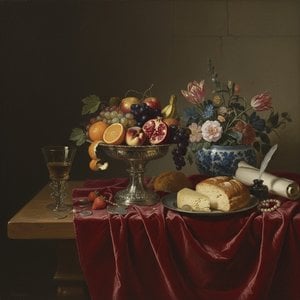
Leonelli’s surviving oeuvre is relatively small, which contributes to the challenges of fully reconstructing his artistic trajectory. However, the works that have been attributed to him reveal a painter deeply engaged with both sacred themes and the natural world. He is particularly celebrated for his early independent still lifes—groundbreaking compositions that stand as precursors to the genre’s full development in the 17th century. Still Life with Grapes and a Bird, painted around 1500-1510, exemplifies this innovative spirit. The work is not merely a depiction of objects but a playful allusion to classical antiquity—specifically, the legendary Greek painter Zeuxis, whose grapes were so realistically rendered that birds attempted to pluck them from the canvas. This reference speaks to Leonelli’s erudition and his desire to elevate still life beyond mere decorative function. His religious panels, such as Saint Francis, demonstrate a similar commitment to naturalistic detail and illusionistic effects. These works often feature intricate backgrounds populated with symbolic objects and meticulously rendered flora and fauna, creating a harmonious blend of the sacred and the earthly.
Patronage, Technique, and Historical Significance
Leonelli’s patrons included members of the Bolognese elite, including Isabella d'Este, the Marchioness of Mantua—a renowned art collector known for her discerning taste. He was commissioned to create a still life for her in 1506, further solidifying his reputation among influential figures. His technique involved a masterful use of oil paint, allowing him to achieve remarkable realism and subtle gradations of light and shadow. The artist’s fascination with trompe-l'œil effects—the art of deceiving the eye—is evident throughout his work, blurring the boundaries between representation and reality. While Leonelli did not establish a large workshop or produce a vast body of paintings, his influence should not be underestimated. He anticipated key developments in still life painting, paving the way for artists like Vincenzo Campi and later masters who would fully explore the genre’s expressive potential. His work represents a crucial moment in the transition from medieval symbolism to Renaissance naturalism—a testament to the power of observation, intellectual curiosity, and artistic innovation within the vibrant cultural landscape of 16th-century Italy.