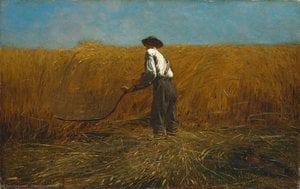
A Pastoral Symphony in Watercolor
In the quietude of Winslow Homer’s 1878 watercolor, Shepherdess Tending Sheep, we are invited into a realm where time seems to decelerate, yielding to the rhythmic pulse of the natural world. This masterpiece is far more than a mere pastoral landscape; it is a profound meditation on the symbiotic relationship between humanity and the earth. As the eye wanders across the canvas, it encounters a solitary shepherdess, a figure of quiet strength and diligent care, anchored amidst her flock. The composition is masterfully balanced, featuring thirteen sheep scattered with intentional variety throughout the verdant setting, their soft forms echoing the gentle undulations of the terrain. A watchful dog rests near her side, adding a layer of domestic harmony and companionship that softens the vastness of the landscape, creating an intimate tableau of peace.
Homer’s technical prowess is on full display through his sophisticated use of watercolor, a medium that demands both precision and a surrender to spontaneity. To capture the ephemeral quality of light filtering through the foliage, he employed delicate brushstrokes and intricate glazing techniques. By layering translucent washes of pigment, Homer achieved an extraordinary sense of atmospheric depth and luminosity, allowing the paper to breathe through the color. This method imbues the scene with an ethereal glow, characteristic of American Impressionism, where the goal is not just to document a scene, but to capture the very sensation of light and air. For the discerning collector or interior designer, this technique offers a visual lightness that can breathe life and tranquility into any curated space.
The Soul of the American Landscape
To understand this work, one must look toward the artist’s unique origins. Unlike many of his peers who sought refinement in European academies, Winslow Homer was a product of the American experience. His early years as a commercial illustrator for Harper’s Weekly instilled in him an observational rigor—a necessity to render the world with clarity and truth. In Shepherdess Tending Sheep, this illustrative precision meets a newfound poetic sensibility. The painting serves as a bridge between his documentary roots and his mature, atmospheric explorations of nature. There is a spiritual weight to the shepherdess’s presence; she represents a lost era of agrarian simplicity, a nostalgic nod to a time when human existence was intimately entwined with the cycles of the seasons.
The emotional resonance of this piece lies in its ability to evoke a sense of profound stillness. In an age of constant motion and digital noise, Homer’s vision offers a sanctuary of contemplation. The subtle textures of wool, the dampness of the earth, and the diffused sunlight all conspire to create a sensory experience that transcends the two-dimensional surface. For those seeking to adorn a home or gallery with art that inspires reflection, this reproduction serves as a window into a more tranquil existence. It is an investment in atmosphere, bringing the enduring, quiet dignity of the American pastoral spirit into the modern interior.



 Visa i rummet
 Köp handmålat konstverk
 Skicka
 Dela
Dela
 Detaljer
 Guide
Guide

 Ladda ner
 Liknande objekt
 Röntgen
 Bildspel
 Besökstatistik


 Läs mer






































 Glasalternativet är endast tillgängligt i storlekar under 110 cm.