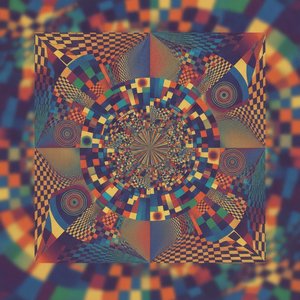
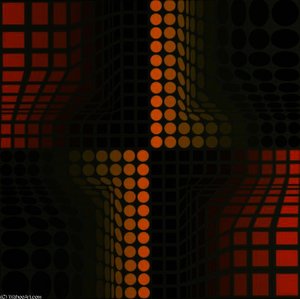
A Spiraling Vision: Victor Vasarely's "Vonal Zoeld"
Victor Vasarely’s 1968 work, “Vonal Zoeld,” is more than just a painting; it’s an invitation to experience the world through a lens of geometric precision and optical illusion. This vibrant piece, recently captured in stunning detail, draws the viewer into a mesmerizing spiral staircase bathed in hues of yellow and orange. It's a testament to Vasarely’s pioneering role as the father of Op Art, a movement dedicated to exploring how our eyes perceive form, color, and motion.
The Architect of Perception: Style and Technique
“Vonal Zoeld” exemplifies Vasarely’s signature style – geometric abstraction taken to its most compelling extreme. The staircase itself is constructed from countless small steps, meticulously rendered to create a sense of depth and movement that defies the flatness of the canvas. This isn't an attempt at realistic representation; rather, it's a carefully orchestrated visual puzzle designed to stimulate the viewer’s perception. Vasarely wasn't interested in depicting reality as it *is*, but in constructing a new reality through the manipulation of shapes and colors. The dominant yellow and orange palette contributes significantly to this effect, evoking feelings of warmth, energy, and perhaps even a touch of disorientation – hallmarks of Op Art. His technique involved layering geometric forms with precise calculations, aiming to create an optical vibration that engages the viewer's eye in a dynamic dance.
A Life Forged in Geometry: Vasarely’s Artistic Journey
To truly appreciate "Vonal Zoeld," it’s essential to understand the artist behind it. Born Károly Vásárhelyi in Pécs, Austria-Hungary (now Croatia), Victor Vasarely initially pursued medical studies before embracing his artistic calling. His early training at the Podolini-Volkmann Academy and later, Sándor Bortnyik's workshop – deeply influenced by the Bauhaus movement – laid the foundation for his unique approach to art. The Bauhaus emphasis on functional design and geometric abstraction profoundly shaped Vasarely’s aesthetic sensibilities. He wasn't merely painting pictures; he was developing a system—a visual language based on fundamental geometric principles that could be applied universally. This systematic approach is evident in "Vonal Zoeld," where the spiral staircase isn't just an image, but a manifestation of underlying mathematical relationships.
Symbolism and Emotional Resonance
While Vasarely’s work often appears purely intellectual, “Vonal Zoeld” possesses a surprising emotional depth. The spiraling form itself can be interpreted as a symbol of continuous movement, growth, or even the cyclical nature of time. The vibrant colors evoke feelings of optimism and energy, while the optical illusions create a sense of dynamism and excitement. Some might perceive it as an artistic representation of a tunnel or winding pathway—a metaphor for life's journey with its twists and turns. Ultimately, the beauty of "Vonal Zoeld" lies in its ability to provoke individual interpretations. It’s a work that invites viewers to actively participate in their own perceptual experience, making each encounter unique and deeply personal.



 Visa i rummet
 Byt till tryckta exemplar
 Skicka
 Dela
Dela
 Detaljer
 Studentguide för konstverk

 Ladda ner
 Liknande objekt
 Röntgen
 Bildspel
 Besökstatistik

 Läs mer






































 Glasalternativet är endast tillgängligt i storlekar under 110 cm.