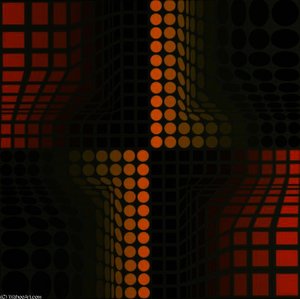
Victor Vasarely’s “Abstract Composition 17”: A Dance of Perception
Victor Vasarely's "Abstract Composition 17" is more than just an image; it’s an invitation to experience the world anew. Born in 1906 in Pécs, Croatia – then part of Austria-Hungary – Vasarely’s life was a deliberate pursuit of visual harmony, beginning with a surprising detour from medical studies into the realm of art. His early training at the Podolini-Volkmann Academy and, crucially, Sándor Bortnyik's “Műhely” workshop, profoundly shaped his approach, immersing him in the principles of functional design and geometric abstraction championed by the Bauhaus movement. This confluence of influences ultimately led to his groundbreaking contribution to Op Art – Optical Art – a style dedicated to manipulating perception through carefully constructed visual illusions.
The Geometry of Movement
This striking black-and-white composition exemplifies Vasarely’s mastery of Op Art. The artwork is dominated by an intricate network of interlocking lines, squares, and rectangles, meticulously arranged to create a dynamic sense of movement and depth. It's a deliberate rejection of traditional representational art; the focus isn't on depicting a recognizable scene but rather on exploring the very nature of visual perception. Vasarely’s technique involved precise execution – oil paint applied with exacting control onto canvas – to achieve this remarkable effect. The high contrast between black and white amplifies these optical effects, drawing the viewer into a captivating dance of shifting forms.
A Historical Context: Op Art and the Pursuit of Illusion
Emerging in the 1960s, Op Art represented a significant shift in artistic thinking. Artists like Vasarely sought to harness scientific principles – particularly those related to optics and visual perception – to create artwork that actively engaged the viewer’s eye. This wasn't simply about creating pretty patterns; it was an intellectual exploration of how our brains interpret visual information. The movement coincided with a broader cultural fascination with technology and its impact on human experience, reflecting a desire to understand and manipulate the world around us through new artistic means.
Symbolism and Emotional Impact
"Abstract Composition 17" possesses a profound symbolic resonance despite its lack of overt subject matter. The geometric forms – squares, rectangles, lines – can be interpreted as representing fundamental building blocks of reality, suggesting an underlying order within apparent chaos. The artwork’s ability to generate movement and vibration taps into primal human responses, evoking feelings of excitement, dynamism, and even a subtle sense of unease. It's a piece that demands attention, prompting the viewer to actively participate in its creation – to become part of the illusion itself.
Frågor och svar
Är "Abstract Composition 17" av Victor Vasarely ett porträtt, landskap eller en kvadratisk komposition?
"Abstract Composition 17" av Victor Vasarely har ett Square-format. Formatet beskriver kompositionens proportioner.
Vilken är den övergripande stämningen i "Abstract Composition 17" av Victor Vasarely?
Den övergripande stämningen i "Abstract Composition 17" av Victor Vasarely är Modern. Stämningen beskriver verkets allmänna atmosfär.
Vilken är den konsthistoriska betydelsen av "Abstract Composition 17" av Victor Vasarely?
"Abstract Composition 17" av Victor Vasarely tillhör Op-Art-rörelsen, inom Modern-perioden. Tillsammans ger de verket dess plats i konsthistorien.
Var kan jag köpa ett tryck av "Abstract Composition 17" av Victor Vasarely?
För att beställa ett tryck av "Abstract Composition 17" av Victor Vasarely, gör helt enkelt din beställning på denna sida: ett konsttryck på bomullscanvas eller arkivbeständigt canvaspapper.
Vilken känsla förmedlar "Abstract Composition 17" av Victor Vasarely?
Den emotionella tonen som har registrerats för "Abstract Composition 17" av Victor Vasarely är Reflective. Den sammanfattar den känsla som verket uttrycker.
Vilken storlek rekommenderas för tryck av "Abstract Composition 17"?
En reproduktion i storleken Large rekommenderas för "Abstract Composition 17" av Victor Vasarely. Storleken kan justeras med bibehållna proportioner.
Är färgerna i "Abstract Composition 17" av Victor Vasarely mättade eller dämpade?
Färgpaletten i "Abstract Composition 17" har en mättnad på Muted.
Vilken färgpalett och vilken känsla förenar "Abstract Composition 17"?
Den Neutrals färgpaletten i "Abstract Composition 17" av Victor Vasarely harmonierar med dess Reflective emotionella ton. Färg är ett av de sätt som ett verk förmedlar känsla på.



 Visa i rummet
 Köp handmålat konstverk
 Skicka
 Dela
Dela
 Detaljer
 Studentguide för konstverk

 Ladda ner
 Liknande objekt
 Röntgen
 Bildspel
 Besökstatistik

 Läs mer






































 Glasalternativet är endast tillgängligt i storlekar under 110 cm.