Hugh McCalmont Cairns – A Portrait of Victorian Power and Dignity
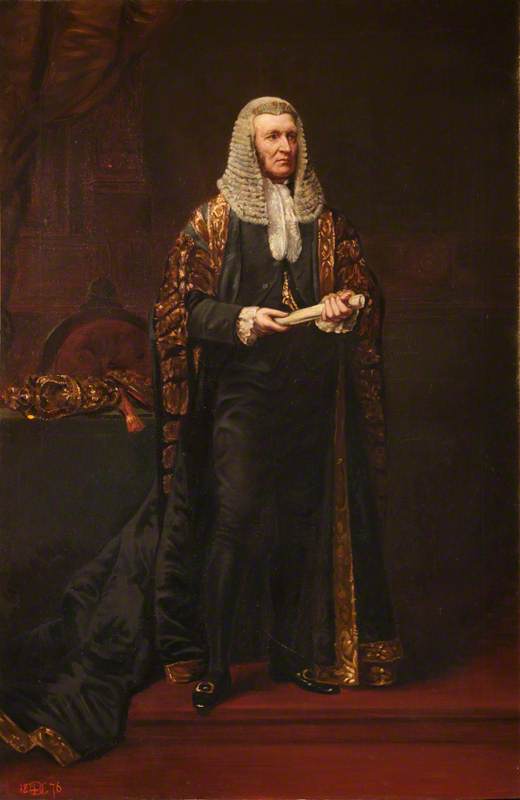
Lowes Cato Dickinson’s “The Right Honourable Hugh McCalmont Cairns (1st Earl Cairns)” is more than just a likeness; it's a carefully constructed tableau of 19th-century British power, legal authority, and the quiet gravitas of a man deeply embedded in the political landscape. Painted in 1876, this portrait offers a fascinating glimpse into the world of Victorian aristocracy and the intricate workings of Parliament. Dickinson, a skilled artist known for his ability to capture both physical likeness and inner character, has created an image that speaks volumes about Cairns’s position and personality.
The composition immediately establishes a sense of formality. Cairns stands on a richly carpeted dais, suggesting a position of importance – perhaps a judge or a member of the House of Lords. His attire—a meticulously rendered robe adorned with gold trim, a full wig signifying his legal standing, and lace cuffs indicative of wealth and status—is a deliberate statement of authority. The careful attention to detail in his clothing reflects the Victorian obsession with appearances and social hierarchy. The red carpet beneath him further emphasizes this elevated position, drawing the viewer’s eye directly to the subject.
Dickinson's Technique and Artistic Style
Dickinson’s style is distinctly characterized by a refined realism blended with a subtle Romantic sensibility. He employs a smooth, polished technique, evident in the delicate rendering of fabrics and the luminous quality of Cairns’s skin. The use of light and shadow creates depth and volume, giving the portrait a three-dimensional feel. Notice how Dickinson masterfully captures the texture of the wig, the sheen of the robe, and the subtle wrinkles around Cairns's eyes – details that contribute to the overall sense of authenticity. The background, though relatively simple with two chairs and a clock, serves to anchor the figure and provide context without distracting from the central subject.
It’s important to note Dickinson’s connection to other prominent artists of his time, particularly John Ruskin and Dante Gabriel Rossetti. His training under these influential figures undoubtedly shaped his artistic approach, contributing to a sensitivity for detail and an appreciation for beauty within a formal framework. The influence of the Pre-Raphaelites can be seen in the meticulous rendering of textures and the careful attention to light and color.
Symbolism and Historical Context
Beyond the portrait’s immediate visual appeal, “The Right Honourable Hugh McCalmont Cairns” is rich in symbolic meaning. The book held in his hand represents his legal profession – a symbol of knowledge, authority, and service to the law. The clock hanging on the wall serves as a reminder of time and the responsibilities associated with leadership. Cairns himself was a highly respected figure in British politics, serving as Lord High Chancellor during a period of significant political change. He was known for his integrity and his commitment to upholding the rule of law.
Painted in 1876, the portrait reflects the Victorian era’s fascination with portraits as markers of status and legacy. It's a testament to the enduring power of visual representation to capture not only physical likeness but also the essence of an individual’s character and position within society. The Earl Cairns’s role as Chancellor was pivotal in shaping legal policy during a time of great social and political reform, making this portrait a valuable historical document.
A Reproduction for Your Space
WahooArt offers a meticulously hand-painted reproduction of “The Right Honourable Hugh McCalmont Cairns” that captures the essence of Dickinson’s original work. This is not merely a print; it's an artistic recreation, painstakingly created by skilled artisans who understand the nuances of the original painting. The reproduction faithfully reproduces the colors, textures, and details, allowing you to bring this captivating portrait into your home or office. Whether you are an art collector, an interior designer seeking to add a touch of Victorian elegance, or simply someone who appreciates fine art, this reproduction offers a beautiful and authentic representation of a significant figure in British history.



 Förhandsvisa
 Beställ tryck
 Skicka
 Dela
Dela
 Visa detaljer

 Ladda ner
 Liknande objekt
 Röntgen
 Bildspel


 Visa mer






































 Glasalternativet är endast tillgängligt i storlekar under 110 cm.





