Early Life and Florentine Beginnings
Sandro Botticelli, född Alessandro di Mariano di Vanni Filipepi omkring 1445 i Florens, Italien, steg fram under en period av extraordinär kulturell upphetsning – den tidiga Renässansen. Hans liv var djupt rotat i stadens konstnärliga och sociala tyg; han strävade aldrig långt ifrån sitt bostadsområde Ognissanti, vilket var ett testamente till både familjeband och det levande kreativa ekosystem som fostrade honom. Hans far, Mariano Filipepi, en guldsmed och senare tennare, gav tidigt en exponering för hantverksskicklighet och noggrannhet – kvaliteter som skulle påverka Botticellis konstnärliga approach djupt. Trots initiala rapporter om träning som guldsmed, fann han snart sin kall under ledning av Fra Filippo Lippi, en framstående målare på den tiden. Detta lärande var avgörande, det fördjupade hans kunskaper i tekniker och estetik i den florentinska skolan samtidigt som det kopplade honom till inflytelserika mecenater som familjen Medici.
A Style Defined by Grace and Myth
Botticellis konstnärliga stil är omedelbart igenkännbar för sin lyriska skönhet, präglad av elegant linjearkitektur, flytande konturer och en delikat användning av färg. Han behärska övergången mellan de sena gotiska traditionerna och den blomstrande renässansestetiken, absorberade influenser från mästare som Fra Angelico och Paolo Uccello men skapade ett unikt personligt synsätt. Hans figurer har en eterisk kvalitet, ofta porträtterade med förlängda proportioner och graciösa poser som uttrycker både rofylldhet och en subtil melankoli. En definierande egenskap i hans verk är den frekventa införlivningen av klassisk mytologi – en reflektion över de humanister intressen som svepte genom renässansens Florens. Han illustrerade inte bara dessa gamla berättelser; han gav dem nya lager av mening, utforskade teman om kärlek, skönhet och andlig längtan. Botticellis teknik var innovativ för sin tid. Han använde ofta en silverstiftsteknik underlag för sina dukar, vilket bidrog till den ljusness och de delikata detaljerna som ses i hans färdiga verk. Hans användning av temperafärg möjliggjorde exakt återgivning och livfulla färger, medan hans senare experiment med oljefärger utvidgade hans uttrycksmöjligheter.
Iconic Masterpieces and Artistic Development
Botticellis arv vilar på ett antal ikoniska målningar som fortfarande fångar publikens uppmärksamhet århundraden senare.
Venus födelse, färdigställd omkring 1486, står som kanske hans mest berömda verk – en allegorisk representation av gudinnan som framträder ur ett snäckskal, och symboliserar renässansens ideal om skönhet och harmoni. Dess eleganta komposition, delikata färgpalett och suggestiva symbolik har gjort den till ett bestående symbol för eran. Samma sak gäller
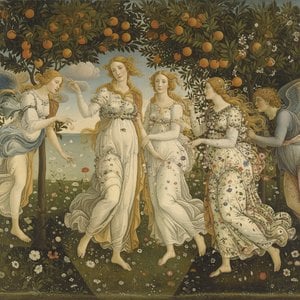
Primavera, skapad omkring 1482, en komplex och gåtfull målning som firar våren och kärleken, befolkad med symboliska figurer hämtade från klassisk mytologi. Dessa verk visar Botticellis behärskning av komposition, hans förmåga att skapa atmosfärisk djup och hans djupa förståelse för mänskliga känslor. Hans tidiga 1470-tal fokuserade på religiösa ämnen, där han finslipade sina tekniska färdigheter och etablerade ett rykte om skicklighet i utförandet. De följande åren markerades av en blomstrande period, med skapandet av hans mest kända mytologiska målningar. Men den sena 1490-talet såg en förändring i hans stil, påverkad av den passionerade predikan från Girolamo Savonarola – en dominikanerpräst som fördömde vad han ansåg vara Florens dekadens och moraliska korruption. Denna period resulterade i mer austera och känslomässigt laddade verk, som återspeglade en växande andlig intensitet.
Major Works
- Venus födelse (c. 1486): En ikonisk representation som symboliserar renässansens ideal om skönhet.
- Primavera (c. 1482): En komplex allegorisk målning som firar våren och kärleken.
- Adoration of the Magi (1475-1476): Visar tidig behärskning av komposition och perspektiv.
- Mystic Nativity (1501): Återspeglar en förändring mot andliga teman i hans senare karriär.
Legacy and Rediscovery
Efter sin död 1510 försvann Botticellis rykte gradvis i glömska. I nästan tre århundraden var hans verk i stort sett glömda, skuggade av mästarnas prestationer under den höga renässansen som Leonardo da Vinci och Michelangelo. Men en anmärkningsvärd återupptäckt inträffade på 1800-talet med uppkomsten av Pre-Raphaeliterna – en grupp engelska konstnärer som förkastade akademiska konventioner och sökte inspiration i den tidiga italienska renässansens konst. De fascinerades av Botticellis linjära elegans, livfulla färger och poetiska känsla, erkände honom som en likasinnad. Denna nya uppskattning utlöste en omvärdering av hans verk, etablerade honom som en av de viktigaste konstnärerna under den tidiga renässansen. Idag firas han för sin unika konstnärliga vision, hans beherskande teknik och hans bestående förmåga att väcka skönhet, känslor och andlig kontemplation. Hans inflytande kan ses i efterföljande generationer av konstnärer som har sökt att fånga samma känsla för elegans och graciöshet i sitt eget arbete. Han är en symbol för Florens konstnärliga prestationer och ett testamente till renässansens humanism.



 Visa i rummet
 Köp handmålat konstverk
 Skicka
 Dela
Dela
 Detaljer
 Guide
Guide

 Ladda ner
 Liknande objekt
 Röntgen
 Bildspel
 Besökstatistik

 Läs mer






































 Glasalternativet är endast tillgängligt i storlekar under 110 cm.