Visa i rummet Se i AR Byt till tryckta exemplar Byt till digital bildförsäljning Skicka
Detaljer Guide Lägg till i favoriter Ladda ner Liknande objekt Röntgen Bildspel Besökstatistik

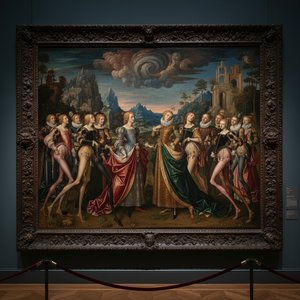
Who comes?

Experience the luminous intimacy of Rupert Bunny's Who comes?, a masterpiece of Edwardian elegance featuring shimmering drapery and sunlit grace that invites you to bring this serene moment into your private collection.

Explore the luminous works of Rupert Charles Wulsten Bunny (1864-1947), an Australian painter celebrated in Paris. Discover his sumptuous colorist style, idyllic scenes of women & water, symbolism, and aestheticism. View paintings like 'Endormies' on

Handgjord oljereproduktion

Handmålad olja på duk i din valda storlek och ram, tillverkad efter beställning av våra konstnärer. ( Byt till tryckta exemplar Byt till digital bildförsäljning)

P118B $10
P118H $10
P118W $10
P438Z $10
P508JH $12
P508YH $12
P805H $10
P805Z $10
P919BZ $10
P919G $10
P919XJ $10
P959ZH $10
P968JZ $12
W106C $8
W218G $10
W218JH $8
W218Y $10
W307PJ $10
W316G $10
W316PJ $8
W316Y $10
W398PJ $8
W4111J $10
W500HY $15
W500JH $15
W692G $12
W849H $8
W940BG $15
W953PJ $8

Standardstorlek
anpassad
CM
INCH

Välj bland våra förinställda storlekar som motsvarar konstverkets ursprungliga proportioner.

bredd
höjd

Du kan ange egna mått för att passa en specifik ram eller yta. Om den valda storleken inte matchar originalbildens proportioner kommer vi antingen att beskära konstverket eller utöka målningen med ytterligare handmålade element. En digital skiss skickas till dig för godkännande innan produktionen påbörjas.
Observera att förhandsvisningen på skärmen inte återspeglar den faktiska beskärningen eller utökningen. Endast skissen visar den slutgiltiga kompositionen korrekt.
Även om anpassade storlekar är möjliga, rekommenderar vi att du väljer en dimension från den fördefinierade listan för att bevara originalproportionerna.

Exempel på vad som kan anpassas: Byt ut ansiktet mot ett foto av kunden; Lägg till ett husdjur (t.ex. byt ut en katt mot en hund); Inkludera ett dolt meddelande i bakgrunden; Ändra bakgrundens landskap eller element.
Efter beställning kommer WahooArt.com team att mejla kunden för instruktioner och tillhandahålla en skissförhandsvisning

Leverans över hela världen () på 3–4 veckor istället för standard 5 veckor. (23 september). Inga kompromisser med kvaliteten.

why_choose_icon
Fri expressfrakt över hela världen
why_choose_icon
Högkvalitativ linnecanvas
why_choose_icon
Fullständig fraktförsäkring
why_choose_icon
Garantier för återbetalning av tullavgifter
why_choose_icon
Garantier för exakt färgåtergivning
why_choose_icon
100 dagars returrätt vid fabrikationsfel
why_choose_icon
100% pengarna tillbaka-garanti
why_choose_icon
Mängdrabatt erbjuds

Totalt pris

$ 272

reproduction

Who comes?

Tryckteknik

Reproduktionsstorlek

-

Totalpris

$ 272

Who comes? is one of a series of works called ‘Days and Nights in August’, painted by Rupert Bunny between 1907 and 1911, which evoke a mood of intimacy and luxurious leisure; of perfume, poetry and distant music. The colours in Who comes? are few – white, black, brown, red, yellow – and they have been orchestrated so that small colour accents are played off against a basic theme. Warm sunlight, filtering through a boldly striped blind, colours the upper part of the picture, whereas in the half-light below the blind the flounced skirts shimmer translucently.Bunny’s chief model, posing for both figures in this painting, was his wife Jeanne. She was ‘a beautiful French woman and her husband delighted to paint her in the long, flounced and flowing dresses of the period. Once he said, with faint distaste: “When short skirts came in I no longer wanted to paint women”’.1The drapery has been painted in a way that has little relation to the bodies beneath. One reviewer in 1911 explained Bunny’s preference for loose drapery as a way of capturing or complementing the indefiniteness of nature, ‘leaving forms and outlines in a state of indecision and flux’.2 In contrast to the geometry of the striped blind, Bunny’s rendering of filmy cloth breaks the shapes so that the attention goes not to outlines and large areas but to surfaces and small accents. The effect is sensuous. Bunny was portraying a luxurious domesticity which, in the fashion terms of the day, was well represented by the tea-gown: ‘It gives a man a sort of luxurious feel of being an Oriental Pasha, as he lies in his chair, smoking the ever-present cigarette, to see himself surrounded by graceful houris clad in gauze and gorgeous draperies shimmering’.3Marcel Proust wrote at length on the same theme in A la recherche du temps perdu (1913–27) and, like Bunny, he lamented the passing of this excessively feminine style with the coming of the First World War.Mary Eagle41 Lucy Swanton, ‘Memoir of Rupert Bunny’, typescript, [Sydney]: Newcastle Region Art Gallery, 1968.2 Melbourne Argus, 24 July 1911, p.7.3 ‘Lamia’ in London Country Life, 28 September 1907.4 Mary Eagle, The Art of Rupert Bunny, Canberra: Australian National Gallery, 1991, p.64.Text © National Gallery of Australia, Canberra 2010From: Anne Gray (ed), Australian art in the National Gallery of Australia, National Gallery of Australia, Canberra, 2002

Om konstnären

early life and training

rupert charles wulsten bunny, an australian painter, was born in st kilda, victoria, in 1864. he received a traditional and academic education in the arts under calderon and laurens. this foundation would later serve him well in his successful career as an expatriate artist in fin-de-siècle paris.

achievements and accolades

bunny's artistic prowess was recognized early, with an honourable mention at the paris salon of 1890 for his painting tritons. he further solidified his reputation by winning a bronze medal at the paris exposition universelle in 1900 for burial of st catherine of alexandria. the french state acquired 13 of his works, including those now housed in the musée du luxembourg and regional collections.

artistic style and themes

bunny was a 'sumptuous colourist and splendidly erudite painter of ideal themes,' as described by art critics. his work often featured groups of female figures, relaxing, dreaming, or dressing/undressing by expanses of water, showcasing his unique blend of symbolism and aestheticism.
  • notable works:
  • endormies (national gallery of victoria, melbourne, australia)
  • sea idyll (national gallery of victoria, melbourne, australia)
  • pastoral (national gallery of australia, canberra, australia)

legacy and online presence

today, bunny's works can be found in various museums and online platforms. for those interested in exploring more of his art, [https://WahooArt.com/@/rupert-charles-wulsten-bunny](https://WahooArt.com/@/rupert-charles-wulsten-bunny) provides an extensive collection of his paintings, including endormies, sea idyll, and pastoral. these works are also available for purchase as museum-quality reproductions through /en/art/show/art-8xyffg-en/

conclusion

rupert charles wulsten bunny, an australian painter from st kilda, victoria, left an indelible mark on the art world with his sumptuous and erudite style. his legacy continues to inspire through his works, now easily accessible via [https://WahooArt.com](https://WahooArt.com).

rupert charles wulsten bunny

rupert charles wulsten bunny

1864 - 1947 , Australia

Snabbfakta

  • Artistic Movement Or Style: Symbolism
  • Artists Who Influenced This Artist:
    • Calderon
    • Laurens
  • Date Of Birth: September 29, 1864
  • Date Of Death: May 25, 1947
  • Full Name: Rupert Charles Wulsten Bunny
  • Nationality: Australian
  • Notable Artworks:
    • Endormies
    • Sea idyll
    • Pastoral
  • Place Of Birth: St Kilda, Australia
Utforska konstverk sorterade efter tema, stil och egenskaper.