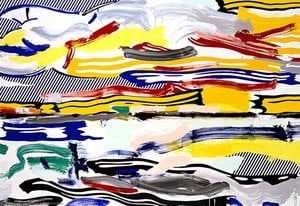
A Bold Statement Against Convention
In the vast landscape of twentieth-century art, few names command as much immediate recognition as Roy Lichtenstein. His work, particularly the striking 1987 piece Coup De Pinceau, serves as a vibrant bridge between the high-brow galleries of Manhattan and the accessible, pulse-pounding energy of American popular culture. To gaze upon this masterpiece is to witness a deliberate rebellion; it is an intentional departure from the heavy, emotive gestures of Abstract Expressionism, replaced instead by a crisp, calculated aesthetic that celebrates the beauty found in the everyday. The painting captures a moment of suspended animation, featuring a woman in an upward pose, her arms outstretched with a gesture that oscillates between grace and defiance. It is a composition that does not merely sit on a wall but demands an audience, pulling the viewer into its bright, unapologetic world.
The brilliance of Coup De Pince lies in its masterful use of color and contrast. The palette is dominated by a striking juxtaposition of primary reds and sunny yellows, set against a stark, pristine white background. This high-contrast arrangement creates an optical vibration that captures the eye instantly, making it an ideal centerpiece for modern interiors. For the discerning collector or interior designer, this piece offers more than just color; it provides a focal point of structural clarity. The way the light seems to emanate from the yellow tones against the white void creates a sense of depth and luminosity, ensuring that the artwork remains dynamic regardless of the lighting conditions in a room.
The Art of the Mechanical Aesthetic
Technically, Lichtenstein’s genius is found in his ability to elevate "low" art through meticulous craftsmanship. While the painting mimics the look of a mass-produced comic strip, the execution is anything but accidental. He utilized a sophisticated halftone printing technique, often referred to as Ben-Day dots, to simulate the shading and color gradation found in commercial printing. By varying the size and density of these tiny dots, Lichtenstein achieved a sense of volume and form that feels both mechanical and deeply human. This method creates a fascinating tension: the viewer perceives a machine-made aesthetic, yet the hand of the artist is evident in the precision and deliberate placement of every single point of color.
This technique does more than just replicate a style; it serves a profound symbolic purpose. By adopting the visual language of advertisements and comic books, Lichtenstein invites us to reconsider the boundaries of fine art. The Coup De Pinceau—a title suggesting a "stroke of the brush"—is itself a witty nod to the very tradition he was reimagining. He takes the disposable imagery of the mid-century era and freezes it in time, granting it a permanence and dignity usually reserved for classical portraiture. This makes the piece an intellectually stimulating addition to any collection, offering layers of meaning that reveal themselves upon repeated viewing.
A Legacy of Empowerment and Expression
Beyond its visual splendor, there is a narrative soul within this work. The subject—a woman poised in a gesture of movement—carries themes of empowerment and resistance. Her posture, arms raised as if preparing to cast something into the world, suggests a breaking of chains or a rejection of societal constraints. This spirit of defiance mirrors the broader Pop Art movement itself, which sought to break free from the elitism of previous eras. For those looking to decorate a space with art that inspires strength and modernity, this painting provides an emotional anchor of resilience.
Whether you are an art historian tracing the lineage of American Pop, a collector seeking a definitive piece of the 1980s zeitgeist, or a designer looking to inject a burst of historical significance into a contemporary setting, Coup De Pinceau stands as a monumental achievement. It is a celebration of the bold, the bright, and the brave—a timeless reminder that even the most commonplace images can be transformed into extraordinary icons of human expression.



 Visa i rummet
 Byt till tryckta exemplar
 Skicka
 Dela
Dela
 Detaljer
 Guide
Guide

 Ladda ner
 Liknande objekt
 Röntgen
 Bildspel
 Besökstatistik

 Läs mer






































 Glasalternativet är endast tillgängligt i storlekar under 110 cm.