Visa i rummet Se i AR Köp handmålat konstverk Byt till digital bildförsäljning Skicka
Detaljer Studentguide för konstverk Lägg till i favoriter Ladda ner Liknande objekt Röntgen Bildspel Besökstatistik

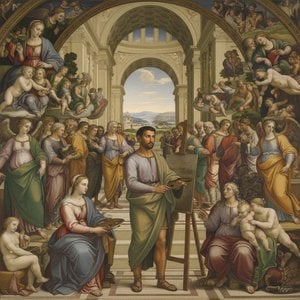
The Virtues

Experience Raphael's 'The Virtues,' a stunning fresco depicting the Cardinal and Theological Virtues. A masterpiece of High Renaissance art, showcasing wisdom, justice, courage & temperance.

Raphael (1483-1520): En renässansmästare känd för sina vackra Madonnor, arkitektur och mästerverk som "Skolan i Athen". Utforska hans tidiga liv i Urbino och konstnärliga arv.

Giclée / Konsttryck

Giclée- eller canvasprint av museumskvalitet med snabb produktion och flexibla ytbehandlingsalternativ. ( Köp handmålat konstverk Byt till digital bildförsäljning)

Corner sample of the P118B picture frame: formgjuten polystyren, 5 cm wide and 3 cm thick
P118B Skr10
Corner sample of the P118H picture frame: formgjuten polystyren, 5 cm wide and 3 cm thick
P118H Skr10
Corner sample of the P118W picture frame: formgjuten polystyren, 5 cm wide and 3 cm thick
P118W Skr10
Corner sample of the P438Z picture frame: formgjuten polystyren, 5.5 cm wide and 3.5 cm thick
P438Z Skr10
Corner sample of the P508JH picture frame: formgjuten polystyren, 7 cm wide and 3.5 cm thick
P508JH Skr12
Corner sample of the P508YH picture frame: formgjuten polystyren, 7 cm wide and 3.5 cm thick
P508YH Skr12
Corner sample of the P805H picture frame: formgjuten polystyren, 5 cm wide and 3.5 cm thick
P805H Skr10
Corner sample of the P805Z picture frame: formgjuten polystyren, 5 cm wide and 3.5 cm thick
P805Z Skr10
Corner sample of the P919BZ picture frame: formgjuten polystyren, 7 cm wide and 3.5 cm thick
P919BZ Skr10
Corner sample of the P919G picture frame: formgjuten polystyren, 7 cm wide and 3.5 cm thick
P919G Skr10
Corner sample of the P919XJ picture frame: formgjuten polystyren, 7 cm wide and 3.5 cm thick
P919XJ Skr10
Corner sample of the P959ZH picture frame: formgjuten polystyren, 5 cm wide and 3 cm thick
P959ZH Skr10
Corner sample of the P968JZ picture frame: formgjuten polystyren, 6 cm wide and 4 cm thick
P968JZ Skr12
Corner sample of the W106C picture frame: massivt trä, 5 cm wide and 3 cm thick
W106C Skr8
Corner sample of the W218G picture frame: massivt trä, 5 cm wide and 3 cm thick
W218G Skr10
Corner sample of the W218JH picture frame: massivt trä, 5 cm wide and 3 cm thick
W218JH Skr8
Corner sample of the W218Y picture frame: massivt trä, 5 cm wide and 3 cm thick
W218Y Skr10
Corner sample of the W307PJ picture frame: massivt trä, 6 cm wide and 3 cm thick
W307PJ Skr10
Corner sample of the W316G picture frame: massivt trä, 6 cm wide and 3 cm thick
W316G Skr10
Corner sample of the W316PJ picture frame: massivt trä, 6 cm wide and 3 cm thick
W316PJ Skr8
Corner sample of the W316Y picture frame: massivt trä, 6 cm wide and 3 cm thick
W316Y Skr10
Corner sample of the W398PJ picture frame: massivt trä, 5 cm wide and 3 cm thick
W398PJ Skr8
Corner sample of the W4111J picture frame: massivt trä, 6.5 cm wide and 3.5 cm thick
W4111J Skr10
Corner sample of the W500HY picture frame: massivt trä, 7 cm wide and 5 cm thick
W500HY Skr15
Corner sample of the W500JH picture frame: massivt trä, 7 cm wide and 5 cm thick
W500JH Skr15
Corner sample of the W692G picture frame: massivt trä, 8 cm wide and 4 cm thick
W692G Skr12
Corner sample of the W849H picture frame: massivt trä, 5 cm wide and 3 cm thick
W849H Skr8
Corner sample of the W940BG picture frame: massivt trä, 7.5 cm wide and 4.5 cm thick
W940BG Skr15
Corner sample of the W953PJ picture frame: massivt trä, 6 cm wide and 3.5 cm thick
W953PJ Skr8

Standardstorlek
anpassad
CM
INCH

Välj bland våra förinställda storlekar som motsvarar konstverkets ursprungliga proportioner.

bredd
höjd

Ange den bredd och höjd du behöver, för att passa din ram eller din vägg. Ett tryck kan endast beskäras, aldrig göras större än bilden, vilket innebär att ett format med en annan formform leder till att en del av bilden går förlorad. Vi skickar en digital mockup för godkännande innan vi trycker något. Bilden som visas på denna sida visar inte den faktiska beskärningen — det är endast mockuppen som gör det.

Leverans över hela världen () på 2 veckor istället för standard 4/5 veckor. (20 oktober)

Fri expressfrakt över hela världen
Högkvalitativ linnecanvas
Fullständig fraktförsäkring
Garantier för återbetalning av tullavgifter
Garantier för exakt färgåtergivning
100 dagars returrätt vid fabrikationsfel
100% pengarna tillbaka-garanti
Mängdrabatt erbjuds

Totalt pris

Skr 669

The Virtues

Giclée / Konsttryck

Reproduktionsstorlek

-

Totalpris

Skr 669

Snabbfakta

  • Influences:
    • Plato
    • Aristotle
  • Subject or theme: Cardinal Virtues
  • Year: 1511
  • Notable elements or techniques: Allegorical fresco
  • Artist: Raphael

Konstquiz

Det finns endast ett korrekt svar på varje fråga.

Fråga 1:
The painting "The Virtues" by Raphael depicts which of the following?
Fråga 2:
In what style was "The Virtues" created?
Fråga 3:
The fresco is located in which Vatican building?
Fråga 4:
What historical figure is prominently featured in the "School of Athens" fresco within the Raphael Rooms?
Fråga 5:
Raphael was born in which Italian city?

A Symphony of Virtue: Unveiling Raphael’s “The Virtues”

Raphael’s fresco, "The Virtues," painted in 1511 for the Stanza della Segnatura within the Vatican Palace, stands as a pinnacle of High Renaissance artistry. More than just a decorative panel, it's a profound meditation on human potential and moral philosophy, commissioned by Pope Julius II to embody the cardinal virtues – Prudence, Justice, Fortitude, and Temperance – alongside wisdom and knowledge. The scene unfolds within an idealized architectural setting, reminiscent of classical Roman design, creating a harmonious blend of earthly grandeur and divine inspiration. The fresco’s impact is immediate; it radiates serenity and intellectual depth, inviting contemplation on the qualities that define a virtuous life.

  • Composition: The arrangement is meticulously balanced, with each virtue occupying a distinct space within the lunettes – arched windows above – of the room. This deliberate structure reinforces their individual significance while contributing to the overall sense of order and harmony.
  • Color Palette: Raphael masterfully employs a restrained yet luminous color palette, dominated by cool blues, greens, and golds. These hues evoke a sense of tranquility and wisdom, complementing the allegorical nature of the subject matter.
  • Symbolism: Each virtue is represented through carefully chosen symbols – Justice with scales, Temperance with grapes and vines, Fortitude with a lion, Prudence with a shield, and Wisdom with an owl. These visual cues deepen the fresco’s meaning, offering viewers a tangible understanding of each concept.

The Architects of Morality: Raphael's Philosophical Vision

Raphael wasn’t merely depicting virtues; he was engaging in a complex philosophical dialogue. The fresco reflects the humanist ideals prevalent during the Renaissance – a renewed interest in classical philosophy and a belief in human potential for moral excellence. The figures, though idealized, are grounded in earthly reality, representing the practical application of virtue within everyday life. The scene echoes Plato’s concept of the ideal city, where each citizen fulfills their designated role based on their inherent strengths and virtues. Notably, Raphael's work directly responds to the intellectual currents of his time, particularly the rediscovery of ancient Greek philosophy and its emphasis on reason and moral conduct.

The fresco’s setting itself—a grand architectural space reminiscent of Roman design—underscores this connection to classical thought. It suggests that virtue is not merely an individual trait but a fundamental element of a well-ordered society, mirroring the principles of civic harmony espoused by Plato and Cicero.

Technique and Artistic Innovation

Raphael’s mastery of fresco technique is evident in every detail. He employed *buon fresco*, a method that involves applying pigments to wet plaster, ensuring their permanence and vibrancy. The intricate details—the drapery, the facial expressions, the architectural elements—demonstrate his exceptional skill as a draftsman and painter. His use of *sfumato* – a subtle blurring technique – creates a sense of depth and atmosphere, lending the fresco an ethereal quality. Furthermore, Raphael’s ability to seamlessly integrate figures into the architectural setting showcases his remarkable compositional skills.

The fresco's scale is also significant; it covers a substantial area of wall space, demanding careful planning and execution. The sheer ambition of the project reflects Raphael’s position as one of the leading artists of his time.

A Legacy of Harmony: “The Virtues” Today

“The Virtues” continues to captivate viewers centuries after its creation. Its enduring appeal lies in its timeless message – a celebration of human potential and the importance of moral character. Reproductions of this masterpiece offer an opportunity to experience Raphael’s genius firsthand, bringing his vision of harmony, balance, and intellectual depth into our homes and spaces. Whether admired as a work of art or studied as a philosophical treatise, “The Virtues” remains a testament to the power of beauty and the enduring relevance of human values.

Frågor och svar

Kan jag se "The Virtues" av Rafael på min egen vägg innan jag köper den?

Sidan för AR-förhandsvisning av "The Virtues" av Rafael använder förstärkt verklighet (AR) för att visa konstverket i ditt eget utrymme, på en kompatibel enhet.

Är "The Virtues" av Rafael en målning, en teckning eller ett tryck?

"The Virtues" är ett verk av typen WallArt.

Hur mättad är färgpaletten i "The Virtues"?

"The Virtues" av Rafael är återgiven med en Subtle Color mättnad.


Om konstnären

Raffael: En renässansmästares liv och verk

Raffaello Sanzio da Urbino, mer känd som Raffael, föddes 1483 i den lilla men kulturellt blomstrande staden Urbino. Hans tidiga år präglades av en atmosfär där konstnärlig skicklighet och humanistiskt lärande högt värderades. Fadern, Giovanni Santi, var inte bara en målare utan också en beläst man som aktivt sökte nya idéer från hela Italien. Denna uppväxt i ett hovmiljö, präglad av förfining och intellektuell diskurs, formade den unge Raffael på djupet. Faderns bortgång vid elva års ålder innebar ett stort ansvar, men också en möjlighet att utveckla sina färdigheter i familjeverkstaden under lokala konstnärers ledning. Redan i dessa tidiga verk anades en mild elegans och noggrann detaljrikedom – kännetecken för hans mogna stil.

Från Umbrien till Florens: Att absorbera nya influenser

Raffaels konstnärliga resa var en ständig utveckling, präglad av intensiva studier och anpassning. Hans initiala utbildning under Pietro Perugino i Perugia lade en solid grund i den umbriska stilen – kännetecknad av mjuka former, harmoniska kompositioner och fridfulla religiösa scener. Raffael hade dock en omättlig nyfikenhet som drev honom att söka nya utmaningar och vidga sina konstnärliga horisonter. År 1504 begav han sig till Florens, en stad som vibrerade av konstnärlig innovation. Här mötte han mästerverken av Leonardo da Vinci och Michelangelo, artister som tänjde gränserna för måleriet på ett sätt ingen tidigare gjort. Han studerade deras tekniker noggrant – Leonardos sfumato, hans subtila ljus- och skuggspel, och Michelangelos kraftfulla anatomiska precision och dramatiska kompositioner. Den florentinska perioden blev en smältdegel för Raffael, som tvingades konfrontera nya konstnärliga möjligheter och syntetisera dem till sin egen unika vision. Influensen syns tydligt i den ökade dynamiken och psykologiska djupet i hans verk från denna tid, särskilt i hans serie av madonnamålningar.

Den romerska triumfen: Beställningar och mästerverk

År 1508 mottog Raffael en kallelse som skulle förändra hans karriär – en inbjudan från påven Julius II att komma till Rom. Detta markerade början på hans mest produktiva och hyllade period. Den eviga staden erbjöd honom en oöverträffad möjlighet att visa sin talang i stor skala, genom att pryda de påvliga lägenheterna i Vatikanen med hisnande fresker. Skolan i Aten, kanske hans mest berömda verk, står som ett bevis på hans mästerliga komposition, perspektiv och filosofiska allegori. Inom detta majestätiska rum samlade Raffael figurer från den klassiska antiken – Platon, Aristoteles, Pythagoras, Euklid – och skapade en levande tableau som hyllade det mänskliga förnuftet och strävan efter kunskap. Han fortsatte att arbeta för påföljande påvar, bland annat Leo X, och åtog sig monumentala projekt som dekorationen av Stanze della Segnatura och Stanza d'Eliodoro. Hans fresker i dessa rum är inte bara dekorativa; de är djupa uttalanden om påvlig makt, religiös tro och renässansens ideal.

En syntes av grace och storhet: Raffaels konstnärliga stil

Raffaels konstnärliga stil beskrivs ofta som en harmonisk blandning av grace, klarhet och idealiserad skönhet. Han hade en extraordinär förmåga att syntetisera olika influenser – den umbriska traditionen, florentinska innovationer, klassisk antiken – till ett unikt balanserat estetiskt uttryck. Hans kompositioner är minutiöst planerade, präglade av en känsla av ordning och proportion som återspeglar hans djupa förståelse för renässansens principer. Hans figurer utstrålar en seren värdighet och emotionell expressivitet, vilket förkroppsligar den humanistiska idealen om mänsklig perfektion. Han var också en mästerlig kolorist, som använde rika, lysande nyanser för att skapa verk som är både visuellt fängslande och intellektuellt stimulerande. Till skillnad från Michelangelos ofta dramatiska och turbulenta stil utstrålar Raffaels arbete en känsla av lugn och harmoni – en kvalitet som har gjort honom älskad av publiken i århundraden.

Arvet och det bestående inflytandet

Raffaels tidiga död 1520, vid endast trettiosju års ålder, avbröt en karriär som var full av potential. Ändå består hans arv som en av de mest betydelsefulla figurerna i västerns konsthistoria. Hans verk blev en hörnsten i den högrenässansens estetik och fungerade som en modell för generationer av artister. Medan Michelangelos inflytande senare skulle dominera den konstnärliga diskursen, upplevde Raffaels betoning på klarhet, harmoni och idealiserad skönhet en renässans under nyklassicismen, hyllad av kritiker som Johann Joachim Winckelmann. Idag fortsätter hans målningar att inspirera vördnad och beundran, och fängslar tittarna med sin tekniska briljans, emotionella djup och bestående dragningskraft. Hans inflytande kan ses i otaliga konstverk som följde, vilket befäster hans plats som en sann mästare av renässansen – en målare som fångade inte bara sina motivs fysiska likhet utan också essensen av mänsklig grace och värdighet.

Rafael

Rafael

1483 - 1520 , Italien

Snabbfakta

  • Artistic Movement Or Style: Högrenässans
  • Artists Or Movements Influenced By This Artist: ['Neoklassicism']
  • Artists Who Influenced This Artist:
    • Leonardo da Vinci
    • Michelangelo
  • Date Of Birth: 1483
  • Date Of Death: 1520
  • Full Name: Raffaello Sanzio da Urbino
  • Nationality: Italiensk
  • Notable Artworks:
    • Skolmästarnas skola
    • Sixtinska madonnan
  • Place Of Birth (City And Country): Urbino, Italien
Utforska konstverk sorterade efter tema, stil och egenskaper.