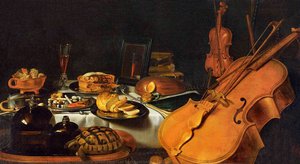
The Poet of Still Life: The Quiet Mastery of Pieter Claesz
In the golden, amber-hued era of the Dutch Golden Age, where grand landscapes and dramatic portraits often commanded the spotlight, there existed a master of the intimate and the overlooked. Pieter Claesz (c. 1597 – 1660) did not seek to capture the sweeping vistas of the world, but rather the profound truths hidden within the quiet corners of a domestic interior. He was an artist who found the infinite in the infinitesimal, transforming simple objects—a shard of bread, a glinting glass, or a weathered skull—into profound meditations on the human condition. To look upon a Claesz painting is not merely to observe a collection of items, but to enter a silent dialogue with mortality and memory.
Born in Berchem, Belgium, near the vibrant artistic hub of Antwerp, Claesz’s early years were shaped by the rich traditions of the Flemish masters. His journey took him to Haarlem in 1620, a move that would irrevocably alter the course of art history. In this bustling center of Dutch commerce and intellect, he established himself not just as a painter, but as a cornerstone of the local artistic community. It was here that he became a prominent member of the Guild of St. Luke, honing a style that would eventually define the ontbijtstukken, or breakfast pieces, that remain his most enduring legacy.
A Symphony of Light and Shadow
The brilliance of Claesz lies in his rejection of the theatrical. While contemporaries like Caravaggio utilized dramatic, high-contrast lighting to stir the soul, Claesz preferred a more subtle, ethereal approach. He mastered the art of chiaroscuro through delicate gradations, allowing light to graze the surface of a pewter plate or seep into the translucent skin of a lemon with breathtaking realism. His palette was often intentionally restrained, favoring monochromatic tones of muted greens, earthy browns, and soft whites, which allowed the textures of his subjects to sing.
Every brushstroke in a Claesz composition serves a dual purpose: to replicate the physical world and to evoke an emotional resonance. He possessed an uncanny ability to render the tactile—the velvety softness of fruit, the cold hardness of metal, and the delicate fragility of glass. This meticulous attention to detail was never merely decorative; it was the vehicle for his deeper philosophical inquiries. Through the careful arrangement of light and texture, he created an atmosphere of stillness, inviting the viewer to pause and contemplate the sensory world before it inevitably fades.
The Vanitas Tradition and the Weight of Existence
Perhaps the most profound aspect of Claesz’s oeuvre is his role as a pioneer of the Vanitas tradition. In these works, the objects on the table are never just objects; they are symbols in a visual sermon regarding the transience of life. A flickering candle, an overturned goblet, or a skull serves as a memento mori—a reminder that all earthly pleasures and human achievements are fleeting. He utilized these motifs to weave complex narratives about the vanity of worldly pursuits and the inevitability of death.
His early works often featured more complex, symbolic arrangements, such as his celebrated depictions involving musical instruments or scholarly tools like inkpots and books. In these compositions, he explored the intersection of art, science, and the senses, suggesting that even the highest human endeavors are subject to the passage of time. As his career progressed into the 1630s, his compositions evolved toward a more monumental and streamlined aesthetic, yet the underlying tension between the beauty of the present moment and the shadow of the future remained ever-present.
Legacy of a Silent Master
The historical significance of Pieter Claesz cannot be overstated. Alongside artists like Willem Claeszoon Heda, he redefined the boundaries of the still life genre, elevating it from mere decorative craft to a sophisticated intellectual pursuit. His influence echoed through the decades, shaping the way subsequent generations of Dutch painters approached light, texture, and symbolism.
Today, his works stand as enduring testaments to the power of restraint. He taught us that there is a profound dignity in the mundane and a haunting beauty in the ephemeral. Through his "breakfast pieces" and Vanitas meditations, Claesz remains a singular voice in art history—a poet who used oil and pigment to write elegies for the fleeting moments of life.



 Visa i rummet
 Byt till tryckta exemplar
 Skicka
 Dela
Dela
 Detaljer
 Guide
Guide

 Ladda ner
 Liknande objekt
 Röntgen
 Bildspel
 Besökstatistik
 Läs mer






































 Glasalternativet är endast tillgängligt i storlekar under 110 cm.