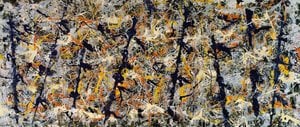
Om konstnären
Early Life and the Seeds of Innovation
Paul Jackson Pollock, född den 28 januari 1912 i Cody, Wyoming, var en man från början präglad av rörelse och ett djupt band till naturen. Hans barndom var fylld med ständig omflyttning – hans far sökte arbete som lantmätare över de vidsträckta landskapen i det amerikanska västlandet, vilket innebar att familjen flyttade ofta. Denna nomadiska uppväxt gav honom en stark anknytning till den naturliga världen och en exponering för olika kulturer, särskilt genom möten med konst från ursprungsbefolkningen under dessa lantmäteriarbeten – intryck som skulle subtilt påverka hans konstnärliga vision senare i livet. Även om han aldrig direkt imiterade inhemska stilar, så fanns det en rå energi och andlig resonans i dessa tidiga erfarenheter som utan tvekan lämnade ett avtryck på honom.
Pollock’s formella konstutbildning inleddes på Manual Arts High School i Los Angeles, följt av studier vid Art Students League of New York under ledning av Thomas Hart Benton. Benton, en framstående figur inom Regionaliströrelsen, betonade rytmisk komposition och berättande teman rotade i amerikansk liv. Pollock absorberade först Bentons läror, men hans inneboende tendens lutar mot mer abstrakta utforskningar. Han var också djupt påverkad av mexikanska muralister som José Clemente Orozco, vars kraftfulla skildringar av social kamp gjorde intryck på honom. Dessa tidiga influenser lade en grund, men det var Surrealismens blomstrande värld som verkligen öppnade upp för Pollocks konstnärliga potential.
The Birth of Action Painting and a Revolutionary Technique
1930-talet såg Pollock experimentera med olika tekniker, på jakt efter alternativ till traditionell penseldragning. Han började hälla färg, utforskade dess flyt och oförutsägbarhet. Men runt 1947 genomgick hans konstnärliga bana en radikal förändring. Han lämnade tavlan helt enkelt liggande på golvet och inledde vad som skulle bli känt som hans "drip-teknik". Han började sedan droppa, spruta och kasta färg på kanvasen från ovan, orkestrerade en dynamisk dans mellan konstnär, medium och yta.
Det handlade inte bara om att applicera färg; det var om att förkroppsliga själva skapandets handling. Pollocks tavlor blev arenor för fysiskt uttryck, fångande den omedelbara intensiteten i hans gester och känslor. De resulterande målarierna präglades av sin "all-over"-komposition – en brist på central fokus som bjuder in betraktaren att utforska hela ytan som ett samlat energifält. Intrikata nätverk av linjer och färger sammanflätas, vilket skapar en visuell komplexitet som är både fängslande och utmanande. Han använde ovana verktyg – pinnar, knivar, till och med sprutor – för att manipulera färgen på oförutsägbara sätt, vilket ytterligare betonade den spontana naturen i hans process.
Denna innovativa metod positionerade Pollock som en central figur i den blomstrande Abstract Expressioniströrelsen, som uppstod i post-krigstidens New York City. Rörelsen prioriterade spontan gest, stor skala och icke-representativ bildspråk, vilket återspeglade en bredare kulturell förskjutning bort från traditionella konstnärliga konventioner. Hans äktenskap med den kvinnliga konstnären Lee Krasner var också avgörande; hon gav honom ovillkorligt emotionellt stöd och uppmuntrade aktivt hans konstnärliga utveckling, erkände det banbrytande i hans verk.
Iconic Works and Lasting Legacy
Pollocks mest kända verk – såsom *Number 1, 1950 (Lavender Mist)*, *One: Number 31, 1950*, *Blue Poles: Number 11, 1952* och *Convergence* – är vittnesbörd om hans revolutionerande teknik. Dessa målarier är inte bara bilder; de är inspelningar av en prestation, fyllda med konstnärens fysiska närvaro och känslomässiga intensitet. Den dynamiska energin som utgår från dessa tavlor är påtaglig, bjuder in betraktaren att fördjupa sig i en värld av ren abstraktion.
Hans stil överträffar bara estetiken; det är en utforskning av processen över produkten. Pollock sökte fånga den omedelbara intensiteten i sina handlingar och känslor på en tavla, avvisade traditionella idéer om komposition och representation. Han grävde djupare in sig i Jungiansk psykologi, utforskade arketyper och det undermedvetna i sin konst, sökte fånga universella symboler och uråldriga energier.
Pollocks inflytande på konohistoriens gång är obestridligt. Han förändrade fundamentalt hur konstnärer angrep målandet, bröt med tavla-baserade metoder och omfamnade ett mer performativt tillvägagångssätt. Hans verk etablerade New York City som ett globalt centrum för modern konst, flyttade fokus bort från europeiskt dominerande. Hans inflytande kan ses i arbetet hos otaliga konstnärer som följde honom, inklusive de som är associerade med Color Field painting och senare former av abstrakt expressionism.
Influences and Artistic Context
Pollock var starkt influerad av en rad olika konstnärliga strömmar och individuella konstnärer. Som nämnts ovan, så var hans tidiga påverkan från Thomas Hart Benton, med sin betoning på rytm och berättande, tydlig. Han studerade även mexikanska muralister som Diego Rivera och José Clemente Orozco, vars kraftfulla skildringar av social kamp resonerade djupt med honom. Dessutom utforskade han Surrealismens idéer om det undermedvetna och drömmar, vilket påverkade hans experimentella teknik.
Pollocks arbete kan också placeras i ett bredare kulturellt sammanhang. Efter andra världskriget sökte konstnärer nya sätt att uttrycka sig, bortom traditionella former. Abstract Expressionism var en del av denna rörelse, och Pollock var en av dess ledande figurer. Hans verk speglade den post-krigstidens oro och osäkerhet, men också ett hopp om framtiden.
Pollock’s legacy extends beyond his artistic achievements. He remains a symbol of creative freedom and innovation, inspiring artists to push boundaries and challenge conventions. His work continues to be studied and admired by art lovers around the world.



 Visa i rummet
 Byt till tryckta exemplar
 Skicka
 Dela
Dela
 Detaljer
 Studentguide för konstverk

 Ladda ner
 Liknande objekt
 Röntgen
 Bildspel
 Besökstatistik


 Läs mer






































 Glasalternativet är endast tillgängligt i storlekar under 110 cm.