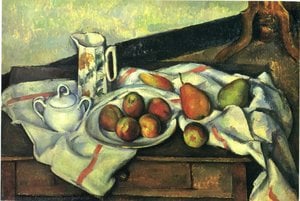
Paul Cézanne’s Sugarbowl, Pears and Tablecloth – A Still Life Transcending the Mundane
Cézanne’s Sugarbowl, Pears and Tablecloth, painted in 1894, isn't merely a depiction of everyday objects; it’s a profound meditation on perception, structure, and the very essence of seeing. This iconic work, now residing at the POLA Art Foundation in Japan, stands as a pivotal moment in art history – a bridge between the fleeting impressions of Impressionism and the groundbreaking explorations of Cubism. It's a painting that invites us to reconsider our relationship with the familiar, revealing an astonishing depth within what initially appears simple.
The scene is deceptively straightforward: a slightly tilted table draped with a tablecloth, upon which rests a sugarbowl, a collection of pears, and a few scattered lemons. Yet, Cézanne’s genius lies not in replicating reality but in constructing an entirely new visual language. He deliberately distorts perspective, creating a sense of spatial ambiguity that challenges the viewer's assumptions about depth and distance. The table plane isn’t perfectly horizontal; it subtly inclines, drawing our eye into the composition. The objects themselves aren’t rendered with photographic accuracy; instead, they are simplified, their forms reduced to essential geometric shapes – pyramids, cylinders, and planes – a technique heavily influenced by his studies of Japanese prints. This deliberate abstraction is not an end in itself but a means of revealing the underlying structure of the scene.
Post-Impressionism: A Revolution in Representation
Cézanne’s approach firmly places him within the Post-Impressionist movement, a reaction against the Impressionists' focus on capturing fleeting moments of light and color. While he admired the Impressionists’ use of color, Cézanne sought to go deeper, exploring the emotional and structural qualities of his subjects. He wasn’t interested in simply *seeing* the world; he wanted to *understand* it – to dissect its forms and rebuild them according to his own vision. This pursuit led him to develop a unique style characterized by bold colors, visible brushstrokes, and an emphasis on form over illusion. His work was profoundly influenced by artists like Vincent van Gogh, whose expressive use of color and dynamic brushwork resonated with Cézanne’s desire to convey emotion through paint.
Color, Form, and the Language of Geometry
Cézanne's masterful manipulation of color is central to the painting's impact. He employs a vibrant palette – rich reds, yellows, greens, and blues – not for decorative effect but to define form and create depth. The warm tones of the pears contrast with the cooler hues of the tablecloth, drawing our attention to specific areas of the composition. Crucially, he uses color not to mimic reality but to suggest it, creating a sense of volume and solidity through carefully layered washes of paint. His brushstrokes are visible and deliberate, building up texture and form with small, precise dabs. The painting is a testament to Cézanne’s understanding of how color can be used to create the illusion of three-dimensionality on a two-dimensional surface.
Symbolism and an Exploration of Domesticity
While seemingly a simple still life, Sugarbowl, Pears and Tablecloth carries symbolic weight. The objects – the sugarbowl, pears, tablecloth – represent domesticity, the quiet rhythms of daily life, and the comforts of home. However, Cézanne’s deconstruction of these familiar forms elevates them to something more profound. By presenting them in a slightly unsettling arrangement, he challenges our conventional understanding of the mundane, inviting us to contemplate the beauty and complexity hidden within everyday objects. The painting evokes a sense of calm contemplation, a feeling of being present in a moment of quiet observation – a reminder that even the most ordinary scenes can hold extraordinary meaning.
Legacy and Inspiration
Cézanne’s innovative approach to still life painting profoundly influenced generations of artists, laying the groundwork for Cubism and other early 20th-century movements. His emphasis on form, color, and perspective revolutionized the way artists approached representation, paving the way for a new era of abstraction. Sugarbowl, Pears and Tablecloth remains a powerful testament to Cézanne’s genius – a painting that continues to inspire and challenge viewers today.



 Visa i rummet
 Byt till tryckta exemplar
 Skicka
 Dela
Dela
 Detaljer
 Studentguide för konstverk

 Ladda ner
 Liknande objekt
 Röntgen
 Bildspel
 Besökstatistik

 Läs mer