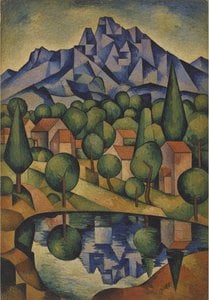
Mont Sainte-Victoire: A Post-Impressionist Masterpiece
Paul Cézanne's "Mont Sainte-Victoire" is more than just a landscape painting; it’s a pivotal work in the transition from Impressionism to Cubism, showcasing Cézanne's revolutionary approach to form and perspective. Created in 1906, this piece exemplifies his lifelong fascination with the mountain near Aix-en-Provence, France, which served as a constant subject throughout his career, particularly from the 1880s until his death.
Subject & Style: Capturing Atmospheric Depth
The artwork depicts Mont Sainte-Victoire under a cloudy sky. Cézanne abandons traditional perspective techniques—like linear perspective to create depth—instead emphasizing the painted surface by bringing foreground, middle ground, and background onto a single plane. This creates a unique sense of spatial ambiguity that challenges conventional representation. The style leans towards Post-Impressionism, characterized by visible brushstrokes and an expressive use of color aimed at capturing atmosphere and light rather than precise detail. It’s not about photographic accuracy but conveying the emotional impact of the scene.
Technique: Building Form with Color Patches
Cézanne's technique is as significant as his subject matter. He utilizes a quasi-abstract style, indicating form and space through the juxtaposition of small, colored patches of paint laid side by side. This impasto technique—where paint is applied thickly—creates a textured surface that adds depth and visual interest. Lines are used expressively to define shapes and contours, particularly in the mountain peaks and tree branches. The cool color palette – predominantly blues, greens, and browns – contributes to a serene yet slightly melancholic mood. Cézanne’s layering of oil paints builds up texture and color, creating a dynamic surface that invites close inspection.
Historical Context & Influence: A Bridge to Cubism
“Mont Sainte-Victoire” was painted in the final year of Cézanne's life, a period when he was refining his distinctive style. His rejection of traditional perspective and emphasis on geometric forms profoundly influenced subsequent artistic movements, most notably Cubism. Artists like Pablo Picasso and Henri Matisse acknowledged Cézanne as a foundational figure, recognizing him as "the father of us all." This painting exemplifies Cézanne’s exploration of how to represent three-dimensional objects on a two-dimensional surface, paving the way for new approaches to pictorial representation.
Symbolism & Emotional Impact: Vastness and Contemplation
Beyond its artistic significance, "Mont Sainte-Victoire" evokes powerful emotions. The vastness of the landscape inspires feelings of awe and tranquility. The diffused lighting and lack of sharp definition create a sense of solitude or contemplation, inviting viewers to reflect on their place within the natural world. Symbolically, the mountain represents permanence and stability amidst the ever-changing atmosphere, offering a timeless image of nature's enduring power.



 Visa i rummet
 Köp handmålat konstverk
 Skicka
 Dela
Dela
 Detaljer
 Studentguide för konstverk

 Ladda ner
 Liknande objekt
 Röntgen
 Bildspel
 Besökstatistik


 Läs mer






































 Glasalternativet är endast tillgängligt i storlekar under 110 cm.