A Pioneer of Female Textile Art: The Legacy of Margaretha Helm
In the grand tapestry of art history, certain names shine with a particular brilliance, not merely for their technical mastery but for the barriers they shattered. Margaretha Helm (1659-1742) was one such luminary. Born in the industrious city of Nuremberg, Germany, Helm emerged during an era when the artistic landscape was overwhelmingly dominated by men. While many women of her time were relegated to the private sphere, Helm carved out a distinguished and public career that bridged the gap between delicate needlework and the rigorous discipline of copper plate engraving. Her life stands as a testament to the power of creative audacity, as she navigated the complex artisan guilds of Nuremberg to establish herself as both an educator and a published designer.
The foundation of Helm’s artistry was laid within the rich traditions of the German artisan class. Though the specific details of her early schooling remain shrouded in the mists of the seventeenth century, it is evident that she underwent a rigorous education in the essential crafts of her age. She mastered the intricate language of embroidery and the precise, demanding science of engraving—skills that allowed her to envision a design on metal before translating its soul into thread. This dual mastery gave her a unique perspective, enabling her to create templates that were as much works of graphic art as they were blueprints for textile decoration.
The Masterpiece: Kunst- und Fleiß-übende Nadel Ergötzungen
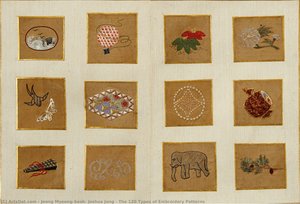
The pinnacle of Helm’s professional achievement arrived in 1720 with the publication of her monumental three-volume work, Kunst-und Fleiss-übende Nadel Ergötzungen, or Pleasing Embroidery Exercises. Published by Johann Christoph Weigel, this ambitious collection was far more than a mere instructional manual; it was a showcase of high Baroque aestheticism. Through these volumes, Helm presented meticulously engraved copper plates that served as exquisite templates for crafters. These designs were intended for a variety of ornamental purposes, ranging from the embellishment of fine clothing to the creation of elaborate shoe decorations, ensuring her influence reached the most fashionable corners of European society.
Her work within these volumes reveals a profound understanding of the late Baroque period's visual vocabulary. Her compositions are characterized by:
- Opulent Ornamentation: A lush, dense arrangement of patterns that celebrate the complexity of the era.
- Floral Symbolism: The frequent use of lilies, roses, and violets, which brought a sense of natural grace to structured textile designs.
- Exotic Influences: The skillful integration of chinoiserie elements, reflecting the period's fascination with the far reaches of the Orient.
- Technical Precision: A seamless marriage between the sharp, decisive lines of engraving and the soft, tactile possibilities of embroidery.
Historical Significance and Artistic Impact
Beyond the physical beauty of her designs, Margaretha Helm’s historical significance lies in her role as a trailblazer for female authorship. In an age where women's contributions to the decorative arts were often anonymous or attributed to male heads of households, Helm had the courage to publish her work under her own name. This act of self-assertion transformed her from a mere practitioner of a craft into a recognized creator of fine art. Her ability to command respect in both the textile and printmaking communities remains an inspiration to historians studying the evolution of gender roles in the arts.
Today, we look back at Helm not just as an embroidery teacher, but as a visionary who utilized the medium of the printed plate to expand the boundaries of textile design. Her legacy lives on in the intricate patterns that continue to fascinate collectors and scholars alike, reminding us that true artistry knows no bounds of gender, only the limitless potential of the human imagination.



 Visa i rummet
 Byt till tryckta exemplar
 Skicka
 Dela
Dela
 Detaljer
 Studentguide för konstverk

 Ladda ner
 Liknande objekt
 Röntgen
 Bildspel
 Besökstatistik
 Läs mer