x


 Köp tryck Köp högupplöst digital bild
 Skicka
 Details
 Lägg till i favoriter
 Ladda ner
 Liknande objekt
 X-Ray
X-Ray
 Bildspel
 Acrylic On PaperOtherNaïve Art (Primitivism)
 1963
1963 30.0 x 23.0 cm
Handmålad olja på duk i din valda storlek och ram, tillverkad efter beställning av våra konstnärer.
Välj bland våra förinställda storlekar som motsvarar konstverkets ursprungliga proportioner.

Du kan ange egna mått för att passa en specifik ram eller yta. Om den valda storleken inte matchar originalbildens proportioner kommer vi antingen att beskära konstverket eller utöka målningen med ytterligare handmålade element. En digital skiss skickas till dig för godkännande innan produktionen påbörjas.
Observera att förhandsvisningen på skärmen inte återspeglar den faktiska beskärningen eller utökningen. Endast skissen visar den slutgiltiga kompositionen korrekt.
Även om anpassade storlekar är möjliga, rekommenderar vi att du väljer en dimension från den fördefinierade listan för att bevara originalproportionerna.
Leverans över hela världen () på 3–4 veckor istället för standard 5 veckor. (1 juli). Inga kompromisser med kvaliteten.


Noah's Ark
Storlek på reproduktion
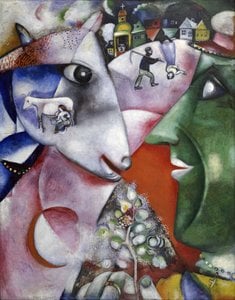
Marc Chagall's "Noah’s Ark," painted in 1963, isn’t merely a depiction of the biblical flood; it’s an immersion into a world brimming with memory, faith, and the artist’s deeply personal vision. This pastel on paper sketch and study, housed within WikiArt’s extensive collection, offers a glimpse into Chagall's unique artistic universe—a realm where folklore intertwines with profound spirituality and childhood recollections dance alongside grand narratives. The work immediately captivates with its vibrant palette and the seemingly chaotic yet harmonious arrangement of figures and animals, reflecting the artist’s signature style of Naïve Art (or Primitivism). It’s a piece that invites prolonged contemplation, revealing layers of meaning beneath its surface exuberance.
Born Moishe Shagal in 1887 in Liozna, Belarus—a town he would always consider his emotional center—Chagall’s artistic development was profoundly shaped by his upbringing within a Hasidic Jewish community. The vibrant rituals, storytelling traditions, and deeply ingrained folklore of Vitebsk permeated his work, manifesting as recurring motifs of flying figures, whimsical animals, and the evocative hues of remembered landscapes. This connection to his past is powerfully evident in “Noah’s Ark.” The painting echoes the artistic sensibilities of a region where Orthodox churches stood alongside bustling Jewish marketplaces—a potent blend of cultures that informed Chagall's distinctive aesthetic. He initially received formal training as a sign painter, but quickly abandoned academic constraints for a more intuitive and expressive approach, one deeply rooted in his personal experiences.
Executed in pastel on paper, “Noah’s Ark” exemplifies Chagall's characteristic use of flattened perspective and simplified forms. The figures are not rendered with meticulous realism but rather as stylized representations imbued with emotional weight. Notice the loose, gestural strokes that define the animals—a dog lounging casually, a pair of birds soaring upwards, a horse standing proudly—each rendered with an almost childlike directness. The composition is deliberately dynamic, creating a sense of movement and overflowing abundance. The colors are intensely saturated – blues, reds, yellows, and greens collide in a joyous explosion, reflecting the energy and vitality of Chagall’s artistic vision. This technique, rooted in Naïve Art, prioritizes emotional expression over precise representation, allowing the viewer to connect with the painting on an intuitive level.
Beyond its surface vibrancy, “Noah’s Ark” is rich in symbolic meaning. The ark itself—a vessel of salvation—becomes a stage for a multitude of figures, representing not just Noah and his family but also the diverse creatures entrusted to his care. The rainbow, prominently featured above the scene, symbolizes God's covenant with humanity after the flood, a promise of renewal and hope. However, Chagall’s interpretation transcends a purely literal reading of the biblical story. The painting feels less like a historical account and more like a dream—a personal meditation on themes of faith, memory, and the enduring power of the human spirit. The inclusion of figures reminiscent of Chagall's own family and friends adds another layer of intimacy to the scene, suggesting that the flood narrative is ultimately a metaphor for life’s challenges and the importance of finding refuge in love and connection.
A reproduction of this captivating artwork offers a beautiful addition to any collection. Its vibrant colors and evocative imagery will bring a touch of Chagall's dreamlike world into your home, serving as a constant reminder of the enduring power of faith, hope, and artistic expression.


1887 - 1985 , Belarus
Utforska Marc Chagalls 25 mest ikoniska målningar! Dröm, färg och rysk folklore möts i dessa tidlösa konstverk. Köp högkvalitativa reproduktioner & hitta inspiration till din inredning på WahooArt.com.

Explore the rich history of biblical art from Giotto to the Renaissance masters. Discover symbolism, techniques & enduring legacies with WahooArt – your source for museum-quality reproductions and expert art insights.

Explore the nuanced world of pastel art! Discover its history, techniques & emotional power with expert insights from WahooArt.com. Find museum-quality reproductions and learn about collecting this delicate medium.
Upptäck 10 ikoniska målningar präglade av vackra rosabruna toner! Fördjupa dig i konsthistorien, lär känna mästerverk från romantiken till impressionismen och hitta inspiration för ditt hem. Köp museumkvalitativa reproduktioner på WahooArt.com.

Upptäck de 10 mest älskade målningarna i ljusrosa toner! Från Monet till Renoir – utforska konsthistoriens romantik, impressionismen och pastellfärger. Köp reproduktioner av högsta kvalitet på WahooArt.com och förvandla ditt hem med tidlösa mästerverk.


Håll dig uppdaterad med de senaste konstnyheterna, exklusiva erbjudanden och inredningsidéer.
Berätta om ditt projekt så kommer våra konstexperter att ge dig 3 personliga konstförslag.
Vi skapar ett urval av 3 alternativ helt anpassat för dig – gratis!
 Dela
Dela





































 Läs mer
 Glasalternativet är endast tillgängligt i storlekar under 110 cm.