Förhandsvisa Förhandsgranska i AR Beställ handmålad reproduktion Byt till digital bild Skicka
Visa detaljer Guide Lägg till i favoriter Ladda ner Liknande objekt Röntgen Bildspel Statistik

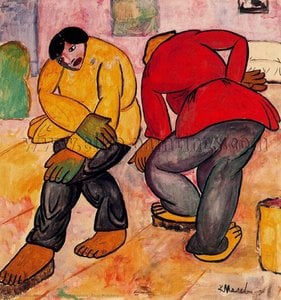
Composition

Kazimir Malevich’s "Composition" (1932) is a dynamic abstract painting featuring layered stripes & bold colors. Explore this Expressionistic/Constructivist masterpiece – a key work of 20th-century art.

Kazimir Malevich (1878-1935): Ukrainas pionjär inom abstrakt konst & Suprematism. Upptäck ikoniska verk som "Svart cirkel" och geometriska formernas inflytande på 20:e århundradets konst.

Giclée / Konsttryck

Giclée- eller canvasprint av museumskvalitet med snabb produktion och flexibla ytbehandlingsalternativ. ( Beställ handmålad reproduktion Byt till digital bild)

Corner sample of the P118B picture frame: formgjuten polystyren, 5 cm wide and 3 cm thick
P118B Skr10
Corner sample of the P118H picture frame: formgjuten polystyren, 5 cm wide and 3 cm thick
P118H Skr10
Corner sample of the P118W picture frame: formgjuten polystyren, 5 cm wide and 3 cm thick
P118W Skr10
Corner sample of the P438Z picture frame: formgjuten polystyren, 5.5 cm wide and 3.5 cm thick
P438Z Skr10
Corner sample of the P508JH picture frame: formgjuten polystyren, 7 cm wide and 3.5 cm thick
P508JH Skr12
Corner sample of the P508YH picture frame: formgjuten polystyren, 7 cm wide and 3.5 cm thick
P508YH Skr12
Corner sample of the P805H picture frame: formgjuten polystyren, 5 cm wide and 3.5 cm thick
P805H Skr10
Corner sample of the P805Z picture frame: formgjuten polystyren, 5 cm wide and 3.5 cm thick
P805Z Skr10
Corner sample of the P919BZ picture frame: formgjuten polystyren, 7 cm wide and 3.5 cm thick
P919BZ Skr10
Corner sample of the P919G picture frame: formgjuten polystyren, 7 cm wide and 3.5 cm thick
P919G Skr10
Corner sample of the P919XJ picture frame: formgjuten polystyren, 7 cm wide and 3.5 cm thick
P919XJ Skr10
Corner sample of the P959ZH picture frame: formgjuten polystyren, 5 cm wide and 3 cm thick
P959ZH Skr10
Corner sample of the P968JZ picture frame: formgjuten polystyren, 6 cm wide and 4 cm thick
P968JZ Skr12
Corner sample of the W106C picture frame: massivt trä, 5 cm wide and 3 cm thick
W106C Skr8
Corner sample of the W218G picture frame: massivt trä, 5 cm wide and 3 cm thick
W218G Skr10
Corner sample of the W218JH picture frame: massivt trä, 5 cm wide and 3 cm thick
W218JH Skr8
Corner sample of the W218Y picture frame: massivt trä, 5 cm wide and 3 cm thick
W218Y Skr10
Corner sample of the W307PJ picture frame: massivt trä, 6 cm wide and 3 cm thick
W307PJ Skr10
Corner sample of the W316G picture frame: massivt trä, 6 cm wide and 3 cm thick
W316G Skr10
Corner sample of the W316PJ picture frame: massivt trä, 6 cm wide and 3 cm thick
W316PJ Skr8
Corner sample of the W316Y picture frame: massivt trä, 6 cm wide and 3 cm thick
W316Y Skr10
Corner sample of the W398PJ picture frame: massivt trä, 5 cm wide and 3 cm thick
W398PJ Skr8
Corner sample of the W4111J picture frame: massivt trä, 6.5 cm wide and 3.5 cm thick
W4111J Skr10
Corner sample of the W500HY picture frame: massivt trä, 7 cm wide and 5 cm thick
W500HY Skr15
Corner sample of the W500JH picture frame: massivt trä, 7 cm wide and 5 cm thick
W500JH Skr15
Corner sample of the W692G picture frame: massivt trä, 8 cm wide and 4 cm thick
W692G Skr12
Corner sample of the W849H picture frame: massivt trä, 5 cm wide and 3 cm thick
W849H Skr8
Corner sample of the W940BG picture frame: massivt trä, 7.5 cm wide and 4.5 cm thick
W940BG Skr15
Corner sample of the W953PJ picture frame: massivt trä, 6 cm wide and 3.5 cm thick
W953PJ Skr8

Standardstorlek
skräddarsydd
CM
INCH

Välj bland våra förinställda storlekar som motsvarar konstverkets ursprungliga proportioner.

bredd
höjd

Ange den bredd och höjd du behöver för att passa din ram eller vägg. Ett tryck kan endast beskäras, aldrig göras större än originalbilden, vilket innebär att ett format med en annan proportion leder till att en del av bilden går förlorad. Vi skickar en digital mockup för godkännande innan vi påbörjar tryckningen. Bilden som visas på denna sida visar inte den faktiska beskärningen — det är endast mockuppen som gör det.

Leverans över hela världen () på 2 veckor istället för standard 4/5 veckor. (26 oktober)

Fri expressfrakt över hela världen
Högkvalitativ linnecanvas
Fullständig fraktförsäkring
Garantier för återbetalning av tullavgifter
Garantier för exakt färgåtergivning
100 dagars returrätt (endast vid fel)
100% pengarna tillbaka-garanti
Mängdrabatt erbjuds

Totalt pris

Skr 674

Composition

Giclée / Konsttryck

Storlek på reproduktion

-

Slutgiltigt pris

Skr 674

Kortfakta

  • medium: Oil paints on canvas (likely)
  • year: 1932
  • artist: Kazimir Severinovich Malevich
  • movement: Suprematism, Expressionism, Constructivism

Konstquiz

Det finns endast ett korrekt svar på varje fråga.

Fråga 1:
Kazimir Malevich is most famously associated with which art movement?
Fråga 2:
What is a defining characteristic of the technique used in 'Composition'?
Fråga 3:
The composition primarily utilizes what type of lines?
Fråga 4:
Which of the following stylistic influences is *not* explicitly mentioned in relation to Malevich's work?

A Symphony of Abstraction: The Pure Sensation of Malevich’s ‘Composition’

To step before Kazimir Malevich's 1932 Composition is to enter a realm where the noise of the material world falls into a profound, rhythmic silence. This horizontal masterpiece does not seek to mirror the landscapes or faces of our daily existence; instead, it invites the viewer into a universe of pure artistic sensation. As a pinnacle of his mature Suprematist style, the work functions as a visual symphony, where color and form dance in a carefully orchestrated tension. It is an exploration of the non-objective, stripping away the skin of reality to reveal a skeletal truth composed entirely of energy, weight, and movement.

The painting is defined by a captivating interplay of layered, rectangular stripes that vary in width and intensity. These are not merely flat bands of pigment but are perceived as dynamic planes existing within a shallow, compressed pictorial space. By deliberately minimizing traditional perspective, Malevich pushes the composition forward, demanding an immediate, visceral engagement from the observer. The eye is drawn into a rhythmic pulse created by the overlapping edges, where the boundaries between shapes become sites of subtle conflict and unexpected harmony.

A Palette of Emotion and Tactile Depth

The emotional resonance of the piece is anchored in its masterful use of color. Malevich employs a bold palette—dominated by deep reds, vibrant greens, cool blues, sun-drenched yellows, and grounding blacks—not to mimic nature, but to evoke a spectrum of human feeling. The juxtaposition of these hues creates a sense of kinetic energy; certain stripes seem to vibrate against their neighbors, while others provide moments of structural stability. This chromatic tension is further heightened by the artist's signature impasto technique. The thick, deliberate application of oil paint lends the canvas a rugged, tactile quality that transforms the surface into a sculptural landscape of its own.

For the discerning collector or interior designer, this texture offers a profound sense of authenticity and presence. The visible brushstrokes serve as a poignant reminder of the artist’s hand, ensuring that the work feels deeply personal rather than mechanically produced. When placed within a modern architectural setting, the interplay of light across these raised ridges of paint creates a living composition that changes with the time of day, offering a sophisticated focal point that embodies both strength and elegance.

Historical Resonance and Modern Legacy

Understanding Composition requires a glimpse into the revolutionary spirit of its era. Emerging from the transformative atmosphere of the Russian avant-garde, Malevich sought to create an art form that reflected a new, utopian world order. Through Suprematism, he believed that geometric abstraction could transcend political and social boundaries to express a universal spirituality. This work represents a radical break from centuries of representational tradition, standing as a monument to the courage of the modern spirit.

Today, this painting remains a cornerstone of abstract art history, offering endless inspiration for those who appreciate the beauty of structural order and emotional depth. Whether serving as a bold statement in a minimalist gallery or adding a layer of intellectual complexity to a curated residential space, Malevich’s Composition continues to captivate. It is more than a painting; it is an invitation to experience the sublime power of pure form.

Frågor och svar

När skapades "Composition" av Kazimir Malevich?

"Composition" av Kazimir Malevich skapades år 1932.

Är "Composition" av Kazimir Malevich fri från upphovsrätt, och varför?

"Composition" av Kazimir Malevich är allmän egendom – upphovsrätten har löpt ut. Upphovsrätten beräknas utifrån konstnärens dödsår, och Kazimir Malevich avled år 1935.

När skapades "Composition" och vilken stilriktning tillhör det?

"Composition" skapades år 1932 inom Constructivism-rörelsen.


Konstnärsbiografi

Kazimir Malevich: En pionjär inom abstrakt konst

Tidigt liv och influenser

  • Född 1878 i Kyiv oblast, Ukraina, i en polsk familj, formades Kazimir Severinovich Malevich tidiga år av det ukrainska landsbygdslanskapet och dess rika folkkultur.
  • Hans uppväxt gav honom en uppskattning för traditionella konstnärliga uttryck som senare skulle påverka hans verk på ett subtilt sätt.
  • Den formella utbildningen började i Kyiv, men Malevich sökte snabbt bredare konstnärliga horisonter genom att röra sig mot Moskva, för att slutligen engagera sig i Europas framväxande avantgarderörelser.
  • Viktiga influenser: Tidig exponering för folkkonst, kombinerat med en längtan efter modernt uttryck, lade grunden till hans unika stil.

Konstnärlig utveckling och centrala rörelser

  • Inledningsvis utforskade Malevich olika stilar, inklusive impressionism, symbolism, fauvism och
    kubism. En avgörande resa till Paris 1912 exponerade honom för de senaste utvecklingarna inom den europeiska konsten.
  • Han rörde sig gradvis bort från föreställande former i sökandet efter ett rent konstnärligt språk baserat på geometriska former och färg.
  • Detta ledde till utvecklingen av suprematismen kring 1915 – en abstrakt rörelse fokuserad på ”det rena känslans överhöghet” inom konsten.
  • Suprematismen förkastade alla försök att avbilda objekt från den synliga världen och prioriterade istället grundläggande geometriska former som kvadrater, cirklar och rektanglar.

Stora prestationer och betydelsefulla verk

  • Svart kvadrat (1915): Möjligen hans mest kända verk, vilket representerar ett radikalt avsteg från traditionell konst och betraktas som ett fundamentalt stycke inom det abstrakta måleriet.
  • Vit på vit (191rag): En serie som utforskar formens och färgens renhet, med vita geometriska former mot en vit bakgrund – vilket pressar abstraktionen till dess yttersta gränser.
  • Stroyuschiysya dom [Hus under konstruktion] (1916): Ett tidigt exempel på suprematism som visar hans unika perspektiv på ukrainsk kultur genom abstrakta former.
  • Han skrev även omfattande om konstteori, där han artikulerade de filosofiska principerna bakom suprematismen och förespråkade ett nytt konstnärligt medvetande.

Historisk betydelse och arv

  • Malevichs arbete fick en djupgående inverkan på utvecklingen av 1900-talets abstrakta konst och influerade rörelser som minimalism och konstruktivism.
  • Han utmanade konventionella föreställningar om representation och banade väg för den icke-objektiva konsten.
  • Hans idéer om ren känsla och geometrisk abstraktion fortsätter att resonera hos konstnärer än idag.
  • Trots politisk förföljelse under Stalin – först stöttad, sedan förtryckt – höll Malevich fast vid sitt skapande och sitt lärande.
  • Inflytande på senare konstnärer: Han påverkade direkt konstnärer som El Lissitzky och formade indirekt otaliga andra genom suprematismens bestående arv.

Sena år och död

  • Under sina senare år återvände Malevich till figurativt måleri i ett försök att syntetisera sina abstrakta principer med föreställande former.
  • Han fortsatte att undervisa och skriva om konst fram till sin död i Leningrad (nuvarande Sankt Petersburg) 1935.
  • Hans arbete förblev relativt okänt i decennier efter hans död, men upplevde en renässans under den senare hälften av 20:e århundradet, vilket befäste hans plats som en av de viktigaste gestalterna i den moderna konsthistorien.
Kazimir Malevich

Kazimir Malevich

1878 - 1935 , Ukraina

Kortfakta

  • Artistic Movement Or Style: Suprematism, Abstrakt konst
  • Artists Or Movements Influenced By This Artist:
    • Minimalism
    • Konstruktivism
    • El Lissitzky
  • Artists Who Influenced This Artist:
    • Impressionism
    • Fauvismer
    • Kubism
  • Date Of Birth: 1878
  • Date Of Death: 1935
  • Full Name: Kazimir Severinovitj Malevich
  • Nationality: Ukrainsk/Rysk
  • Notable Artworks:
    • Svart cirkel
    • Vit på vit
    • Hus under konstruktion
  • Place Of Birth: Kyiv, Ukraina
Utforska konstverk sorterade efter tema, stil och egenskaper.