Visa i rummet Se i AR Köp handmålat konstverk Byt till digital bildförsäljning Skicka
Detaljer Studentguide för konstverk Lägg till i favoriter Ladda ner Liknande objekt Röntgen Bildspel Besökstatistik

Untitled

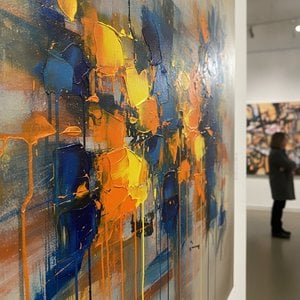
Experience the vibrant energy of Karel Appel's COBRA masterpiece; this abstract burst of color captures raw instinct from 1960—discover your own artistic freedom.

Karel Appel var en banbrytande nederländsk konstnär känd för sin färgstarka och spontana CoBrA-stil. Hans verk utforskar barnlik kreativitet, krigets fasor och en unik postkrigstidens uttrycksform.

Konstverket som visas på denna sida skyddas av upphovsrättslagen, vilket innebär att vi inte lagligt kan skapa eller sälja en identisk reproduktion. Detta skydd upprätthålls genom internationella avtal såsom den Bernkonventionen och genom nationella lagar, inklusive de som fastställs av Amerikansk upphovsrättslag – Titel 17. Alla rättigheter förbehållna. Återgivning av konstverk är förbjuden utan skriftligt tillstånd från WahooArt.

Denna metod följer fullt ut upphovsrättsliga regler eftersom den inte innebär kopiering eller duplicering av det skyddade konstverket. Istället är det en kreativ nytolkning – en ny målning som är influerad av originalet men inte identisk med det.

Giclée / Konsttryck

Giclée- eller canvasprint av museumskvalitet med snabb produktion och flexibla ytbehandlingsalternativ. ( Köp handmålat konstverk Byt till digital bildförsäljning)

Corner sample of the P118B picture frame: moulded polystyrene, 5 cm wide and 3 cm thick
P118B Skr10
Corner sample of the P118H picture frame: moulded polystyrene, 5 cm wide and 3 cm thick
P118H Skr10
Corner sample of the P118W picture frame: moulded polystyrene, 5 cm wide and 3 cm thick
P118W Skr10
Corner sample of the P438Z picture frame: moulded polystyrene, 5.5 cm wide and 3.5 cm thick
P438Z Skr10
Corner sample of the P508JH picture frame: moulded polystyrene, 7 cm wide and 3.5 cm thick
P508JH Skr12
Corner sample of the P508YH picture frame: moulded polystyrene, 7 cm wide and 3.5 cm thick
P508YH Skr12
Corner sample of the P805H picture frame: moulded polystyrene, 5 cm wide and 3.5 cm thick
P805H Skr10
Corner sample of the P805Z picture frame: moulded polystyrene, 5 cm wide and 3.5 cm thick
P805Z Skr10
Corner sample of the P919BZ picture frame: moulded polystyrene, 7 cm wide and 3.5 cm thick
P919BZ Skr10
Corner sample of the P919G picture frame: moulded polystyrene, 7 cm wide and 3.5 cm thick
P919G Skr10
Corner sample of the P919XJ picture frame: moulded polystyrene, 7 cm wide and 3.5 cm thick
P919XJ Skr10
Corner sample of the P959ZH picture frame: moulded polystyrene, 5 cm wide and 3 cm thick
P959ZH Skr10
Corner sample of the P968JZ picture frame: moulded polystyrene, 6 cm wide and 4 cm thick
P968JZ Skr12
Corner sample of the W106C picture frame: solid wood, 5 cm wide and 3 cm thick
W106C Skr8
Corner sample of the W218G picture frame: solid wood, 5 cm wide and 3 cm thick
W218G Skr10
Corner sample of the W218JH picture frame: solid wood, 5 cm wide and 3 cm thick
W218JH Skr8
Corner sample of the W218Y picture frame: solid wood, 5 cm wide and 3 cm thick
W218Y Skr10
Corner sample of the W307PJ picture frame: solid wood, 6 cm wide and 3 cm thick
W307PJ Skr10
Corner sample of the W316G picture frame: solid wood, 6 cm wide and 3 cm thick
W316G Skr10
Corner sample of the W316PJ picture frame: solid wood, 6 cm wide and 3 cm thick
W316PJ Skr8
Corner sample of the W316Y picture frame: solid wood, 6 cm wide and 3 cm thick
W316Y Skr10
Corner sample of the W398PJ picture frame: solid wood, 5 cm wide and 3 cm thick
W398PJ Skr8
Corner sample of the W4111J picture frame: solid wood, 6.5 cm wide and 3.5 cm thick
W4111J Skr10
Corner sample of the W500HY picture frame: solid wood, 7 cm wide and 5 cm thick
W500HY Skr15
Corner sample of the W500JH picture frame: solid wood, 7 cm wide and 5 cm thick
W500JH Skr15
Corner sample of the W692G picture frame: solid wood, 8 cm wide and 4 cm thick
W692G Skr12
Corner sample of the W849H picture frame: solid wood, 5 cm wide and 3 cm thick
W849H Skr8
Corner sample of the W940BG picture frame: solid wood, 7.5 cm wide and 4.5 cm thick
W940BG Skr15
Corner sample of the W953PJ picture frame: solid wood, 6 cm wide and 3.5 cm thick
W953PJ Skr8

Standardstorlek
anpassad
CM
INCH

Välj bland våra förinställda storlekar som motsvarar konstverkets ursprungliga proportioner.

bredd
höjd

Du kan ange egna mått för att passa en specifik ram eller yta. Om det valda måttet inte överensstämmer med originalbildens proportioner kommer vi antingen att beskära konstverket eller utöka bilden med en speglad eller enfärgad kant. En digital mockup skickas för ditt godkännande innan produktionen påbörjas.
Vänligen notera att förhandsvisningen på skärmen inte återspeglar den faktiska beskärningen eller utökningen. Endast mockuppen visar den slutgiltiga kompositionen korrekt.
Även om anpassade storlekar är möjliga, rekommenderar vi att du väljer ett mått från den fördefinierade listan för att bevara de ursprungliga proportionerna.

Leverans över hela världen () på 2 veckor istället för standard 4/5 veckor. (11 oktober)

Fri expressfrakt över hela världen
Högkvalitativ linnecanvas
Fullständig fraktförsäkring
Garantier för återbetalning av tullavgifter
Garantier för exakt färgåtergivning
100 dagars returrätt vid fabrikationsfel
100% pengarna tillbaka-garanti
Mängdrabatt erbjuds

Totalt pris

Skr 660

Untitled

Giclée / Konsttryck

Reproduktionsstorlek

-

Totalpris

Skr 660

Snabbfakta

  • Artistic style: Abstract Expressionism
  • Movement: COBRA
  • Artist: Karel Appel
  • Title: Untitled
  • Year: 1960
  • Subject or theme: Organic shapes
  • Medium: Screenprint

Konstquiz

Det finns endast ett korrekt svar på varje fråga.

Fråga 1:
What avant-garde movement is Karel Appel strongly associated with for this artwork?
Fråga 2:
Which element of the artwork's composition is described as eschewing traditional perspective?
Fråga 3:
According to the description, what emotion is often symbolized by the color yellow in Appel's work?
Fråga 4:
What type of forms populate the artwork, described as rounded and organic, reminiscent of natural elements?
Fråga 5:
What medium is the artwork most likely to be, given the visible layering and texture?

A Symphony of Spontaneity: The Primal Energy of Karel Appel

In the landscape of post-war European modernism, few voices resonate with as much raw, unbridled vitality as that of Karel Appel. His 1960 work, Untitled, serves as a breathtaking manifesto of the COBRA movement, an avant-garde collective that sought to strip away the suffocating layers of academic tradition in favor of something far more primal. To encounter this piece is to witness a deliberate rebellion; it is not merely a composition of pigment on paper, but an explosion of instinctual expression. The artwork captures a moment where the artist’s hand moves with the freedom of a child, yet carries the profound weight of a man navigating a world recovering from the shadows of conflict. Through its vibrant palette and gestural urgency, the work invites the viewer into a realm where emotion dictates form, and where the boundaries between the creator and the canvas dissolve into pure, rhythmic motion.

The visual language of this masterpiece is defined by its biomorphic forms—organic, rounded shapes that seem to pulse with an internal life force. There is no rigid geometry here, nor any attempt at traditional perspective; instead, Appel utilizes an asymmetrical arrangement where colors and shapes overlap in a dance of beautiful chaos. The palette is nothing short of celebratory, dominated by sun-drenched yellows, deep oceanic blues, and fiery reds, all anchored by bold strokes of black and punctuated by flashes of orange and white. These colors are not merely decorative choices but are deeply symbolic; the yellow radiates an infectious optimism, while the blue offers a moment of contemplative stillness amidst the surrounding energy. This interplay of hues creates a complex textural landscape, where the visible layering of the printmaking process suggests a tactile depth that draws the eye into a continuous, wandering exploration.

Historical Resonance and Interior Inspiration

To understand the soul of this work, one must look to the historical heartbeat of the COBRA movement. Born from a desire to break free from the constraints of Surrealism and Cubism, Appel and his contemporaries looked toward the "primitive"—finding profound inspiration in African masks, tribal art, and the uninhibably honest drawings of children. This 1960 print embodies that search for authenticity, rejecting meticulous representation in favor of intuition and gesture. The technique, likely a screenprint or lithograph, allows for a fascinating tension between the flatness of the medium and the perceived movement of the brushstrokes. Each layer of ink contributes to a sense of immediacy, as if the artist’s energetic movements were captured in mid-motion, frozen forever in a state of becoming.

For the discerning collector or interior designer, this artwork offers more than just visual interest; it provides a transformative emotional atmosphere. Its lack of a singular focal point allows it to integrate seamlessly into sophisticated modern environments, acting as a dynamic anchor in a room. In a minimalist setting, its bold colors can provide a much-needed burst of life and character, while in a more eclectic space, it serves as a testament to the enduring power of the avant-garde. Owning a high-quality reproduction of this piece is an invitation to live alongside a fragment of art history—a piece that celebrates the joy of existence, the beauty of imperfection, and the eternal, restless spirit of human creativity.

Frågor och svar

Hur balanserar "Untitled" ljus och mörker?

"Untitled" har en övergripande ljusstyrka på bright, och dess luminans är Bright Balance.

Vilket är skapelseåret för "Untitled" av Karel Appel?

"Untitled" av Karel Appel skapades år 1960.

Hur gammal var Karel Appel när "Untitled" skapades?

Karel Appel var 39 år gammal när hen skapade "Untitled" år 1960. Åldern är beräknad utifrån konstnärens födelseår, 1921.

Hur relaterar färgerna i "Untitled" av Karel Appel till verkets känsla?

I "Untitled" ackompanjeras Joyful känsla av Neutrals färger.

Vilket nationellt ursprung ligger bakom COBRA Expressionism i "Untitled"?

"Untitled" skapades av Karel Appel, född i Nederländerna, inom COBRA Expressionism-rörelsen. Konstnärens ursprung knyter verket till COBRA Expressionism så som det utövades av konstnärer från Nederländerna.

Vilken konstnär och vilken stil ligger bakom "Untitled"?

Karel Appel skapade "Untitled" inom COBRA Expressionism-rörelsen.

Vem har skapat "Untitled"?

Konstnären bakom "Untitled" är Karel Appel. Verket är katalogiserat under Karel Appels namn.


Om konstnären

A Life Painted in Bold Strokes: The World of Karel Appel

Christiaan Karel Appel, known affectionately as ‘Kik’ from childhood, burst onto the post-war art scene like a vibrant explosion of color and energy. Born in Amsterdam in 1921, his early life was steeped in the everyday rhythms of working-class Holland – his father a barber, his lineage tracing back to French Huguenots through his mother. This grounding, however, would soon be superseded by an irrepressible artistic drive that defied convention and ultimately reshaped the landscape of European art. A pivotal moment arrived at age fourteen with his first painting, a still life of fruit, followed shortly after by a paint set and easel gifted by his uncle Karel Chevalier, who also provided early instruction. These gifts weren’t merely tools; they were keys unlocking a world where imagination reigned supreme. The shadow of the Second World War loomed large over Appel’s formative years. Studying at the Rijksakademie van Beeldende Kunsten in Amsterdam during the German occupation proved challenging, yet it was there he forged lifelong bonds with fellow artists Corneille and Constant, friendships that would prove crucial to his artistic evolution. Facing opposition from his parents regarding his chosen path and fearing forced labor under Nazi rule, Appel bravely left home, choosing a life dedicated to art over conformity.

Early Life and Artistic Beginnings

Karel Appel’s childhood was marked by a profound connection to the tangible world—the bustling streets of Amsterdam, the routines of his father's barbershop, and the heritage of Huguenot ancestry passed down through his mother. This formative experience instilled in him a sensitivity to texture and form that would become central to his artistic practice. At fourteen, he embarked on his artistic journey with a simple still life depicting fruit—a deliberate choice reflecting an interest in capturing the essence of everyday objects. Crucially, this moment was accompanied by a transformative gift: a paint set and easel from his uncle Karel Chevalier, who recognized Appel’s innate talent and nurtured his burgeoning creativity. This bequest wasn't simply material assistance; it represented access to a realm where instinctual expression superseded academic constraints—a path that would ultimately define Appel’s artistic trajectory.

The CoBrA Revolution: Spontaneity and the Childlike Vision

Appel’s artistic breakthrough arrived in 1948 with the formation of CoBrA – an acronym derived from Copenhagen, Brussels, and Amsterdam – representing the movement's core cities. Alongside Corneille, Constant, Jan Nieuwenhuys, and Christian Dotremont, Appel spearheaded a radical departure from established artistic norms. CoBrA wasn’t merely a style; it was a philosophy rooted in spontaneity, experimentation, and a profound embrace of the untamed creativity found in children's art and primitive cultures. Influenced by masters like Pablo Picasso and Henri Matisse, as well as the raw energy of Jean Dubuffet, Appel rejected rigid formalism in favor of intuitive expression. He began sculpting in 1947, utilizing assemblage techniques – constructing works from found materials painted in a bold palette of white, red, yellow, blue, and black. This period saw him involved with the Experimentele Groep, further solidifying his commitment to artistic innovation. The controversial fresco "Questioning Children" (1949), commissioned for Amsterdam City Hall, exemplified CoBrA’s provocative spirit but also sparked public outcry, ultimately leading to its being covered up – a testament to the movement's challenging nature. Appel drew inspiration from Danish and Nordic mythology, weaving these ancient narratives into his increasingly abstract compositions.

International Horizons: From Paris to New York and Beyond

Facing resistance to CoBrA’s uncompromising vision in the Netherlands, Appel relocated to Paris in 1950, a city that offered greater artistic freedom and recognition. This marked the beginning of an expansive period of international travel and exposure. He explored Mexico, the USA, Yugoslavia, and Brazil, absorbing diverse cultural influences that enriched his artistic vocabulary. His time in New York City and Florence further broadened his horizons, allowing him to connect with a wider network of artists and collectors. A pivotal moment arrived in 1954 with his first American gallery exhibition at Martha Jackson Gallery, followed by the inclusion of "Child and Beast II" (1951) in the influential Museum of Modern Art exhibition “The New Decade” in 1955. Appel’s murals became increasingly prominent during this period, showcasing his ability to translate his dynamic style onto a larger scale. Despite initial setbacks, his work experienced a resurgence in popularity in the Netherlands after 1990, with major exhibitions organized by Rudy Fuchs in Amsterdam and Brussels, solidifying his legacy within his homeland.

Legacy and Influence

Karel Appel’s contribution to post-war European art is undeniable. He established the Karel Appel Foundation to safeguard his artworks and promote public awareness of his oeuvre, ensuring that future generations could appreciate the depth and breadth of his artistic vision. The foundation continues to champion Appel's legacy as an artist who dared to challenge conventions and embrace spontaneity—a spirit that resonates powerfully with contemporary artists striving for authentic expression. His work remains a significant testament to CoBrA’s revolutionary ethos and serves as inspiration for those pursuing artful innovation today.
Karel Appel

Karel Appel

1921 - 2006 , Nederländerna

Snabbfakta

  • Artistic Movement Or Style: CoBrA, Expressionism
  • Artists Who Influenced This Artist:
    • Picasso
    • Matisse
    • Dubuffet
  • Date Of Birth: April 25, 1921
  • Date Of Death: May 3, 2006
  • Full Name: Christiaan Karel Appel
  • Nationality: Dutch
  • Notable Artworks:
    • Square Man
    • Parrot Woman with Bird
    • Hip, Hip, Hoorah
  • Place Of Birth: Amsterdam, Netherlands