A Solitary Quest for Fortune
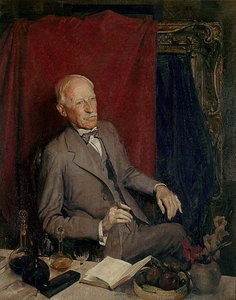
In the quiet, heavy atmosphere of Julian Ashton’s 1889 masterpiece, The Prospector, we are invited into a moment of profound, singular focus. The painting presents us with a solitary figure, a man etched by the ruggedness of his environment, deeply immersed in the rhythmic, ancient ritual of gold panning. As he leans over his pan, the world around him seems to fall away, leaving only the intense connection between the seeker and the earth. This is not merely a depiction of labor; it is a portrait of human perseverance. The composition, vertically oriented, pulls our gaze downward toward the glint of potential within the pan, while simultaneously emphasizing the isolation of the figure against a backdrop of dense, shadowy foliage that suggests a wilderness both beautiful and unforihing.
The emotional resonance of the piece lies in its ability to evoke the spirit of the frontier—a time defined by the relentless pursuit of something precious. There is a palpable sense of solitude, yet it is not a lonely painting; rather, it is one of quiet determination. The act of panning for gold serves as a powerful symbol of hope and the eternal human struggle to uncover value amidst the grit and stone of life. For the collector or the designer, this artwork offers more than just visual beauty; it provides a window into a narrative of grit and aspiration that remains deeply relatable across generations.
Mastery of Light and Earthly Texture
Technically, The Prospector is a triumph of late 19th-century realism, heavily informed by the influence of the French Barbizon School. Ashton utilizes a masterful command of light to breathe life into the scene, employing a dramatic, directional light source that strikes the subject from the side. This lighting strategy creates high-contrast highlights on the man’s weathered face and hands, drawing the viewer's eye immediately to the focal point of his labor. The interplay of deep shadows and bright illumination adds a sculptural depth to the figure, making him appear almost tangible within the frame.
The artist’s use of color and texture further enhances the realism of this rugged landscape. A palette dominated by earthy ochres, deep browns, and muted forest greens creates a harmonious, organic atmosphere that feels grounded in nature. Ashton employs a sophisticated layering technique, using visible brushstrokes and subtle impasto to replicate the rough, tactile quality of the prospector’s clothing and the jagged surfaces of the surrounding rocks. This richness of texture contrasts beautifully with the smooth, reflective surface of the metal pan, creating a sensory experience that invites the viewer to feel the grit of the soil and the coolness of the water. It is this meticulous attention to detail that makes a high-quality reproduction of this work such a captivating centerpiece for any sophisticated interior.
A Legacy of Realism and Resilience
To understand The Prospector, one must consider the hand of Julian Ashton, an artist whose life was as much about building institutions as it was about capturing light. Trained in the prestigious Académie Julian in Paris, Ashton brought a sophisticated European sensibility to his depictions of local life. His ability to blend academic precision with the spontaneous, en plein air spirit of the Impressionist movement allowed him to capture the essence of his subjects with unparalleled honesty. This painting stands as a testament to that duality—a work that is both technically rigorous and emotionally raw.
For those looking to adorn a space with art that tells a story, this piece offers an unparalleled opportunity. It brings a sense of history, stability, and quiet strength to a room. Whether placed in a study, a library, or a grand living area, The Prospector serves as a constant reminder of the beauty found in dedication and the enduring allure of the search for something greater than ourselves.



 Visa i rummet
 Byt till tryckta exemplar
 Skicka
 Dela
Dela
 Detaljer
 Studentguide för konstverk

 Ladda ner
 Liknande objekt
 Röntgen
 Bildspel
 Besökstatistik


 Läs mer






































 Glasalternativet är endast tillgängligt i storlekar under 110 cm.