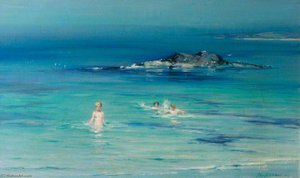
The Soul of the Scottish Moorland: The Life of John Campbell Mitchell
In the misty, windswept landscapes of late Victorian and Edwardian Scotland, few artists captured the ephemeral beauty of the wilder terrains as poignantly as John Campbell Mitchell. Born on December 1, 1861, in the coastal town of Campbeltown, Argyllshire, Mitchell’s early life was a tapestry of contrasting paths. While he was initially apprenticed to a local law firm, his heart remained tethered to the rugged scenery of his youth. This duality between the structured world of legal study and the untamed spirit of the Scottish coast would later manifest in his art as a masterful balance between technical precision and atmospheric freedom. Under the pivotal mentorship of the renowned William McTaggart, Mitchell’s latent talent was nurtured, leading him away from the courtroom and toward the prestigious Edinburgh College of Art.
The evolution of Mitchell's brushwork was profoundly shaped by his journey to the heart of the art world in Paris. Studying under Jean-Joseph Benjamin-Constant, he absorbed the vibrant, light-drenched techniques of French Impressionism, which breathed a new vitality into his approach to landscape. Upon returning to Scotland, he did not merely replicate foreign styles but instead synthesized them with the unique, somber, and dramatic character of his homeland. Settling in Corstermine, Edinburgh, Mitchell dedicated himself to documenting the shifting moods of the Scottish weather, finding profound inspiration in the expansive views of Kintyre, Galloway, and the coastal stretches of Aberlady.
Technique and the Mastery of Light
To gaze upon a Mitchell canvas is to experience the very breath of the moorland. His style was defined by broad, open views that utilized a sophisticated command of tonalism and color. He possessed a rare ability to render the heavy, moisture-laden skies of Scotland, using thick impasto to give texture to clouds and the shimmering surface of coastal waters. His works often feature:
- Atmospheric Light: A preoccupation with how sunlight pierces through storm clouds to illuminate specific patches of heather or sand.
- Tonal Harmony: A palette that, while capable of brilliance, often leaned into the muted, earthy tones characteristic of the Scottish landscape.
- Dynamic Movement: The ability to convey the restless energy of the wind across the hills and the rhythmic pulse of the sea against the shore.
In celebrated works such as "Cattle on the Solway" and "Sunset, Argyllshire," one can observe his transition from a student of form to a master of atmosphere. His paintings are not merely static depictions of geography; they are emotional responses to the grandeur and intimacy of nature, where a single grazing animal or a distant curlew serves as a focal point within an overwhelming expanse of sky and earth.
Legacy and Artistic Standing
Mitchell’s ascent within the prestigious Royal Scottish Academy (RSA)—achieving Associate status in 1904 and full membership in 1919—marked his arrival as a cornerstone of the Scottish art community. His dedication to portraying the natural splendor of Scotland with unwavering precision ensured that his work resonated with both contemporary critics and future generations of collectors. Beyond his technical skill, Mitchell’s significance lies in his role as a bridge between the traditional landscape traditions of the 19th century and the more fluid, expressive sensibilities of the early 20th century.
Though he passed away in 1922 at the age of sixty, his influence persists through the enduring evocative power of his landscapes. He left behind a visual legacy that continues to serve as a window into a vanished era of Scottish pastoral life, reminding us of the profound connection between the artist's eye and the untamed soul of the land. His works remain cherished in significant collections, including the Manchester Art Gallery and various esteemed museums across Scotland, standing as eternal echoes of the moorland’s quiet majesty.



 Visa i rummet
 Byt till tryckta exemplar
 Skicka
 Dela
Dela
 Detaljer
 Guide
Guide

 Ladda ner
 Liknande objekt
 Röntgen
 Bildspel
 Besökstatistik


 Läs mer