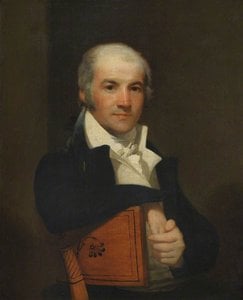
A Portrait of Statesmanship: Gilbert Stuart’s Horatio Gates
Gilbert Stuart's "Horatio Gates," painted in 1793, is more than just a likeness; it’s a carefully constructed embodiment of the ideals and anxieties of early American republicanism. This portrait, rendered in oil on canvas with the meticulous detail characteristic of Stuart’s mature style, offers a glimpse into the life of a man deeply intertwined with the nation's nascent identity – Horatio Gates, a distinguished general who played a pivotal role in the Revolutionary War.
The painting immediately draws the eye to Gates himself. He is depicted in a commanding three-quarter pose, his gaze direct and resolute. The lighting, expertly employed by Stuart, sculpts his features, highlighting the strength of his jawline and the intelligence in his eyes. His attire – a dark military coat adorned with the subtle embellishments of rank, a crisp white shirt beneath, and a vibrant blue sash – speaks volumes about his service and status within the newly formed United States Army. Crucially, a gold medal rests prominently around his neck, a tangible symbol of recognition for his bravery and leadership during the war, particularly at Saratoga – an event that secured crucial French support for the American cause.
Neoclassical Precision and Stuart’s Signature Style
Stylistically, “Horatio Gates” firmly places itself within the Neoclassical tradition, a movement deeply influenced by classical Greek and Roman art. This is evident in the carefully balanced composition, the restrained palette dominated by deep browns, blues, and whites, and the emphasis on idealized form. However, Stuart’s genius lies not simply in replicating classical ideals but in imbuing them with an distinctly American sensibility. He avoids overt theatricality, opting instead for a dignified and understated elegance that reflects the values of republican virtue.
The brushwork itself is remarkably refined – a hallmark of Stuart's later career. Notice the subtle gradations of tone, particularly in the rendering of Gates’ clothing and the folds of his coat. This meticulous attention to detail speaks to Stuart’s dedication to capturing not just the outward appearance but also the very essence of his subject. The background, deliberately dark and indistinct, serves to further emphasize Gates as the focal point, creating a sense of importance and gravitas.
Symbolism and the Ideals of Republican Virtue
Beyond its technical brilliance, “Horatio Gates” is rich in symbolic meaning. The military attire, naturally, represents his service and sacrifice for the nation. However, it’s the medal that carries the most potent message – a testament to his commitment to republican virtue and the ideals upon which America was founded. The choice of a gold medal, a symbol of honor and distinction, underscores the importance Stuart placed on recognizing those who upheld these values during a critical period in American history.
Furthermore, Gates’ posture and gaze convey a sense of quiet authority and unwavering resolve. He embodies the stoic ideal of the republican citizen – a man dedicated to public service and committed to upholding the principles of liberty and self-governance. The painting, therefore, functions as a visual manifesto for the nascent American republic, projecting an image of strength, integrity, and patriotic devotion.
A Legacy of Portraiture and American Identity
Gilbert Stuart’s “Horatio Gates” remains a significant work in the history of American portraiture. It exemplifies his mastery of technique, his ability to capture both physical likeness and psychological depth, and his profound understanding of the symbolic power of art. Reproductions of this iconic painting continue to resonate with viewers today, offering a tangible connection to a pivotal moment in American history – a time when the ideals of republicanism were being forged and enshrined.
Whether displayed as a centerpiece in a grand hall or incorporated into a carefully curated interior design scheme, “Horatio Gates” serves as a powerful reminder of the enduring legacy of Gilbert Stuart and his profound contribution to the visual representation of American identity.
Frågor och svar
Vilken storlek bör jag välja för tryck av "Horatio Gates" till mitt rum?
I ett Living Room rekommenderas "Horatio Gates" i tryckstorleken Large.
Tillhör "Horatio Gates" av Gilbert Stuart de mest eftertraktade verken inom Neoclassical Portraiture?
"Horatio Gates" av Gilbert Stuart klassificeras som Iconic och tillhör Neoclassical Portraiture-rörelsen.
Hur möts epok och stil i "Horatio Gates" av Gilbert Stuart?
"Horatio Gates" tillhör den Neoclassical Portraiture rörelsen, och dess skapare verkade under Tidig modern tid-eran.



 Visa i rummet
 Byt till tryckta exemplar
 Skicka
 Dela
Dela
 Detaljer
 Studentguide för konstverk

 Ladda ner
 Liknande objekt
 Röntgen
 Bildspel
 Besökstatistik


 Läs mer






































 Glasalternativet är endast tillgängligt i storlekar under 110 cm.