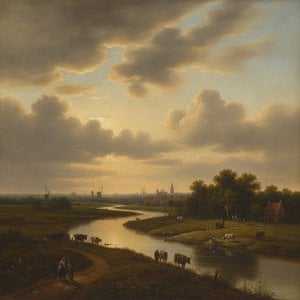
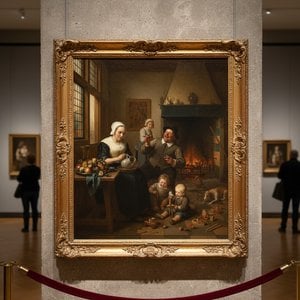
Gabriel Metsu: En Skymning från Det Dutcha Gyllene Ålders Själ
Gabriel Metsu, en gestalt som ofta förblir i skuggorna av sina mer framträdande kollegor, var en sann innovatör inom det dutchka gyllene ålders konst. Född 1629 i Leiden, Nederländerna, representerade Metsu en unik och komplex stil – en eklektisk blandning av traditionella och moderna element som gjorde honom till en fascinerande figur i sin tid. Hans liv var inte präglat av stora monumentala verk utan snarare av en djupgående utforskning av vardagslivet, ett intresse som genomsyrade hans konst och gav den en sällsynt intimitet. Metsu växte upp i en familj där konsten hade rötter – hans far, Jacques Metsue, var en mångsidig hantverkare och målare med anor från Hainaut, vilket förmodligen bidrog till Gabriel’s tidiga intresse för olika konstnärliga tekniker. Denna kulturella bakgrund, kombinerat med den Leiden-inspirerade atmosfären, formade hans konstnärliga syn.
En Konstnär i Kontrast: Stil och Teknik
Metsu var känd för sin brist på en fast stilistisk identitet. Han behärskade en rad olika genrer – historiafoton, stillivspainteringar, porträtt och genrebilder – men undvek att helt identifiera sig med någon specifik trend. Detta gjorde honom till en ”högt eklektisk konstnär”, som ofta beskrivs. Hans verk kännetecknas av en subtil realism, en noggrannhet i detaljerna och en förmåga att fånga ögonblick av vardagslivet på ett sätt som är både gripande och intimt. Trots att endast 14 av hans anslagsvis 133 verk är daterade, vittnar de om en konstnärlig utveckling som var lika fascinerande som den var svårfångad. En stark influens från Rembrandt van Rijn är tydligt synlig i Metsu’s tidiga arbete, särskilt i hans användning av ljus och färg – Rembrandts dramatiska kontraster och skuggor speglas i Metsu’s verk. Efter sin flytt till Amsterdam 1655 förändrades hans stil markant, med en ökad fokus på inre miljöer och genrescener som fångade den vardagliga verkligheten i staden. Hans roll som mentor för målarna Michiel van Musscher och Joost van Geel understryker hans engagemang för den konstnärliga gemenskapen i Leiden.
Porträtt av Ett Liv: Teman och Symbolik
Metsu’s konst var ofta fylld med teman som speglade de sociala och kulturella normerna i sin tid. Han skildrade frekvent unga kvinnor, marknadsplatser och äldre personer – motiv som ofta innehöll symboliska element. Ett exempel är ”Poultry Seller” (Kycklingsäljaren), där detaljerna i utseendet och miljön bär på en djupare mening. Metsu var en skicklig användare av emblem, alltså bilder som representerar moraliska eller filosofiska principer. Hans verk är inte bara representationer av verkligheten utan också komplexa budskap om livets förgänglighet, skönhet och moral. Porträttet ”Portrait of the Hinlopen Family” (Porträtt över familjen Hinlopen) är ett utmärkt exempel på hans förmåga att blanda genre- och porträttmålning till en harmonisk helhet.
Metsu’s Arv: Museer och Utställningar
Gabriel Metsu’s verk finns idag representerade i flera prestigefyllda museer, inklusive Rijksmuseum i Amsterdam. Hans konst fortsätter att fascinera besökare och forskare med sin subtila skönhet och komplexa symbolik. För de som vill utforska hans arbete ytterligare kan man besöka National Gallery of Art i Washington D.C., där en omfattande samling av hans verk finns tillgängliga för visning. Genom att studera Metsu’s konst får vi en djupare inblick i det dutchka gyllene ålders mångfald och dess konstnärliga innovationer. Hans bidrag till den europeiska konsten är fortfarande relevant idag, och hans verk fortsätter att inspirera och beröra oss med sin sällsynta förmåga att fånga ögonblick av mänskligt liv.
Referenser



 Visa i rummet
 Köp handmålat konstverk
 Skicka
 Dela
Dela
 Detaljer
 Studentguide för konstverk

 Ladda ner
 Liknande objekt
 Röntgen
 Bildspel
 Besökstatistik

 Läs mer






































 Glasalternativet är endast tillgängligt i storlekar under 110 cm.