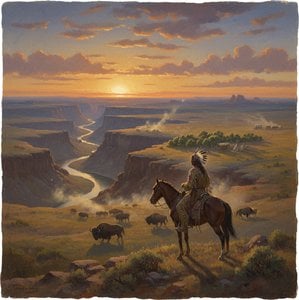
A Lone Figure Against the Vastness: Frederic Remington’s “Ridden Down”
Frederic Remington's "Ridden Down," painted in 1905, isn’t merely a depiction of cowboys and horses; it’s a profound meditation on solitude, resilience, and the enduring spirit of the American West. This oil-on-canvas masterpiece, currently residing within the Amon Carter Museum of American Art in Fort Worth, Texas, captures a pivotal moment – a lone Native American rider silhouetted against an expansive, undulating sand dune landscape under a brilliant, cloudless sky. Remington, a master of portraying the frontier, expertly blends realism with an impressionistic sensibility, creating an image that simultaneously feels immediate and deeply symbolic.
The painting’s composition immediately draws the eye to the central figures: a man, clad in a simple green shirt, riding a powerful mustang. The horse is positioned behind him, its head lowered as if acknowledging the immensity of the terrain. Remington skillfully employs horizontal lines created by the towering sand dunes, which dominate the scene and establish a sense of overwhelming scale. These sweeping forms contrast sharply with the verticality of the rider and horse, emphasizing their vulnerability against the backdrop of nature’s grandeur. Two birds soar high above, adding a touch of fleeting beauty to this otherwise stark landscape – perhaps representing freedom or a distant hope.
The Brushstroke and Palette: A Window into Remington's Technique
Remington’s technique is immediately recognizable—bold, expressive brushstrokes that convey both the physicality of the scene and an underlying sense of movement. He doesn’t shy away from visible texture; the sand dunes are rendered with a rough, grainy quality, while the horse’s coat appears almost sculpted by the artist's hand. The color palette is dominated by warm yellows and ochres, reflecting the sun-baked earth and creating a feeling of intense heat. Cool blues in the sky provide a striking contrast, highlighting the vastness of the space and adding depth to the composition. Remington masterfully uses light and shadow to sculpt the forms, lending them a remarkable three-dimensionality.
The painting’s dynamic energy is further enhanced by his use of color—a vibrant, almost feverish application that captures the intensity of the desert environment. Notice how he subtly shifts tones within the sand dunes, suggesting variations in texture and depth. This attention to detail, combined with his confident brushwork, elevates “Ridden Down” beyond a simple landscape painting; it becomes a visceral experience for the viewer.
Symbolism and Context: A Portrait of the West
"Ridden Down" is more than just a visual record of the American West; it’s imbued with layers of symbolic meaning. The lone rider, often interpreted as a Native American figure, embodies themes of survival, adaptation, and resilience in the face of an increasingly encroaching civilization. The posture of the horse—lowered head, steady gait—suggests both respect for the land and a quiet determination to endure. Considering Remington’s own career, which coincided with a period of significant change and displacement for Native American communities, the painting can be viewed as a poignant commentary on this historical context.
Painted in 1905, “Ridden Down” reflects the waning days of the frontier era. Remington’s work often depicted scenes of cowboys, Indians, and the wild west—a romanticized vision that captured the imagination of a nation eager to define its identity. However, it's important to note that Remington’s portrayal was not without its complexities; he sometimes perpetuated stereotypes while simultaneously capturing the raw beauty and inherent drama of the West. The painting stands as a testament to his skill as an artist and a valuable window into a transformative period in American history.
A Legacy of Western Art: Exploring “Ridden Down” Further
To delve deeper into Frederic Remington’s artistic legacy, consider examining "The Wounded Buffalo," another iconic work showcasing his mastery of capturing the spirit of the West. You can explore more of his paintings and writings at WahooArt.com, where you'll find a curated selection of his most celebrated works. For further insights into Remington’s life and career, visit the Amon Carter Museum of American Art (here) or explore his biography on Wikipedia (here). And for a visual journey through the world of Frederic Remington, be sure to visit this page.
Frågor och svar
Hur förhåller sig motivet i "Ridden Down" till Frederic Remingtons vanliga teman?
Bland Frederic Remingtons dokumenterade teman – western expansion influence, native american culture", frontier life depiction, military & exploration, remington's iconic style, american identity theme, landscapes & human scale, key work in artist corpus – har "Ridden Down" ett eget fokus på american west, native american, horseback riding, desert landscape, remington art, western theme, lone figure, dynamic scene”.
Vilket nationellt ursprung ligger bakom American Regionalism” i "Ridden Down"?
"Ridden Down" skapades av Frederic Remington, född i USA, inom American Regionalism”-rörelsen. Konstnärens ursprung knyter verket till American Regionalism” så som det utövades av konstnärer från USA.
Vem är upphovspersonen till "Ridden Down" och vilket år skapades verket?
"Ridden Down" skapades av Frederic Remington år 1905.
Vilket rum rekommenderas för "Ridden Down" av Frederic Remington?
"Ridden Down" av Frederic Remington rekommenderas för ett Living Room. Detta förslag baseras på verkets motiv, färger och stämning.
Vad är luminansen i "Ridden Down" av Frederic Remington?
Färgerna i "Ridden Down" uppvisar en Luminous luminans.
Vem har skapat "Ridden Down" och i vilken stil är den utförd?
Bakom "Ridden Down" står Frederic Remington och American Regionalism”-rörelsen.
Under vilket år och inom vilken stil skapades "Ridden Down"?
"Ridden Down" skapades år 1905 som ett verk inom American Regionalism”-rörelsen. Datum och stil placerar konstverket i sin rätta plats i konsthistorien.
Är "Ridden Down" av Frederic Remington fri från upphovsrätt?
Upphovsrättslig status för "Ridden Down" av Frederic Remington: verket är allmän egendom – upphovsrätten har löpt ut. Detta avgör om reproduktioner av bilden får framställas fritt.



 Visa i rummet
 Köp handmålat konstverk
 Skicka
 Dela
Dela
 Detaljer
 Studentguide för konstverk

 Ladda ner
 Liknande objekt
 Röntgen
 Bildspel
 Besökstatistik


 Läs mer






































 Glasalternativet är endast tillgängligt i storlekar under 110 cm.