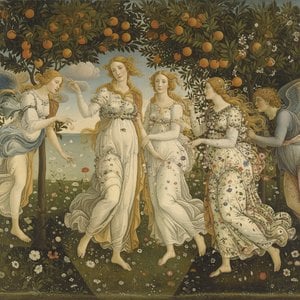
The Divine Deluge: A Renaissance Masterpiece in Ceramic Form
Behold this breathtaking circular panel, a testament to the dazzling artistry of Renaissance maiolica. Dating from 1537, this work captures one of history's most dramatic biblical narratives: the catastrophic drowning of Pharaoh’s army. The sheer energy contained within its glazed surface is palpable; it is not merely an illustration, but a moment frozen in time—a divine judgment rendered with breathtaking technical skill. One can almost hear the roar of the floodwaters and feel the panic echoing across the depicted scene.
A Symphony of Color and Composition
The visual impact of this piece is immediate and overwhelming. The palette explodes with the richness characteristic of Italian Renaissance ceramics—deep, vibrant blues battling against fiery reds, accented by shimmering golds and earthy greens. The composition itself is a masterclass in narrative arrangement. The artist has skillfully divided the circular space into distinct zones: the chaotic struggle in the foreground, the central maelstrom engulfing the enemy in the middle ground, and the stylized permanence of the background architecture. While the perspective retains that characteristic slight flattening typical of maiolica—a choice that elevates decoration over strict realism—the depth is suggested through masterful layering and scale variation, drawing the viewer inexorably into the heart of the biblical drama.
Technique and the Hand of Francesco Xanto Avelli
This work speaks volumes about the technical prowess of its creator, Francesco Xanto Avelli. As a leading figure in Urbino’s ceramic tradition, Avelli employed the intricate process of maiolica painting. This technique involves meticulously applying colored glazes over fired clay bodies, allowing for complex color blending and modeling that mimics depth while retaining the inherent smoothness of the ceramic medium. The precision required to define every struggling figure, overturned boat, and architectural detail speaks to an almost obsessive dedication to craft. It is a dialogue between the permanence of fired earth and the fleeting drama of human fate.
Symbolism and Enduring Resonance
Beyond its stunning aesthetics lies profound symbolic weight. The entire scene functions as a powerful allegory: the flood represents divine cleansing, while the radiant sun piercing the chaos serves as an unmistakable symbol of God’s omnipotence. For the modern collector or designer, this piece offers more than mere ornamentation; it is a contemplation on power, consequence, and salvation. Its enduring appeal lies in its ability to transform a historical religious narrative into a vibrant, emotionally charged focal point for any grand interior space.
Bringing Renaissance Drama Home
To own a reproduction of this plate is to invite a piece of Italian artistic history into your home. It serves as an unparalleled conversation starter, appealing equally to the connoisseur who appreciates Avelli’s technical genius and the decorator seeking a dramatic, culturally rich accent piece. The combination of its vibrant color story and its deep narrative resonance ensures that it will not merely hang on a wall or sit upon a mantelpiece; it will command attention and inspire contemplation.



 Byt till tryckta exemplar
 Skicka
 Dela
Dela
 Detaljer
 Guide
Guide

 Ladda ner
 Liknande objekt
 Bildspel
 Besökstatistik


 Läs mer






































 Glasalternativet är endast tillgängligt i storlekar under 110 cm.