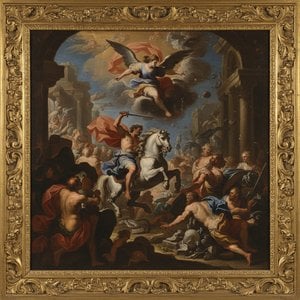
Early Life and Artistic Beginnings
Charles Le Brun’s story begins in the vibrant heart of Paris, a city brimming with artistic ambition and royal patronage. Born in 1619, he wasn't simply born into an artistic family; it was as if the creative spirit flowed through his very veins from the start. Even at just eleven years old, young Charles displayed a remarkable talent for drawing, quickly catching the eye of Simon Vouet, one of the most celebrated painters of his time and a leading figure in the burgeoning French art scene. Vouet, himself a master of the emerging Baroque style, took Le Brun under his wing, providing him with invaluable training and introducing him to the influential circles of Parisian society. This early mentorship was crucial, laying the foundation for Le Brun’s future success.
However, Le Brun's artistic journey didn’t stop there. He continued his studies under François Perrier, another respected artist in Paris, further honing his skills and expanding his knowledge. But it was a pivotal four-year sojourn to Rome between 1642 and 1646 that truly shaped his artistic development. This period marked a profound turning point, exposing him to the grandeur of ancient Roman sculpture and the innovative techniques of contemporary Italian masters like Raphael. He immersed himself in the classical world, meticulously studying its forms and principles, absorbing influences from both antiquity and the vibrant artistic landscape of Renaissance Italy. It was during this time that Le Brun began to develop his distinctive style – a harmonious blend of Baroque dynamism and classical restraint.
A Style Forged in Rome and Paris
Returning to Paris in 1646, Charles Le Brun swiftly established himself as a rising star within the artistic community. His early works reflected the stylistic influences he’d absorbed in Rome – the elegance of Vouet and the intellectual depth of Poussin. Yet, he wasn't merely a mimic; he began to forge his own unique voice, gradually moving away from strict adherence to classical models towards a more dynamic and expressive Baroque style. This evolution was marked by an increasing emphasis on dramatic composition, rich color palettes, and meticulous detail – hallmarks that would become synonymous with his name.
Le Brun’s artistic development wasn't confined solely to technical skill; it also involved a growing understanding of the theoretical underpinnings of art. He meticulously studied the works of Raphael, absorbing his compositional techniques and striving to emulate his mastery of perspective and form. This dedication to both technique and theory would later inform his role as a leading art theorist in France.
Royal Patronage and Architectural Grandeur
The mid-17th century witnessed a dramatic shift in Le Brun’s career, propelled by the ascendancy of Louis XIV – the “Sun King” – to the throne. Recognizing Le Brun's exceptional talent and organizational abilities, the king appointed him as First Painter to the King in 1664, a position that granted him unparalleled influence over French art. This appointment wasn’t merely a title; it was a testament to his artistic merit and a symbol of royal favor.
Le Brun's role extended far beyond simply painting portraits. He became deeply involved in the decoration of some of France’s most iconic landmarks, including the Palace of Versailles. His contributions were breathtakingly ambitious – he oversaw the creation of the magnificent Ambassadors’ Staircase (1674-78), the opulent Hall of Mirrors (1678-86), and the serene Peace and War Rooms, transforming these spaces into symbols of royal power and artistic splendor. These projects weren't just decorative; they were carefully orchestrated statements about Louis XIV’s reign and the glory of France.
Beyond Versailles, Le Brun’s influence extended to other significant structures, including Vaux-le-Vicomte, a lavish chateau he designed and decorated, showcasing his versatility as an architect and designer. His work at these locations demonstrated not only artistic skill but also masterful planning and organizational capabilities.
The Shaping of French Artistic Orthodoxy
Le Brun’s influence extended beyond the creation of individual artworks; he played a crucial role in shaping the very standards of French art during the reign of Louis XIV. He established the Académie Royale de Peinture et de Sculpture in 1648, transforming it into a powerful institution that served as both a training ground for young artists and a gatekeeper of artistic orthodoxy. The Academy’s curriculum, heavily influenced by Le Brun's theories on classical composition, dictated what was considered acceptable – and unacceptable – in French art.
Le Brun’s theoretical writings, particularly his *Méthode pour apprendre à dessiner les passions* (Method for Learning to Draw Passions), became a standard textbook for artists throughout Europe. His emphasis on the intellectual basis of artistic expression—the idea that painting should evoke emotion and thought rather than simply delight the eye—had a lasting impact on art education and artistic practice. His approach, rooted in classical principles, helped solidify a distinct French style characterized by elegance, restraint, and grandeur.
Legacy and Historical Significance
Charles Le Brun’s legacy is one of profound influence and enduring importance. He wasn't merely a painter; he was a pivotal figure in the cultural landscape of 17th-century France. His work helped define the Baroque style in France, establishing him as one of the most significant artists of his era. His role as a theorist and administrator cemented his position as a central force in shaping French artistic identity.
Even today, Le Brun’s contributions are celebrated. The meticulous detail and dramatic compositions of his works continue to captivate viewers, while his influence on subsequent generations of artists is undeniable. He remains a testament to the power of artistic vision, technical skill, and intellectual rigor—a true master of his craft who left an indelible mark on the history of art.



 Visa i rummet
 Byt till tryckta exemplar
 Skicka
 Dela
Dela
 Detaljer
 Guide
Guide

 Ladda ner
 Liknande objekt
 Röntgen
 Bildspel
 Besökstatistik


 Läs mer






































 Glasalternativet är endast tillgängligt i storlekar under 110 cm.