Byt till tryckta exemplar Köp handmålat konstverk Skicka
Detaljer Studentguide för konstverk Lägg till i favoriter Ladda ner Liknande objekt Bildspel Besökstatistik

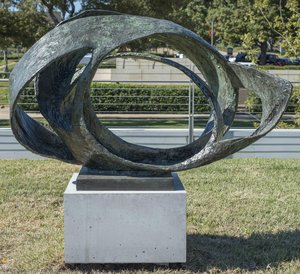
Prototype for Maquette, Three Forms in Echelon

Barbara Hepworth's 'Prototype for Maquette, Three Forms in Echelon' is an iconic abstract sculpture embodying modernism’s elegance and exploration of form & space. Discover its layered composition & artistic significance.

Utforska den moderna skulpturen av Dame Barbara Hepworth (1903–1975). En pionjär inom abstrakt konst, Hepworths verk – inklusive 'Oval Form' & 'Two Forms' – blandar surrealism och abstraktion. Upptäck hennes arv på Hepworth Wakefield.

Köp en högupplöst, förbättrad digital bild med betydligt högre kvalitet än förhandsvisningen online.

Varje fil är noggrant förberedd av våra interna specialister med hjälp av avancerade verktyg och professionell manuell retuschering. Vi säkerställer att varje bild har exceptionell skärpa, exakt färgåtergivning och fina detaljer.

Den slutgiltiga filen levereras via e-post inom 72 timmar, optimerad för omedelbar användning i professionella sammanhang, redaktionellt bruk och tryckmiljöer. Detta är samma kvalitet som med förtroende används av ledande designstudior, förlag och gallerier.

Digital bild

Ladda ner en högupplöst fil för personlig visning, utskrift och kreativa projekt. ( Byt till tryckta exemplar Köp handmålat konstverk)

Totalpris

$ 24,90

Ingår i varje beställning av digital bild

Professionell digital leverans, garanterad

När du väljer WahooArt.com får du inte bara en bild – du får ett professionellt förädlat digitalt konstverk, skapat med precision och med en garanterad tillfredsställelse. Här är allt som ingår i din beställning, automatiskt:

shipping_icon
Snabb leverans via e-post

Din högupplösta digitala bild skickas till dig via e-post inom 72 timmar efter beställning – redo för omedelbar användning.

canvas_icon
AI-förbättrad digital fil

Ditt konstverk optimeras professionellt med hjälp av avancerade AI-verktyg och manuell redigering, vilket garanterar maximal detaljrikedom, skärpa och färgnoggrannhet.

insurance_icon
Gratis livstidsåterutskick

Har du råkat radera eller tappa bort din fil? Ingen oro – vi skickar den kostnadsfritt till dig när som helst.

tax_icon
Inga importavgifter – någonsin

Njut av ditt konstverk omedelbart utan tull, importavgifter eller leveranskostnader – digitala nedladdningar är alltid skattefria.

color_icon
Garanterad färgåtergivning

Vi säkerställer att din digitala bild återger de ursprungliga färgerna så exakt som möjligt med hjälp av professionella verktyg och färghantering.

return_icon
100 dagars nöjdhetsgaranti

Om du inte är nöjd med din digitala bild kommer vi att revidera den eller återbetala 100% inom 100 dagar – utan frågor.

guarantee_icon
100% pengarna-tillbaka-garanti

Inte nöjd? Få full återbetalning inom 100 dagar efter att du mottagit din digitala fil – utan frågor.

discount_icon
Rabatt vid storköp

Köp 3 bilder, spara 10% – Köp 5, spara 15% – Köp 10+, spara 20%. Perfekt för kreativa projekt, gallerier och byråer.

Snabbfakta

  • Subject or theme: Organic shapes, balance
  • Location: Tate St Ives
  • Notable elements: Echelon arrangement, curved forms
  • Movement: Modernism
  • Artist: Barbara Hepworth
  • Influences: Abstraction-Création
  • Medium: Wood/Stone Sculpture

Konstquiz

Det finns endast ett korrekt svar på varje fråga.

Fråga 1:
What is the primary material used in Barbara Hepworth’s sculpture, ‘Prototype for Maquette, Three Forms in Echelon’?
Fråga 2:
The sculpture's arrangement follows which compositional principle?
Fråga 3:
What artistic movement is Barbara Hepworth most closely associated with?
Fråga 4:
The photograph’s lighting appears to be...
Fråga 5:
Based on the description, what is a possible symbolic interpretation of the sculpture’s forms?

A Sculptural Meditation on Form and Space

Barbara Hepworth’s “Prototype for Maquette, Three Forms in Echelon,” a deceptively simple yet profoundly resonant sculpture, stands as a testament to the artist's pioneering approach to modern abstraction. Created in 1961 during a period of intense experimentation and exploration within her studio at St Ives, Cornwall, this piece isn’t merely a collection of shapes; it’s an invitation to contemplate the relationship between form, space, and the inherent qualities of materials – specifically, the cool, tactile embrace of stone or wood.

The sculpture presents three distinct, organically curved forms arranged vertically on a stark white background. These aren't representational figures; instead, they embody an elemental language, suggesting echoes of natural forms—waves, rocks, or perhaps even the contours of the human body—without ever explicitly depicting them. The arrangement follows an echelon pattern, each form subtly offset from the one below, creating a dynamic sense of upward movement and spatial depth. This deliberate asymmetry is key to Hepworth’s aesthetic; she sought to disrupt traditional notions of balance and harmony, favoring instead a more intuitive and expressive approach.

Materiality and Technique: A Dance Between Hand and Stone

Hepworth's process was deeply rooted in the materiality of her chosen medium. She rarely used preparatory sketches, preferring to work directly from intuition and feeling, allowing the stone or wood to guide the form. The “Prototype” itself is a crucial stage in this process – a preliminary model intended to refine the composition and explore the interplay of light and shadow before committing to a larger-scale version. The matte texture of the sculpture, achieved through careful carving and polishing, invites tactile engagement; one can almost feel the cool smoothness of the stone beneath their fingertips.

Her technique involved a subtractive approach – carefully removing material to reveal the underlying form—combined with an understanding of how light interacts with different surfaces. The subtle tonal shifts within the sculpture’s surface, achieved through meticulous polishing and manipulation of the grain, create a sense of depth and volume, drawing the eye upwards and inviting contemplation. The stark white background serves not as a distraction but as a crucial element in highlighting the forms' inherent qualities, emphasizing their purity and simplicity.

Symbolism and Emotional Resonance

Hepworth’s work consistently explores themes of human connection to nature and the inner self. These three abstract forms can be interpreted as representing interconnectedness—a visual metaphor for the flow of life forces or perhaps a meditation on the fundamental building blocks of existence. The vertical arrangement evokes a sense of aspiration, reaching towards something beyond the immediate, while the subtle curves suggest fluidity and movement.

Considering Hepworth’s broader body of work, this “Prototype” shares affinities with her earlier explorations of ‘Form and Function,’ where she sought to create sculptures that were both aesthetically pleasing and responsive to their environment. It's a piece that speaks to the enduring power of abstraction—its ability to evoke profound emotions and ideas through purely visual means. The sculpture’s quiet intensity invites viewers to engage in a personal dialogue with its forms, prompting reflection on the nature of beauty, space, and our relationship to the world around us.

Further Exploration


Konstnärsbiografi

Barbara Hepworth: Pioneer of Abstract Sculpture

Barbara Hepworth (1903–1975) stands as one of the most influential figures in twentieth-century British art, recognized for her groundbreaking contributions to modern sculpture and her unwavering dedication to exploring the relationship between form and space. Born Jocelyn Barbara Hepworth in Wakefield, Yorkshire, she possessed an innate fascination with natural forms—particularly pebbles and seashells—which would profoundly shape her artistic vision throughout her prolific career. Her formative years were marked by a deep connection to the rugged landscape of West Yorkshire, fostering a sensitivity for texture and materiality that would become central to her sculptural practice.
  • Early Influences: Hepworth’s artistic journey began with studies at Leeds School of Art in 1920, where she encountered Henry Moore, establishing a collaborative spirit that would endure throughout their lives. This formative period instilled in her an appreciation for geometric abstraction and the exploration of fundamental visual principles.
  • Royal College of Art & Surrealism: Continuing her education at the Royal College of Art from 1921 until she graduated in 1924, Hepworth embraced the burgeoning avant-garde movement of Surrealism, collaborating with Ben Nicholson and Paul Nash. This exposure to surrealist ideas fueled her experimentation with unconventional materials and techniques.

The Unit One Movement & Early Sculptural Innovations

Hepworth’s artistic breakthrough arrived in 1933 with the formation of Unit One, alongside Nicholson, Nash, and others—a collective dedicated to uniting Surrealism and abstraction. This movement championed a radical departure from representational art, prioritizing pure form and exploring its inherent dynamism. Hepworth's early sculptures – notably *Oval Form* (Trezion) – exemplify this aesthetic ethos, characterized by smooth surfaces and subtly curving shapes that defy easy categorization.
  • Material Exploration: Hepworth’s mastery lay in her ability to transform raw materials—primarily stone and bronze—into evocative forms. She meticulously honed her craft, mastering techniques of carving and casting to achieve unparalleled precision and expressive power.
  • Influence of Moore & Nicholson: Hepworth's artistic dialogue with Henry Moore and Ben Nicholson proved invaluable in shaping her aesthetic sensibilities. Their shared commitment to exploring the interplay between organic and geometric forms propelled her creative endeavors forward.

Mature Style & Monumental Commissions

Throughout the 1940s and 1950s, Hepworth’s sculptural output intensified, reflecting a deepening engagement with both landscape and human figure. Her distinctive style—characterized by concentric circles and voids—became synonymous with modern sculpture.
  • Landscape as Inspiration: Hepworth drew inspiration from the Yorkshire countryside, translating its contours and textures into monumental sculptures that captured the essence of natural forms. Pieces like *Two Forms* and *Totem* stand as testament to her ability to convey profound emotional resonance.
  • Public Recognition & Legacy: Hepworth’s work garnered international acclaim, securing prestigious commissions—including Winged Figure for John Lewis—and cementing her place among the foremost sculptors of her time. Her enduring influence continues to inspire artists today.

The Hepworth Wakefield & Continuing Artistic Exploration

Today, Barbara Hepworth’s legacy resides prominently at The Hepworth Wakefield, where a comprehensive collection showcases her oeuvre—spanning from early explorations of abstraction to monumental sculptures that redefine the boundaries of artistic expression.
  • A Singular Vision: Hepworth's unwavering dedication to exploring form and space—coupled with her profound sensitivity for materials—established her as an unparalleled innovator in modern sculpture. Her work remains a beacon of creativity, inviting viewers to contemplate the fundamental questions of art and existence.
Barbara Hepworth

Barbara Hepworth

1903 - 1975 , Storbritannien

Kortfattad info

  • Artistic Movement Or Style: Modernism
  • Artists Or Movements Influenced By This Artist: ['Abstraction']
  • Artists Who Influenced This Artist: ['Henry Moore']
  • Date Of Birth: 10 januari 1903
  • Full Name: Barbara Hepworth
  • Nationality: Brittisk
  • Notable Artworks:
    • Oval Form
    • Two Forms
    • Totem
  • Place Of Birth: Wakefield, England