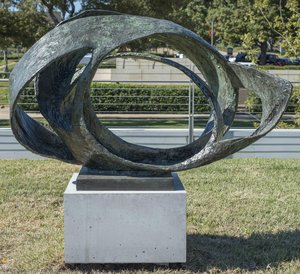
Involute II: A Dance of Form and Void – An Exploration of Barbara Hepworth’s Sculptural Vision
Dame Barbara Hepworth's "Involute II," created in 1956, is more than just a sculpture; it’s an invitation to contemplate the relationship between form, space, and the very essence of human experience. This remarkable piece, crafted primarily from bronze – though hints of its earlier plaster origins remain – embodies Hepworth's signature style: a profound exploration of abstraction rooted in organic forms and a deep connection to the natural world. The work’s genesis lies within a period of intense creative evolution for Hepworth, following her relocation to St Ives, Cornwall, where she found an unparalleled environment for artistic inspiration.
The title itself, "Involute," derived from a geometric term describing a spiral curve, immediately suggests a dynamic movement – a sense of continuous unfolding and returning. Hepworth masterfully translates this mathematical concept into a tangible form. The sculpture presents a large, rounded ball, pierced through with a central aperture. This hole isn’t merely an absence; it's a crucial element that fundamentally alters our perception of the object. It creates a visual dialogue between the solid exterior and the implied emptiness within, inviting us to consider the interplay of volume and void – a core principle in Hepworth’s oeuvre.
The Language of Form: Materiality and Technique
Hepworth's technique was revolutionary for her time. She didn’t simply carve stone or wood; she worked directly with metal, employing methods akin to sculpting clay. She began by creating a series of thin sheets of bronze, manipulating them with files and abrasives until they achieved the desired texture – a surface that felt both smooth and subtly rough, reflecting light in unexpected ways. This process, documented extensively in her studio, allowed her to imbue the metal with an almost tactile quality, as if inviting the viewer to reach out and trace its contours.
The choice of bronze itself is significant. Bronze possesses a remarkable ability to capture detail while simultaneously conveying a sense of weight and solidity. It’s a material that can both suggest movement and evoke stillness – qualities perfectly embodied in "Involute II." The subtle variations in color within the patina—ranging from deep browns to hints of green—further enhance this effect, adding layers of visual complexity.
Symbolism and Emotional Resonance
"Involute II" is not simply a geometric form; it’s imbued with symbolic meaning. Hepworth herself described her work as a dialogue between form and space, reflecting a deep interest in the human condition. The pierced aperture can be interpreted as representing an opening to the unknown, a portal through which we might access deeper levels of consciousness or experience. It speaks to themes of vulnerability, transformation, and the inherent tension between containment and release.
Furthermore, the spiral form itself carries powerful associations with growth, evolution, and the cyclical nature of life. It echoes the patterns found in seashells, galaxies, and even the human body – connecting the sculpture to a broader sense of universal order. The work’s emotional impact is profound; it evokes feelings of serenity, contemplation, and a subtle sense of mystery.
A Legacy of Modern Sculpture
Barbara Hepworth's "Involute II" stands as a testament to her pioneering spirit and her enduring influence on modern sculpture. Her work continues to resonate with viewers today, challenging us to reconsider our assumptions about form, space, and the relationship between art and experience. Reproductions of this iconic piece offer an exceptional opportunity to bring Hepworth’s visionary aesthetic into your home or office – a chance to engage with a truly remarkable work of art that transcends time and speaks directly to the human soul.
Frågor och svar
Är "Involute II" av Barbara Hepworth en målning, en teckning eller ett tryck?
"Involute II" av Barbara Hepworth är klassificerat som Skulptur. Kategorin beskriver vilken typ av konstverk originalet är.
Vilken fas i Barbara Hepworths karriär tillhör "Involute II" (1956)?
Årtalet 1956 placerar "Involute II" i Mid-Century Modern av Barbara Hepworths konstnärliga utveckling.
Vilken period av Barbara Hepworths karriär tillhör "Involute II"?
"Involute II" tillhör Barbara Hepworths Mid-Century Modern i konstnärskarriären. Denna klassificering relaterar verket till konstnärens utveckling.



 Beställ handmålad reproduktion
 Skicka
 Dela
Dela
 Visa detaljer
 Guide
Guide

 Ladda ner
 Liknande objekt
 Bildspel
 Statistik


 Visa mer






































 Glasalternativet är endast tillgängligt i storlekar under 110 cm.