The Visionary Spirit of Andrej Barčík
Andrej Barčík (1928 – 2004) stands as a pivotal figure in the artistic landscape of Slovakia, embodying the spirit of late modernism with his distinctive blend of observation and experimentation. Born in Zavrie, Slovakia, Barčík’s journey into art began formally at the Prague School, where he honed his skills and absorbed influences from European avant-garde movements—a formative experience that would profoundly shape his artistic vision. His upbringing instilled a deep appreciation for Slovak folklore and tradition alongside an eagerness to engage with broader artistic dialogues, creating a dual influence rooted in heritage and propelled by intellectual curiosity.
His studies in Prague provided him with invaluable technical training, equipping him with the tools necessary to translate conceptual ideas into compelling visual representations. This foundation allowed Barčík to develop a practice that encompassed a remarkable range of mediums, demonstrating both versatility and adaptability. He excelled in drawing, painting, collage, and graphic art, often combining techniques to achieve layered textures and expressive effects. His approach was never merely about mastering individual skills; it was about harnessing their synergistic potential to convey complex emotions and narratives through the canvas.
Technique and the Language of Texture
A defining characteristic of Barčík’s oeuvre is his mastery of texture, particularly his preference for impasto. By applying paint in thick, palpable layers, he created surfaces that invited tactile engagement, capturing the very dynamism of his subjects. This heavy application of medium allowed him to bridge the gap between the physical world and abstract emotion. In works such as "A Young Woman," one can observe how thick impasto and expressive brushstrokes evoke a sense of profound introspection, transforming a portrait into an abstract expressionist study of muted tones and light.
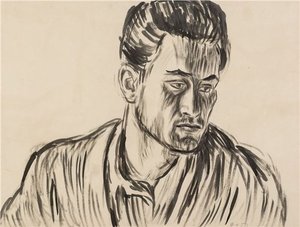
His technical repertoire also extended into the delicate realm of line and form. In his black and white drawings, such as the striking "Sitting Nude from the Back," Barčík demonstrated a timeless ability to study the human form with meticulous detail. These works showcase a different facet of his talent—one of restraint and elegance, where the absence of color allows the structural beauty of the figure to command the viewer's attention, highlighting his role as a significant contributor to Slovak modern art.
A Legacy of Tradition and Innovation
Barčík’s artistic output is characterized by a captivating juxtaposition of realism and abstraction. He possessed a unique ability to navigate between the serene beauty of the natural world and the complexities of human vulnerability. His landscapes, such as "Landscape with a Tracer," serve as a poignant connection to his roots, offering a captivating naive folk painting of rural Slovakia. Through stylized forms and subtle symbolism, he captured the essence of the Slovak countryside, imbuing the landscape with a sense of quiet mythos.
Throughout his career, Barčík remained a bridge between eras. His significance lies in his ability to honor the traditions of his homeland while pushing toward the frontiers of modern experimentation. The major themes of his work include:
- The Human Condition: Exploring vulnerability and contemplation through evocative nude studies.
- Cultural Heritage: Integrating Slovak folklore and rural landscapes into a modern aesthetic.
- Materiality: Using heavy textures and diverse mediums to create depth and emotional resonance.
- Abstract Expressionism: Utilizing expressive brushwork to move beyond mere representation into the realm of pure emotion.
Ultimately, the legacy of Andrej Barčík is one of profound artistic synthesis. He remains a celebrated figure whose work continues to resonate with those seeking the intersection of historical tradition and the bold, transformative power of modern art.



 Visa i rummet
 Byt till tryckta exemplar
 Skicka
 Dela
Dela
 Detaljer
 Guide
Guide

 Ladda ner
 Liknande objekt
 Röntgen
 Bildspel
 Besökstatistik


 Läs mer






































 Glasalternativet är endast tillgängligt i storlekar under 110 cm.