The Silent Sculptor of Utrecht
In the golden twilight of the Dutch seventeenth century, amidst the bustling workshops of Utrecht, lived a master whose hands shaped both the boundaries of art and the figures within them. Ambrosius van Swol (c. 1640 – 1680) remains a figure shrouded in a certain poetic obscurity, a name whispered alongside the giants of his era like Rembrandt and Vermeer, yet possessing a distinct, tactile legacy. While history often favors the sweeping narratives of painters, Van Swol carved a niche for himself through a dual mastery of the frame and the form. His early documented career, beginning around 1643, reveals an artist deeply embedded in the visual fabric of his city, serving as both a meticulous frame maker and a sculptor of profound anatomical insight.
To understand Van Swol is to understand the importance of the threshold. In his early years, he was renowned for crafting ornate frames that were far more than mere borders; they were essential extensions of the masterpieces they held. These gilded and carved enclosures were designed with a sophisticated grasp of optics, intended to enhance the luminosity and color palettes of the era's great paintings. Through this work, Van Swol developed an intimate relationship with light and shadow, a sensitivity that would later breathe life into his three-dimensional creations.
A Mastery of Form and Drama
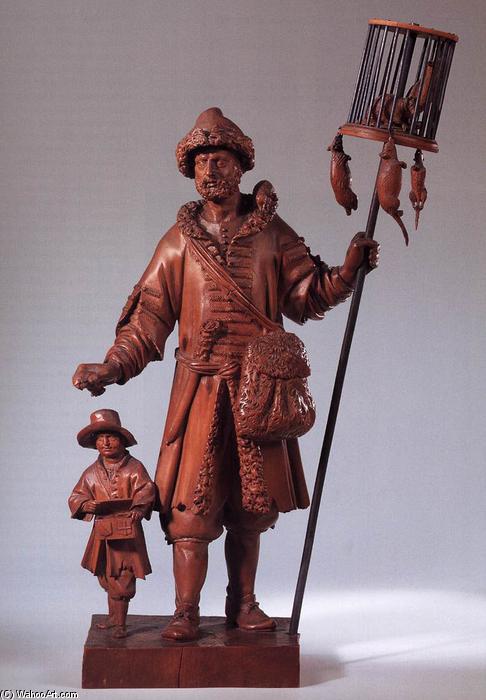
As his career matured, Van Swol’s true sculptural voice emerged, characterized by the dramatic realism and emotional intensity synonymous with the Baroque style. His most celebrated achievement, “The Rat-Catcher,” stands as a testament to this period of creative flowering. Executed around 1660, this remarkable piece transcends simple depiction to offer a visceral glimpse into the grit and determination of everyday life. The sculpture captures a moment of focused tension, where the musculature of the figure—particularly the straining arms of the catcher—is rendered with an unparalleled accuracy that speaks to his deep study of human anatomy.
This work was not born in isolation but was part of a rich dialogue with the broader Dutch artistic landscape. Van Swol’s sculptural vision aligned closely with the naturalism and expressive dynamism championed by Albert Vinckenbrinck, another prominent Utrecht sculptor. There is a palpable sense of movement and life in his figures, an attempt to freeze a singular, breathless moment of action within the permanence of stone or bronze. His ability to convey complex human emotions through physical form allowed him to bridge the gap between the decorative and the profound.
Legacy and Historical Significance
Though his life was relatively short, ending in 1680, the impact of Van Swol’s craftsmanship left an indelible mark on the Utrecht school. His work often drew inspiration from the evocative imagery found in the etchings of Rembrandt, particularly the themes of common laborers and the dramatic interplay of light. By translating the graphic energy of printmaking into the physical weight of sculpture, he contributed to a unique synthesis of mediums that defined the Dutch Golden Age.
Today, the remnants of his brilliance can still be found in prestigious collections, such as Museum Van Loon, where his work continues to invite contemplation. His legacy is defined by several key contributions:
- The Art of the Frame: Elevating the decorative border into a vital component of the viewing experience through an advanced understanding of light and aesthetics.
- Baroque Realism: Bringing a heightened sense of anatomical truth and emotional urgency to small-scale sculpture.
- Cultural Integration: Connecting the sculptural traditions of Utrecht with the broader, world-renowned influences of the Dutch masters.
Ambrosius van Swol may be remembered as a "silent" sculptor, yet his work speaks with a resounding clarity, reminding us that the true essence of art often lies in the meticulous details and the profound strength found in the most humble of subjects.


 Byt till tryckta exemplar
 Skicka
 Dela
Dela
 Detaljer
 Guide
Guide

 Ladda ner
 Liknande objekt
 Bildspel
 Besökstatistik


 Läs mer


