Visa i rummet Se i AR Köp handmålat konstverk Byt till digital bildförsäljning Skicka
Detaljer Studentguide för konstverk Lägg till i favoriter Ladda ner Liknande objekt Röntgen Bildspel Besökstatistik

La Chiaruccia

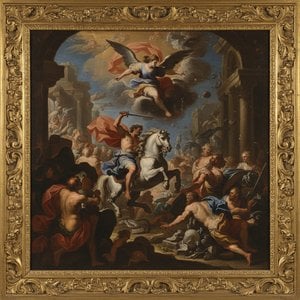
La Chiaroscuro - Alexandre Cabanel (1875-1889) portrays a woman adorned with flowers and gazing intently at the viewer against a backdrop of serene mountains and trees. Executed in 1848, this masterpiece exemplifies the meticulous craftsmanship characteristic of academic art.

Upptäck Alexandre Cabanel (1823-1889), en mästare inom fransk akademisk målning känd för sina klassiska och historiska verk som "Venus födelse". Utforska porträtt, religiösa scener och hans bestående inflytande.

Giclée / Konsttryck

Giclée- eller canvasprint av museumskvalitet med snabb produktion och flexibla ytbehandlingsalternativ. ( Köp handmålat konstverk Byt till digital bildförsäljning)

Corner sample of the P118B picture frame: formgjuten polystyren, 5 cm wide and 3 cm thick
P118B Skr10
Corner sample of the P118H picture frame: formgjuten polystyren, 5 cm wide and 3 cm thick
P118H Skr10
Corner sample of the P118W picture frame: formgjuten polystyren, 5 cm wide and 3 cm thick
P118W Skr10
Corner sample of the P438Z picture frame: formgjuten polystyren, 5.5 cm wide and 3.5 cm thick
P438Z Skr10
Corner sample of the P508JH picture frame: formgjuten polystyren, 7 cm wide and 3.5 cm thick
P508JH Skr12
Corner sample of the P508YH picture frame: formgjuten polystyren, 7 cm wide and 3.5 cm thick
P508YH Skr12
Corner sample of the P805H picture frame: formgjuten polystyren, 5 cm wide and 3.5 cm thick
P805H Skr10
Corner sample of the P805Z picture frame: formgjuten polystyren, 5 cm wide and 3.5 cm thick
P805Z Skr10
Corner sample of the P919BZ picture frame: formgjuten polystyren, 7 cm wide and 3.5 cm thick
P919BZ Skr10
Corner sample of the P919G picture frame: formgjuten polystyren, 7 cm wide and 3.5 cm thick
P919G Skr10
Corner sample of the P919XJ picture frame: formgjuten polystyren, 7 cm wide and 3.5 cm thick
P919XJ Skr10
Corner sample of the P959ZH picture frame: formgjuten polystyren, 5 cm wide and 3 cm thick
P959ZH Skr10
Corner sample of the P968JZ picture frame: formgjuten polystyren, 6 cm wide and 4 cm thick
P968JZ Skr12
Corner sample of the W106C picture frame: massivt trä, 5 cm wide and 3 cm thick
W106C Skr8
Corner sample of the W218G picture frame: massivt trä, 5 cm wide and 3 cm thick
W218G Skr10
Corner sample of the W218JH picture frame: massivt trä, 5 cm wide and 3 cm thick
W218JH Skr8
Corner sample of the W218Y picture frame: massivt trä, 5 cm wide and 3 cm thick
W218Y Skr10
Corner sample of the W307PJ picture frame: massivt trä, 6 cm wide and 3 cm thick
W307PJ Skr10
Corner sample of the W316G picture frame: massivt trä, 6 cm wide and 3 cm thick
W316G Skr10
Corner sample of the W316PJ picture frame: massivt trä, 6 cm wide and 3 cm thick
W316PJ Skr8
Corner sample of the W316Y picture frame: massivt trä, 6 cm wide and 3 cm thick
W316Y Skr10
Corner sample of the W398PJ picture frame: massivt trä, 5 cm wide and 3 cm thick
W398PJ Skr8
Corner sample of the W4111J picture frame: massivt trä, 6.5 cm wide and 3.5 cm thick
W4111J Skr10
Corner sample of the W500HY picture frame: massivt trä, 7 cm wide and 5 cm thick
W500HY Skr15
Corner sample of the W500JH picture frame: massivt trä, 7 cm wide and 5 cm thick
W500JH Skr15
Corner sample of the W692G picture frame: massivt trä, 8 cm wide and 4 cm thick
W692G Skr12
Corner sample of the W849H picture frame: massivt trä, 5 cm wide and 3 cm thick
W849H Skr8
Corner sample of the W940BG picture frame: massivt trä, 7.5 cm wide and 4.5 cm thick
W940BG Skr15
Corner sample of the W953PJ picture frame: massivt trä, 6 cm wide and 3.5 cm thick
W953PJ Skr8

Standardstorlek
anpassad
CM
INCH

Välj bland våra förinställda storlekar som motsvarar konstverkets ursprungliga proportioner.

bredd
höjd

Ange den bredd och höjd du behöver, för att passa din ram eller din vägg. Ett tryck kan endast beskäras, aldrig göras större än bilden, vilket innebär att ett format med en annan formform leder till att en del av bilden går förlorad. Vi skickar en digital mockup för godkännande innan vi trycker något. Bilden som visas på denna sida visar inte den faktiska beskärningen — det är endast mockuppen som gör det.

Leverans över hela världen () på 2 veckor istället för standard 4/5 veckor. (25 oktober)

Fri expressfrakt över hela världen
Högkvalitativ linnecanvas
Fullständig fraktförsäkring
Garantier för återbetalning av tullavgifter
Garantier för exakt färgåtergivning
100 dagars returrätt vid fabrikationsfel
100% pengarna tillbaka-garanti
Mängdrabatt erbjuds

Totalt pris

Skr 674

La Chiaruccia

Giclée / Konsttryck

Reproduktionsstorlek

-

Totalpris

Skr 674

Snabbfakta

  • Medium: Oil on canvas
  • Subject or theme: Female Portrait
  • Location: Musée Fabré Montpellier
  • Movement: Romanticism
  • Notable elements or techniques: Detailed portraiture; Classical composition
  • Dimensions: 97 x 78 cm

Konstquiz

Det finns endast ett korrekt svar på varje fråga.

Fråga 1:
What is the primary subject of Alexandre Cabanel's painting?
Fråga 2:
In what year was Alexandre Cabanel's painting completed?
Fråga 3:
What artistic style is most characteristic of Alexandre Cabanel's work?
Fråga 4:
The painting utilizes what technique to achieve a realistic portrayal of the woman and her surroundings?
Fråga 5:
What is the symbolic significance of the flowers held by the woman in the portrait?

Alexandre Cabanel’s “La Chiaroscuro”: A Portrait of Elegance Rooted in Classical Tradition

  • Subject Matter: Alexandre Cabanel's "La Chiaroscuro" depicts a woman—likely intended to represent Marie Alexandrine Louise Bonaparte, Napoleon III’s sister—seated gracefully amidst a tranquil landscape. Her gaze is directed towards the viewer, establishing an intimate connection between subject and observer.
  • Style: The painting embodies the quintessential style of academic art prevalent in France during its Belle Époque period. Characterized by meticulous detail and idealized beauty, it adheres to classical conventions—specifically those championed by Jacques-Louis David—emphasizing harmony, balance, and proportion.
  • Technique: Cabanel employed oil paint on canvas with exceptional precision. He utilized glazing techniques—applying thin layers of translucent pigment over subsequent coats—to achieve luminous effects and subtle tonal variations. The artist’s masterful brushwork contributes to the painting's textural richness, capturing the delicate folds of the woman’s gown and the intricate patterns of the foliage.
  • Historical Context: Painted in 1848, “La Chiaroscuro” reflects the artistic sensibilities of a time marked by optimism and grandeur. Napoleon III’s reign witnessed a flourishing of cultural endeavors—a deliberate effort to revive France's prestige after the Franco-Prussian War. Cabanel’s work aligns perfectly with this prevailing ethos, serving as a testament to the enduring power of classical ideals.
  • Symbolism: The woman’s pose and attire convey notions of dignity and composure—symbols of aristocratic virtue. The flowers held in her hands represent beauty, purity, and remembrance—suggesting an allusion to Marie Bonaparte's familial heritage and honoring the memory of Napoleon Bonaparte.

The Luminosity of Glazing: Cabanel’s Approach to Light and Color

Cabanel’s technique is particularly noteworthy for its incorporation of glazing—a method that elevates oil paint beyond mere pigment application. By applying thin, translucent layers of color over previously painted surfaces, he achieved remarkable tonal depth and luminosity. This process allowed him to capture the subtle nuances of light filtering through the trees and mountains in the background, creating an atmospheric illusion that enhances the painting’s overall visual impact. The glazing technique is a hallmark of Baroque art but was skillfully adapted by Cabanel to suit the aesthetic demands of his era.

A Window into Napoleon III's Vision: Artistic Patronage and National Identity

Napoleon III recognized the importance of artistic patronage in shaping national identity. He actively supported artists like Cabanel—commissioning monumental canvases that celebrated French history and culture—aiming to instill pride and patriotism among his subjects. “La Chiaroscuro” exemplifies this ambition, presenting Marie Bonaparte as a figure of noble grace and embodying the ideals of classical beauty—values deemed crucial for upholding France’s cultural heritage.

Emotional Resonance: Capturing Graceful Dignity

Despite its formal aesthetic, “La Chiaroscuro” possesses an undeniable emotional resonance. Cabanel succeeds in conveying a sense of serene dignity and contemplative beauty—capturing the essence of Marie Bonaparte’s character with remarkable sensitivity. The painting's harmonious composition and masterful execution evoke feelings of tranquility and admiration—inspiring viewers to contemplate the enduring legacy of classical art.

Frågor och svar

Tillhör "La Chiaruccia" av Alexandre Cabanel de mest eftertraktade verken inom Romanticism?

"La Chiaruccia" av Alexandre Cabanel klassificeras som Iconic och tillhör Romanticism-rörelsen.

Hur förhåller sig motivet i "La Chiaruccia" till Alexandre Cabanels vanliga teman?

"La Chiaruccia" skildrar woman, veil, flowers, landscape, mythology, painting, elegance, medan Alexandre Cabanels dokumenterade teman är classical ideals, romantic beauty, religious serenity, portraiture mastery, academic tradition. En jämförelse mellan dessa visar hur verket förhåller sig till konstnärens vanliga motiv.

Hur gammal var Alexandre Cabanel när "La Chiaruccia" skapades?

När "La Chiaruccia" skapades år 1848, var Alexandre Cabanel – född 1823 – 25 år gammal.


Om konstnären

Alexandre Cabanel: A Titan of Academic Painting

Alexandre Cabanel, född 28 september 1823 i Montpellier i Frankrike, död 23 januari 1889 i Paris, var en fransk konstnär. Han är utan tvekan den mest framstående representanaten för den akademiska konstens praktiker under andra halvan av det nionde århundrade och hans verk fortsätter att fascinera publiken än idag. Hans konstnärliga resa började inte inom familjen, utan som son till en simpel snickare – vilket gav honom ett starkt arbetsmoral och kanske också en ödmjukhet inför hantverket. Även i ung ålder var Cabanel obestridligt begåvad; redan vid tio års ålder fick han formell utbildning på den lokala konstskolan i Montpellier där han studerade under Jean-Baptiste Oudry och senare François-Edouard Picot. Detta tidiga geni säkerställde honom en stipendium för att studera i Paris 1839, där han gick direkt till École des Beaux-Arts och blev elev hos Picot – samma Picot som hade utbildat Jacques-Louis David och vidareutbildade Cabanel i klassiska principer. Detta var inte bara om teknik; det omfattade också en bred utbildning i litteratur, historia och filosofi vilket gav honom djup för sina ämnen. Hans första försök till Prix de Rome stipendium avslöjade ambition och vilja att förbättra sina färdigheter – något som slutligen lyckades 1845 när han till sist erhöll denna prestigefyllda prisplats. Detta gav honom en period av studier i Rom, där han absorberade lärdomarna från renässansens mästare och deras konstnärliga teknik.
  • Early Life and Artistic Formation
  • The Roman Years and Rise to Prominence
  • A Master of Academic Style
  • Notable Paintings
  • Legacy and Influence

Early Life and Artistic Formation

Alexandre Cabanel föddes i Montpellier, söner till en snickare och växte upp i en familj som värderade hantverkets praktiker. Detta tidiga miljöskapande gav honom ett starkt arbetsmoral och kanske också en ödmjukhet inför konstens komplexitet. Vid tio års ålder började han studera på den lokala konstskolan där han redan vid denna tidpunkt visade upp ett extraordinärt talent för att skapa bilder och fånga rörelser med precision och känsla. Detta tidiga geni säkerställde honom en stipendium för att studera i Paris 1839, där han gick direkt till École des Beaux-Arts och blev elev hos François-Edouard Picot – samma Picot som hade utbildat Jacques-Louis David och vidareutbildade Cabanel i klassiska principer. Detta var inte bara om teknik; det omfattade också en bred utbildning i litteratur, historia och filosofi vilket gav honom djup för sina ämnen. Han studerade under Picots vägledning och absorberade de klassiska idéerna som styrde konstnärligheten vid denna tidpunkt – vilket skulle forma hans konstnärliga utveckling genom hela livet. Detta tidiga fokus på klassisk utbildning var avgörande för att skapa den grundläggande kunskapen som Cabanel behövde för att skapa bilder av hög kvalitet och komplexitet."
Alexandre Cabanel

Alexandre Cabanel

1823 - 1889 , Frankrike

Snabbfakta

  • Artistic Movement Or Style: Akademisk realism
  • Artists Who Influenced This Artist:
    • Jacques-Louis David
    • François-Edouard Picot
  • Date Of Birth: 28 september 1823
  • Full Name: Alexandre Cabanel
  • Nationality: Fransk
  • Notable Artworks:
    • Venus födelse
    • Othello berättar om sina strider
    • Faidra
  • Place Of Birth: Montpellier, Frankrike
Utforska konstverk sorterade efter tema, stil och egenskaper.