Förhandsvisa Förhandsgranska i AR Byt till tryck Byt till digital bild Skicka
Visa detaljer Guide Lägg till i favoriter Ladda ner Liknande objekt Röntgen Bildspel Statistik

Barbier

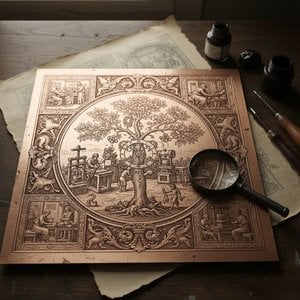
Discover 'Barbier' by Abraham Bosse, a stunning 17th-century etching showcasing French life & artistry. Explore this masterpiece’s rich detail and historical significance.

Abraham Bosse (1604-1676) was a French artist renowned for his detailed etchings depicting 17th-century life, fashion, and interiors. A founding member of the Académie Royale, he influenced artists like Hogarth with his unique blend of realism & tech

Handgjord oljereproduktion

Handmålad olja på duk i din valda storlek och ram, tillverkad efter beställning av våra konstnärer. ( Byt till tryck Byt till digital bild)

Corner sample of the P118B picture frame: formgjuten polystyren, 5 cm wide and 3 cm thick
P118B Skr10
Corner sample of the P118H picture frame: formgjuten polystyren, 5 cm wide and 3 cm thick
P118H Skr10
Corner sample of the P118W picture frame: formgjuten polystyren, 5 cm wide and 3 cm thick
P118W Skr10
Corner sample of the P438Z picture frame: formgjuten polystyren, 5.5 cm wide and 3.5 cm thick
P438Z Skr10
Corner sample of the P508JH picture frame: formgjuten polystyren, 7 cm wide and 3.5 cm thick
P508JH Skr12
Corner sample of the P508YH picture frame: formgjuten polystyren, 7 cm wide and 3.5 cm thick
P508YH Skr12
Corner sample of the P805H picture frame: formgjuten polystyren, 5 cm wide and 3.5 cm thick
P805H Skr10
Corner sample of the P805Z picture frame: formgjuten polystyren, 5 cm wide and 3.5 cm thick
P805Z Skr10
Corner sample of the P919BZ picture frame: formgjuten polystyren, 7 cm wide and 3.5 cm thick
P919BZ Skr10
Corner sample of the P919G picture frame: formgjuten polystyren, 7 cm wide and 3.5 cm thick
P919G Skr10
Corner sample of the P919XJ picture frame: formgjuten polystyren, 7 cm wide and 3.5 cm thick
P919XJ Skr10
Corner sample of the P959ZH picture frame: formgjuten polystyren, 5 cm wide and 3 cm thick
P959ZH Skr10
Corner sample of the P968JZ picture frame: formgjuten polystyren, 6 cm wide and 4 cm thick
P968JZ Skr12
Corner sample of the W106C picture frame: massivt trä, 5 cm wide and 3 cm thick
W106C Skr8
Corner sample of the W218G picture frame: massivt trä, 5 cm wide and 3 cm thick
W218G Skr10
Corner sample of the W218JH picture frame: massivt trä, 5 cm wide and 3 cm thick
W218JH Skr8
Corner sample of the W218Y picture frame: massivt trä, 5 cm wide and 3 cm thick
W218Y Skr10
Corner sample of the W307PJ picture frame: massivt trä, 6 cm wide and 3 cm thick
W307PJ Skr10
Corner sample of the W316G picture frame: massivt trä, 6 cm wide and 3 cm thick
W316G Skr10
Corner sample of the W316PJ picture frame: massivt trä, 6 cm wide and 3 cm thick
W316PJ Skr8
Corner sample of the W316Y picture frame: massivt trä, 6 cm wide and 3 cm thick
W316Y Skr10
Corner sample of the W398PJ picture frame: massivt trä, 5 cm wide and 3 cm thick
W398PJ Skr8
Corner sample of the W4111J picture frame: massivt trä, 6.5 cm wide and 3.5 cm thick
W4111J Skr10
Corner sample of the W500HY picture frame: massivt trä, 7 cm wide and 5 cm thick
W500HY Skr15
Corner sample of the W500JH picture frame: massivt trä, 7 cm wide and 5 cm thick
W500JH Skr15
Corner sample of the W692G picture frame: massivt trä, 8 cm wide and 4 cm thick
W692G Skr12
Corner sample of the W849H picture frame: massivt trä, 5 cm wide and 3 cm thick
W849H Skr8
Corner sample of the W940BG picture frame: massivt trä, 7.5 cm wide and 4.5 cm thick
W940BG Skr15
Corner sample of the W953PJ picture frame: massivt trä, 6 cm wide and 3.5 cm thick
W953PJ Skr8

Standardstorlek
skräddarsydd
CM
INCH

Välj bland våra förinställda storlekar som motsvarar konstverkets ursprungliga proportioner.

bredd
höjd

Ange den bredd och höjd du behöver för att passa din ram eller din vägg. Eftersom detta är handmålat kan konstnären, vid ett annat format, måla lite mer runt bilden eller beskära den något – det är du som väljer. Vi skickar en digital mockup för godkännande innan målningen påbörjas. Bilden som visas på denna sida representerar inte det slutgiltiga resultatet — det är endast mockuppen som visar det.

Exempel på vad som kan anpassas: Byt ut ansiktet mot ett foto av kunden; Lägg till ett husdjur (t.ex. byt ut en katt mot en hund); Inkludera ett dolt meddelande i bakgrunden; Ändra bakgrundens landskap eller element.
Efter beställning kommer WahooArt.com team att mejla kunden för instruktioner och tillhandahålla en skissförhandsvisning

Leverans över hela världen () på 3–4 veckor istället för standard 5 veckor. (25 oktober). Inga kompromisser med kvaliteten.

Fri expressfrakt över hela världen
Högkvalitativ linnecanvas
Fullständig fraktförsäkring
Garantier för återbetalning av tullavgifter
Garantier för exakt färgåtergivning
100 dagars returrätt (endast vid fel)
100% pengarna tillbaka-garanti
Mängdrabatt erbjuds

Totalt pris

Skr 3191

Barbier

Reproduktionsmetod

Storlek på reproduktion

-

Slutgiltigt pris

Skr 3191


Konstnärsbiografi

The Chronicler of Seventeenth-Century Splendor

Abraham Bosse stands as a pivotal figure in French Baroque art, celebrated primarily for his groundbreaking etchings that captured the vibrant tapestry of seventeenth-century Paris and its aristocratic circles. Born to Huguenot parents in Tours, France—a city scarred by religious conflict—Bosse’s formative years instilled within him a profound appreciation for detail and observation, qualities that would define his artistic vision throughout his prolific career. His father was a tailor, providing Bosse with an early understanding of craftsmanship and meticulous rendering, skills he would later translate into the exacting precision of his prints.

The trajectory of his life took a decisive turn when he moved toward greater horizons, embarking on a formal apprenticeship with Melchior Tavernier, an Antwerp-born engraver and publisher, around 1620. This partnership proved instrumental in establishing his reputation as one of the era's foremost printmakers. Tavernier’s influence extended beyond mere technical guidance; he fostered Bosse’s burgeoning fascination with artistic innovation and encouraged him to explore diverse subjects. Early etchings, notably those produced under Tavernier’s patronage, demonstrated a nascent stylistic sensibility rooted in Dutch and Flemish art traditions—a deliberate choice that simultaneously honored established precedents while subtly injecting them with distinctly French nuances.

Technical Mastery and the Callot Influence

A pivotal encounter with Jacques Callot in Paris around 1630 irrevocably altered Bosse's artistic trajectory. Callot’s revolutionary etching techniques—characterized by a remarkable level of textural detail and a masterful manipulation of tonal gradation—became an immediate inspiration for Bosse, who enthusiastically adopted these innovations. This embrace of Callot’s approach resulted in prints that possessed an unparalleled realism, allowing Bosse to render the delicate textures of lace, the sheen of silk, and the complex architectural perspectives of Parisian interiors with breathtaking clarity.

Bosse's work often transcended simple documentation, moving into the realm of social commentary and allegorical depth. His ability to weave together the mundane and the magnificent is evident in several key themes of his oeuvre:

  • The Elegance of Social Ritual: Through works like Musical Society (1635), he captured the lively, sophisticated gatherings of the Parisian elite, documenting the era's social etiquette and musical culture.
  • Sensory Allegories: In masterpieces such as The Five Senses: Hearing (1635), Bosse utilized his technical prowess to explore human perception, blending scenes of musicians and historical drama into a singular, evocative composition.
  • Narrative Grandeur: His engravings, including Roger Showing a Gallery of Paintings to Several Cardinals (1656), demonstrated his capacity for dramatic storytelling, utilizing intricate detail to depict biblical figures amidst courtly intrigue.

Legacy and Historical Significance

Beyond the copperplate, Bosse’s impact on the art world was institutional and enduring. As a founding member of the Académie Royale, he helped shape the formal standards of French art, ensuring that the precision and observational rigor he championed would become hallmarks of the national style. His meticulous attention to fashion and interior design has made his work an invaluable primary source for historians seeking to understand the material culture of the 17th century.

The influence of Bosse’s unique blend of realism and technical innovation extended far beyond the borders of France, reaching later masters such as William Hogarth. By bridging the gap between the meticulous traditions of Northern Europe and the burgeoning grandeur of the French Baroque, Abraham Bosse created a visual language that remains as captivating today as it was during the reign of Louis XIV. His legacy lives on in every fine line of his etchings, which continue to breathe life into the vanished world of old Paris.

Abraham Bosse

Abraham Bosse

1604 - 1676 , France

Kortfakta

  • Full Name: Abraham Bosse
  • Nationality: French
  • Date Of Birth: 1604
  • Date Of Death: 1676
  • Place Of Birth: Tours, France
  • Notable Artworks:
    • The Five Senses: Hearing
    • Barbier
    • Roger Showing a Gallery of Paintings
  • Artistic Movement Or Style: Baroque
  • Artists Who Influenced This Artist:
    • Jacques Bellange
    • Jacque Callot
  • Artists Or Movements Influenced By This Artist: ['William Hogarth']