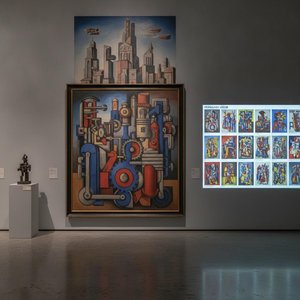
The Multi-Faceted Vision of Quebec
Omer Parent moves through the twentieth century not as a single-medium specialist, but as a restless observer of light and commerce. Born in 1907, his early years in Quebec lead him to the École des beaux-arts de Québec, where he refines his painterly foundations between 1922 and 1925. The scene shifts in 1927 when he arrives in France. At the École Nationale des Arts décoratifs de Paris, the rigid structures of his early training meet the sudden, sharp edges of modern art. This encounter with European modernity alters his trajectory, planting seeds for a career that will eventually span film, photography, and graphic design.
His professional life unfolds in layers across Montreal and Quebec. He works as a decorator for major department stores and as an advertising graphic designer, applying a sharp eye to the commercial landscape. In 1952, his work A mari usque ad mare emerges—a massive undertaking measuring 1.5 meters in height and 9 meters in width. This public painting functions as a panoramic map of Canadian industry. It captures the movement of Pacific fisheries, the grit of oil drilling, and the quiet rhythm of maple syrup production. At its center, a maple leaf sits beneath the winged helmet of Hermes, the Greek god of commerce, anchoring the vast array of activities from aeronautics to mining.
A Legacy of Instruction and Innovation
The educator emerges as strongly as the artist. Parent takes up roles that shape the next generation of Quebecois creators, serving as a professor and later as the director of the École des beaux-arts de Québec starting in 1949. His institutional influence reaches its peak in 1970 when he founds and directs the École des arts visuels de l'Université Laval. His contributions to the Canadian cultural fabric are formally recognized in 1971 when he is named an Officer of the Order of Canada.
Beyond the canvas, his experiments continue on celluloid and film. He explores the technical limits of 16mm Kodachrome color film through camera tests that reveal a fascination with light and color. His cinematic output includes the experimental fiction film La vie d’Émile Lazo in 1937 and the footage of Vacances estivales, which captures moments of unscripted joy among his colleagues. These films, along with his photographic work, demonstrate a preoccupation with framing—the window through which he views the world.
- Key Roles: Painter, photographer, filmmaker, advertising graphic designer, and professor.
- Major Institutions: École des beaux-arts de Québec, Université Laval.
- Notable Honors: Officer of the Order of Canada (1971).
Pitanja i odgovori
Mogu li da istražim dela umetnika Omer Parent putem ključnih reči?
Radove umetnika Omer Parent možete istražiti putem ključnih reči na njegovoj stranici Preko ključnih reči. Svaka ključna reč grupiše srodna dela.
Mogu li da sortiram dela umetnika Omer Parent prema boji?
Spektar boja umetnika Omer Parent je stranica koja organizuje njegova dela prema bojama.
Gde se mogu pronaći dela umetnika Omer Parent grupisanja po paleti boja?
Da biste pronašli dela umetnika Omer Parent u specifičnoj paleti boja, posetite njegovu stranicu Preko palete boja.
Koja dela umetnika Omer Parent imaju najviše pregleda?
Stranica Statistika umetnika Omer Parent prikazuje statistiku izračunatu na osnovu umetničkih dela tog autora koja su navedena na ovaj sajt.