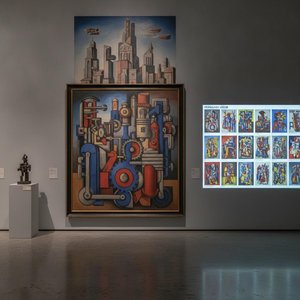
The Spirit of Abstraction
Born in Algiers, Noël Pasquier carried a sense of movement and color that would eventually find its home in the landscapes of Paris and the rugged coasts of Brittany. His hands, skilled in both the delicate touch of a painter and the heavy labor of a sculptor, sought to translate the intangible into form. He did not limit himself to a single medium; instead, he moved between bronze, textile, ceramics, and glass with a restless curiosity. His work often returns to a specific shade of blue, a color that seems to pull at the threads of memory and childhood, inviting a quiet reflection on what has been lost and what remains.
In the realm of lyrical abstraction, Pasquier found a language that allowed him to explore the vastness of space. His creations range from the monumental to the very small, proving that a grand vision can exist within a tiny fragment of paper or a small piece of marble. This versatility allowed him to inhabit many worlds, from the public squares of Suresnes to the quiet corners of private collections.
A Presence in Public and Private Spaces
The scale of his ambition is perhaps best seen in his contributions to the urban landscape. He has left his mark on the very architecture of French life, painting murals that adorn the Rennes TGV station and transforming entire neighborhoods in Suresnes. His reach extended far beyond the borders of France, as his works traveled to cities such as New York, London, Tokyo, Budapest, Sao Paolo, Tel-Aviv, Beirut, Shanghai, Singapore, Boston, and Chicago. These exhibitions were not merely displays but dialogues with a global audience, spanning from the bustling streets of Tokyo to the cultural hubs of Germany and Italy.
His legacy is preserved in institutions that guard the history of the twentieth century. His engraved works are held by the Bibliothèque nationale de France in Paris and the Public Library in New York, ensuring that his precise lines and textures endure. This recognition of his technical skill and artistic vision was further honored when he was named a Chevalier of the Ordre des Arts et des Lettres in 2013.
The Materiality of Form
To watch Pasquier work is to understand the relationship between weight and lightness. He has mastered the heavy resistance of steel, specifically corten steel, and the permanence of bronze, yet he is equally at home with the fragility of glass and the softness of textiles. This duality is a central theme in his life's work. He has applied his vision to diverse surfaces, including:
- Metal such as bronze and steel
- Stone and Glass including marble and glass
- Soft Media such as textile and paper
- Traditional Surfaces like canvas and ceramics
Whether he was illustrating literary works or creating large-scale murals, his focus remained on the essence of the subject. His art does not demand attention through noise, but through a steady, rhythmic presence that connects the viewer to a sense of deep, internal memory.
Pitanja i odgovori
Gde se mogu pronaći dela umetnika Noël Pasquier grupisanom prema ključnim rečima?
Da biste pronašli dela umetnika Noël Pasquier na određenu temu, koristite stranicu Preko ključnih reči ovog umetnika, koja grupiše radove prema ključnim rečima.
Mogu li da istražim dela umetnika Noël Pasquier prema kolorističkom spektru?
Stranica Spektar boja organizuje dela umetnika Noël Pasquier prema boji.
U kom istorijskom periodu je stvarao/la Noël Pasquier?
Noël Pasquier je radila u periodu Modern. Ovaj period smešta umetnikov rad u istorijski kontekst.
Gde mogu pronaći statistiku o delima umetnika Noël Pasquier?
Statistika o delima umetnika Noël Pasquier dostupna je na njegovoj stranici Statistika.