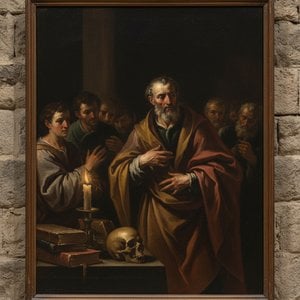
A Soul Forged in Conflict and Color
Marian Vayreda i Vila was far more than a mere practitioner of the arts; he was a living embodiment of the turbulent, shifting identities that defined late 19th-century Catalonia. Born in 1853 in the historic town of Olot, within the Girona province, his very existence was shaped by the echoes of war and the deep-seated traditions of the Alt Garrotxa region. His lineage, rooted in noble Catalan families, carried the scars of the First Carlist War—a conflict that saw his family's ancestral home consumed by flames, forcing a displacement to Girona that would forever link his personal history to the political upheavals of Spain. This early exposure to the volatility of nationalism and the resilience of regional identity became the silent protagonist in much of his later creative output.
While many remember him as a soldier and an activist for the Carlist cause, Vayreda’s true sanctuary was found within the delicate nuances of visual and literary expression. His artistic journey began with formal training at the Escola de Dibuix d’Olot, where he encountered the rigorous techniques of Jean-Léon Gérôme. This Parisian influence instilled in him a profound respect for meticulous detail and a reverence for religious iconography, elements that would later define his sculptural endeavors. Alongside his collaborator Joan Carles Panyó, Vayreda became a pioneer of innovation, experimenting with new materials like wood pulp paste to breathe life into religious figures through his workshop, El Arte Cristiano. This period marked the beginning of a legacy where craftsmanship met a deep-seated devotion to the spiritual and cultural heritage of his homeland.
The Intersection of Pen and Paintbrush
As his career matured, Vayreda’s creative spirit expanded beyond the tactile world of sculpture and painting into the profound depths of literature. He possessed a rare ability to navigate the complex space between Carlism and the emerging Catalan nationalism, a duality that allowed him to capture the psychological landscape of a society in transition. His literary achievements reached a pinnacle with the publication of his novel, La Punyalada. Though published posthumously in 1904, the work was immediately recognized as a masterpiece of Catalan prose, celebrated for its emotional depth and its ability to weave the political tensions of the era into a compelling human narrative. Through his writing, he gave a voice to the cultural renaissance—the Renaixença—that was sweeping through Catalonia.
The significance of Vayreda’s work lies in this seamless blending of disparate roles. He was not simply an observer of history but an active participant in its making. His life's work serves as a bridge between the traditionalist, often rigid structures of the past and the burgeoning modern identity of the Catalan people. To study his biography is to witness the evolution of an artist who used every medium at his disposal—be it the sculpted saint, the painted landscape, or the written word—to document the enduring spirit of his people. His legacy remains a vital cornerstone of Catalan cultural history, reminding us of a time when art and identity were inextricably bound by the struggles of a changing world.
Pitanja i odgovori
Koliko je umetničkih dela autora Marian Vayreda I Vila dostupno za pregled?
Možete pregledati 1 umetničkih dela dela umetnika Marian Vayreda I Vila na stranici Sva umetnička dela.
Koja raspoloženja izražavaju dela umetnika Marian Vayreda I Vila?
Soba raspoloženja umetnika Marian Vayreda I Vila je stranica koja prikazuje umetnikova dela raspoređena prema raspoloženju.
Mogu li da istražim dela umetnika Marian Vayreda I Vila putem ključnih reči?
Stranica Preko ključnih reči umetnika Marian Vayreda I Vila grupiše dela umetnika prema njihovim ključnim rečima.