A Life Forged in Color and Tradition
The life of Kazimierz Ostrowski was a profound journey through the heart of twentieth-century European art, beginning in Berlin in 1917 and finding its ultimate resonance in Gdynia. His early years were marked by movement and adaptation; after his family relocated to Poznań in 1920, the young artist’s path eventually led him to the coastal vitality of Gdynia. Before he was a master of the brush, Ostrowski demonstrated a keen eye for detail through more practical endeavors, working alongside his brother Zygments to paint the names and insignias of great ships like the SS Kościuszko and MS Batory. This early exposure to the grand scale of maritime identity likely instilled in him a deep respect for form and precision that would later define his academic mastery.
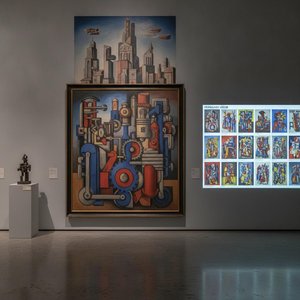
Following the upheaval of World War II, Ostrowski’s dedication to the formal arts took center stage. In 1945, he began his rigorous studies at the Academy of Fine Arts in Sopot, a period of intense intellectual and creative growth. His talent was so unmistakable that it earned him a prestigious scholarship from the French government in 1949, whisking him away to the vibrant art scene of Paris. It was here, under the mentorship of the legendary Fernand Léger, that Ostrowski’s horizons expanded beyond traditional boundaries. Immersed in the avant-garde atmosphere of France, he absorbed the structural complexities of Cubism and the dreamlike depths of Surrealism, elements that would later infuse his Polish landscapes and still lifes with a sophisticated, modern sensibility.
The Mastery of Form and Spirit
Upon returning to Poland, Ostrowski did not merely practice art; he became a cornerstone of its academic foundation. Serving as a professor at the Academy of Fine Arts in Gdańsk from 1964 until 1987, he nurtured generations of artists, passing on a legacy of technical excellence and experimental courage. His teaching philosophy encouraged students to bridge the gap between classical training and contemporary innovation, much like his own evolution from the academic traditions of Sopot to the modernism of Paris.
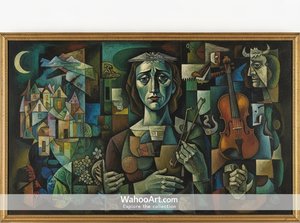
His body of work is a breathtaking tapestry of diverse subjects, ranging from the quiet intimacy of still lifes to the sweeping narratives of landscapes. One can see his technical prowess in pieces such as “Accordion, two-row melody keyboard with twelve basses,” painted in 1987. In this work, he does more than depict an instrument; he captures a piece of Polish soul. Through a rich palette of golds, deep browns, and blacks, and the delicate application of floral motifs, he elevates a folk icon to a subject of high art, celebrating the cultural heartbeat of Mazovian society. Similarly, his “Compositions with Masks” reveals a more abstract side of his genius, utilizing intense blues and semi-abstract human and animal forms to explore the boundaries of shape and movement.
A Legacy of Excellence
The significance of Kazimierz Ostrowski extends far beyond the canvas, as evidenced by the numerous accolades that marked his illustrious career. His contributions were recognized through a multitude of prestigious honors, including:
- First prize for painting at the First Exhibition of Polish young painting, sculpture and graphics (1957).
- The Artistic Award of the City of Gdynia, recognizing his profound impact on his local community.
- The Golden Cross of Merit and various commemorative medals for his lifelong dedication to the cultural landscape of Gdynia.
- First prize from the Ministries of Culture and Arts (1982), cementing his status as a national treasure.
Today, Ostrowski’s influence continues to ripple through the art world, not only through his prolific exhibitions—numbering over sixty across Poland and abroad—but also through the Kazimierz Ostrowski Award. Established in 2002, this award honors excellence in Polish design and art, ensuring that the spirit of innovation and dedication he embodied remains a guiding light for contemporary creators. He remains a pivotal figure of mid-century European painting, a master who could capture both the grand scale of history and the delicate whisper of a folk melody.
Pitanja i odgovori
U kom istorijskom periodu je stvarao/la Kazimierz Ostrowski?
Kazimierz Ostrowski je radila u periodu Modern. Ovaj period smešta umetnikov rad u istorijski kontekst.
Gde se mogu pronaći dela umetnika Kazimierz Ostrowski grupisanom prema umetničkim pravcima?
Umetnički pravci u kojima je Kazimierz Ostrowski stvarao možete videti na stranici Svi umetnički pravci, koja grupiše dela prema pokretu.
Gde se mogu pronaći dela umetnika Kazimierz Ostrowski grupisanom prema ključnim rečima?
Radove umetnika Kazimierz Ostrowski možete istražiti putem ključnih reči na njegovoj stranici Preko ključnih reči. Svaka ključna reč grupiše srodna dela.