Early Life and Formation in the Parisian Art World
Henri Sallembier, born in Paris in 1753, emerged during a period of significant artistic transition in France. The Rococo’s playful exuberance was gradually giving way to the more restrained elegance of Neoclassicism, and Sallembier found himself positioned at the cusp of these shifting styles. While biographical details remain somewhat sparse, it is known that he received training as both a painter and a draftsman, quickly demonstrating an aptitude for ornament engraving – a skill highly valued in the Parisian decorative arts scene. This early focus on detail and precision would become a defining characteristic of his work.
The Paris of Sallembier’s youth was a vibrant hub of artistic production, fueled by the demands of a wealthy aristocracy eager to adorn their homes with luxurious furnishings and captivating imagery. He wasn't directly associated with the major academies, but rather thrived within the network of workshops and private commissions that flourished outside of those established institutions. This independence allowed him a degree of stylistic freedom, enabling him to synthesize influences from various sources and forge his own unique artistic path.
A Pioneer of Louis XVI Style
Sallembier is most prominently recognized as one of the key figures in establishing the distinctive aesthetic of the Louis XVI style. This wasn’t a radical break with the past, but rather an evolution – a refinement of Rococo sensibilities tempered by a growing appreciation for classical forms and symmetry. Sallembier's contribution lay in his ability to translate this evolving taste into exquisitely detailed paintings and engravings.
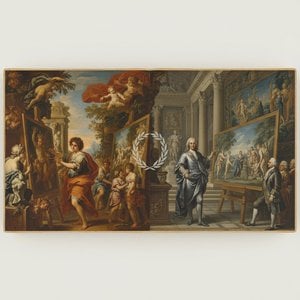
His work often features idyllic landscapes populated with elegant palace scenes, meticulously rendered architectural elements, and carefully composed groupings of figures. These compositions weren’t simply depictions of reality; they were idealized visions of aristocratic leisure and refined living. The influence of artists like Hubert Robert, known for his romanticized ruins and picturesque views, can be detected in Sallembier's landscapes, though he infused them with a greater sense of order and clarity.
Technical Mastery and Ornament Engraving
Sallembier’s technical skill was exceptional. His paintings demonstrate a remarkable command of perspective, light, and shadow, creating a convincing illusion of depth and atmosphere. However, it was his work as an ornament engraver that truly set him apart. He produced designs for furniture, wallpaper, textiles, and other decorative objects, showcasing an extraordinary ability to create intricate patterns and motifs.
The J. Paul Getty Museum Journal notes his imaginative assemblages of urns and vases, often in the style of Clodion, highlighting the sophistication of his ornamental work. This skill was crucial during a period when decorative arts were considered just as important as painting or sculpture – indeed, they were often inseparable. Sallembier’s engravings weren't merely preparatory sketches; they were works of art in their own right, admired for their precision and elegance.
Later Years and Historical Significance
Sallembier continued to work prolifically throughout the late 18th century, adapting his style to meet the changing demands of his clientele. While the French Revolution undoubtedly disrupted the aristocratic patronage system that had supported much of his early career, he managed to maintain a steady stream of commissions. He died in Paris in 1820, leaving behind a legacy as one of the most important stylistic pioneers of the Louis XVI period.
His significance lies not only in the beauty and refinement of his individual works but also in his role in shaping the broader aesthetic landscape of late 18th-century France. Sallembier’s influence can be seen in the decorative arts produced throughout Europe, and his paintings continue to captivate viewers with their idyllic charm and exquisite detail. He represents a fascinating intersection of artistic styles – a bridge between the Rococo's playful extravagance and the Neoclassical emphasis on order and clarity.
Major Achievements
- Pioneering Louis XVI Style: Sallembier was instrumental in defining the aesthetic of the Louis XVI period, characterized by refined elegance and classical influences.
- Masterful Ornament Engraving: His intricate designs for furniture, wallpaper, and textiles were highly sought after and admired for their precision and sophistication.
- Idyllic Landscape Paintings: Sallembier’s paintings of palace scenes set within picturesque landscapes captured the aristocratic ideal of leisure and refined living.
- Technical Skill & Detail: His exceptional command of perspective, light, and shadow created a convincing illusion of depth and atmosphere in his works.
Pitanja i odgovori
Otkud je Henri Sallembier?
Henri Sallembier je rođen/a u France.
U kom istorijskom periodu je stvarao/la Henri Sallembier?
Henri Sallembier je stvarala u periodu Early Modern. Ovaj period smešta umetnikov rad u istorijski kontekst.
U kojim je umetničkim pravcima Henri Sallembier stvarala/stvarao?
Stranica Svi pravci grupiše dela umetnika Henri Sallembier prema umetničkom pravcu.