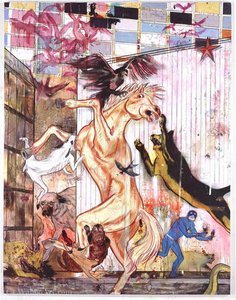
Daniel Richter: A Visionary of Fragmented Histories
Born in Eutin, Germany, in 1962, Daniel Richter’s artistic journey is a compelling narrative of shifting styles and profound engagement with the visual world. Initially rooted in abstract expressionism, his work has evolved into a distinctive approach characterized by large-scale oil paintings populated with fragmented figures drawn from historical reproductions—newspapers, photographs, and even illustrations—layered within vibrant, often unsettling color palettes. Richter’s career is not simply about depicting images; it's an exploration of memory, history, and the way we construct narratives through visual representation.
Richter’s early artistic training was crucial to his development. He attended Hochschule für bildende Künste Hamburg from 1991 to 1995, a period marked by a resurgence of expressive painting influenced by figures like Werner Büttner and Albert Oehlen. This formative experience instilled in him a willingness to embrace emotional intensity and a departure from purely formal concerns. Working as an assistant to Oehlen further broadened his perspective, exposing him to innovative techniques and a critical approach to representation. His early work leaned towards abstract color fields, but it was the influence of figures like Raymond Pettibon and Charles Burns that would later shape his distinctive style.
The Rise of Historical Fragments
A pivotal shift occurred in Richter’s artistic practice around 2002. He began to incorporate historical images—often sourced from newspapers or magazines—into his paintings, transforming them into densely populated scenes teeming with figures. This move wasn't a simple act of appropriation; rather, it represented a deliberate attempt to disrupt the linear flow of history and expose its inherent ambiguities. These aren’t straightforward depictions of past events; they are fragmented narratives, assembled from disparate sources, creating a sense of disorientation and questioning the reliability of historical accounts.
The figures within these compositions are rarely clearly defined, often appearing as ghostly presences or blurred outlines. Richter deliberately obscures their identities, inviting viewers to project their own interpretations onto the scene. The vibrant color palettes—ranging from intense reds and yellows to cool blues and greens—further contribute to this atmosphere of ambiguity and emotional resonance. Critics have noted a connection between his work and the Symbolist painters of the late 19th century, particularly James Ensor and Edvard Munch, who similarly explored themes of anxiety, alienation, and the subconscious.
Stage Design and Conceptual Expansion
Richter’s artistic practice extends beyond painting. He has become a highly sought-after stage designer, notably for the Salzburg Festival. His designs for productions like *Bluebeard's Castle* (2008) and *Lulu* (2010) are characterized by their theatricality and conceptual depth. In these projects, Richter doesn’t merely create sets; he constructs entire worlds—layered with symbolism and inviting multiple interpretations. The Salzburg Opera’s production of *Lulu* in 2010, in particular, showcased his ability to seamlessly integrate visual art and performance.
This engagement with stage design has further expanded Richter's artistic vocabulary, demonstrating a willingness to experiment with different mediums and approaches. It also highlights the interconnectedness of his work—the fragmented narratives he creates in paintings often resonate with the themes and ideas explored in his theatrical designs.
Recognition and Legacy
Richter’s work has garnered significant critical acclaim and numerous awards, including the Otto-Dix Award (1998), the Preis der Nationalgalerie (2002), and the Kunstpreis Finkenwerder (2009). His 2001 book, *Facing East from Indian Country*, a historical study of Native American history, was shortlisted for the Pulitzer Prize. These accolades reflect not only his artistic talent but also his intellectual curiosity and commitment to exploring complex social and historical issues.
Daniel Richter’s legacy lies in his ability to transform seemingly mundane sources—newspapers, photographs, illustrations—into powerful works of art that challenge our understanding of history and memory. His fragmented narratives invite viewers to engage with the past in a critical and imaginative way, solidifying his position as one of the most important contemporary artists working today.