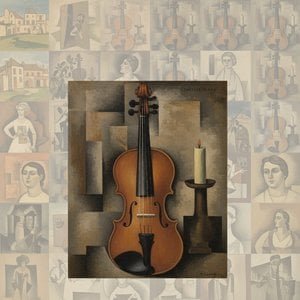
A Pioneer of American Abstraction: The Life and Art of Carl Holty
Born in Freiburg im Breisgau, Germany, in 1900, Carl Robert Holty’s journey as an artist was one shaped by transatlantic currents and a relentless pursuit of visual language. His parents, both American citizens, were temporarily residing in Germany while his father completed medical studies, but the family soon returned to their roots, settling in Milwaukee, Wisconsin. This early relocation placed young Holty within a vibrant German-American community, fostering an appreciation for heritage alongside exposure to a new world. From a tender age, art beckoned; his grandfather nurtured this nascent passion by introducing him to local galleries, and formal lessons with a German painter soon followed. Even as a teenager, Holty demonstrated a keen eye and skillful hand, filling sketchbooks with cartoons and exploring the possibilities of poster design—early indicators of a creative spirit eager to communicate visually. His education progressed rapidly; he completed high school in just two and a half years at Milwaukee University School before briefly attending Marquette University and then serving in the Reserve Officers' Training Corps during World War I. These experiences, though diverse, ultimately led him back to his artistic calling, first at the Art Institute of Chicago and later at the Parsons School of Design in New York City.
European Influences and the Search for a Visual Language
Returning to Milwaukee in 1923, Holty established himself as a portrait painter, but the allure of European artistic innovation proved irresistible. In 1925, he embarked on a decade-long sojourn that would profoundly shape his aesthetic trajectory. Initially settling in Munich, his plans to study at the Royal Academy were diverted by a pivotal encounter with Vaclav Vytlacil, who steered him towards the studio of Hans Hofmann. This proved transformative. Hofmann’s emphasis on conceptual drawing—understanding form not merely as representation but as a tactile and intellectual construct—opened up entirely new vistas for Holty. He later recalled that Hofmann “opened up” a new world for him, instilling a deep understanding of space, color, and shape. Following the tragic loss of his wife in 1930, Holty relocated to Paris, immersing himself in the heart of the avant-garde. In 1932, he joined Robert Delaunay’s *Abstraction-Création* group, finding a platform for his work in their influential magazine and aligning himself with movements like Cubism and Neo-Plasticism. His Parisian canvases drew comparisons to those of Juan Gris and Pablo Picasso, revealing a strong engagement with Synthetic Cubism's fragmented forms and spatial explorations. Simultaneously, he began incorporating biomorphic shapes, hinting at the influence of Surrealism’s organic imagery.
American Abstract Art and a Dedication to Education
The year 1935 marked Holty’s return to the United States, where he reconnected with both Hans Hofmann and Vaclav Vytlacil, as well as Stuart Davis—key figures in the burgeoning American art scene. He quickly became an integral part of this movement, co-founding the American Abstract Artists (AAA) group in 1936 and serving as its chairman from 1938 to 1944. This leadership role positioned him at the forefront of promoting abstract art within a nation still largely accustomed to representational styles. During this period, Holty’s artistic style underwent a subtle but significant evolution. He moved away from strict Cubist adherence, embracing biomorphism and developing a unique visual vocabulary characterized by rhythmic arrangements of color and shape. His innovative techniques—such as taping to achieve precise edges and layering paint through overpainting—added further depth and complexity to his compositions. Beyond his artistic practice, Holty dedicated himself to education, holding teaching positions at Brooklyn College from 1950 until 1970, where he earned the title of professor emeritus. He also shared his expertise as a visiting instructor at institutions like the Art Students League, Washington University in St. Louis, and the University of Louisville.
Mature Style, Lasting Legacy
By the 1960s, Holty’s work had reached a state of refined abstraction. Contours began to dissolve, giving way to subtle, toned-down colors that dominated his canvases. He explored nuanced variations within single color palettes, creating atmospheric and contemplative works. Throughout his career, he continued to engage with the artistic community, serving as an artist in residence at several universities—Georgia State University, the University of Florida, the University of California at Berkeley, the University of Wisconsin, and the Corcoran School of Art. In 1969, he collaborated with Romare Bearden on *The Painter’s Mind*, a testament to his intellectual curiosity and commitment to artistic discourse. Carl Holty passed away in New York City in 1973, leaving behind a rich body of work and a significant contribution to the development of American abstract art. His papers, donated to the Archives of American Art by Charles Byrne in 1977, serve as invaluable resources for scholars seeking to understand his artistic process and intellectual influences. Today, Holty is recognized as a pioneering figure who bridged European modernist ideas with the American context, described by Andrew Stevens as a key link between younger painters and the burgeoning abstract movement. His legacy endures not only through his paintings but also through the countless students he inspired during his decades-long teaching career.
Key Characteristics of Holty’s Work
- Color & Form: At the heart of Holty's artistic vision lay a masterful command of color, shape, and form. He explored their interplay to create dynamic and engaging compositions.
- Abstraction & Biomorphism: His journey evolved from Cubist fragmentation towards more organic, biomorphic shapes, ultimately culminating in a refined abstract style that balanced structure with fluidity.
- Rhythmic Composition: A sense of rhythm and movement is central to Holty’s paintings. He achieved this through the careful arrangement of forms and the interplay of color densities, creating visual harmonies that resonate with viewers.
- Influence of Hans Hofmann: The impact of Hofmann's teachings on his understanding of space, texture, and conceptual drawing remained a constant throughout his career, shaping his approach to painting and his artistic philosophy.
Holty’s work stands as a testament to the power of abstraction—a visual language capable of expressing profound emotions and ideas without relying on representational imagery. His dedication to experimentation, coupled with his commitment to education, cemented his place as a pivotal figure in American art history.