Blanche Hoschedé Monet: A Silent Companion to Impressionism
Within the luminous and often turbulent tapestry of the Impressionist movement, certain names shine with an undeniable brilliance, while others exist in a soft, peripheral glow. Blanche Hoschéde Monet (1865-1947) belongs to that evocative second category—a figure of quiet, profound artistry whose life was inextricably woven into the very fabric of Giverny. Born in Paris on November 10th, 1865, Blanche was the daughter of Ernest Hoschéde, a prominent businessman and a vital patron to Claude Monet. Her early years were marked by the intersection of commerce and high art, as her father’s collection helped nurture the burgeoning talent of the man who would become her mentor, step-father, and eventually, her husband.
The trajectory of Blanche’s life was irrevocably altered by the shifting fortunes of her family. When Ernest Hoschéde’s financial empire crumbled in 1877, the subsequent auction of his collection forced a relocation to the picturesque landscape of Vétheuil. It was here, amidst the sweeping river views and pastoral serenity, that Blanche began to find her own artistic voice. While history often remembers her through the lens of her relationship with Claude Monet, her presence in Giverny was far more than that of a mere relative; she was a dedicated student and a devoted assistant, absorbing the master’s techniques of en plein air painting and applying them to her own sensitive observations of nature.
The Art of Light and the Giverny Legacy
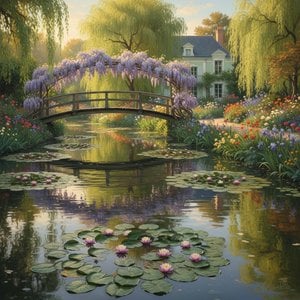
Blanche’s artistic development was characterized by a deep, rhythmic connection to the seasonal cycles of the gardens at Giverny. As she moved through the roles of student and collaborator, her brushwork began to mirror the ephemeral qualities of light and atmosphere that defined the Impressionist era. She did not merely paint landscapes; she documented the soul of the garden. Her works often focused on the delicate interplay between water, flora, and light, capturing the weeping willows and the floating lilies with a precision that felt both intimate and expansive.
Her technical approach was heavily influenced by her close proximity to Monet’s late-period masterpieces. She learned to navigate the complexities of color theory and the way light dissolves form, yet she maintained a distinct sensibility. Her landscapes often possess a certain stillness—a contemplative quality that distinguishes them from the more energetic brushstrokes of her contemporaries. This period of her life was also marked by artistic exchange; she collaborated with American expatriates such as Theodore Earl Butler and John Leslie Breck, creating works that blended French Impressionist traditions with a fresh, transatlantic perspective.
A Lasting Impression on Art History
Though for many decades her name was whispered in the shadows of the Monet legacy, modern art history has begun to reclaim Blanche Hoschéde Monet as a significant painter in her own right. Her significance lies not only in her technical skill but in her role as a custodian of the Giverny aesthetic. She lived through the transformation of the Impressionist movement from a radical new way of seeing into a celebrated pillar of art history, and her paintings serve as vital primary documents of that era's atmosphere.
Today, her legacy is preserved in various collections and institutions, most notably within the Musée Blanche Hoschedé-Monet (formerly the Musée Municipal A.g. Poulain de Vernon). To study her work is to experience a more intimate version of Impressionism—one that is less about the grand spectacle of light and more about the quiet, enduring beauty found in the corners of a beloved garden. Her life remains a testament to the power of artistic devotion and the subtle, indelible marks left by those who work alongside greatness.
Pitanja i odgovori
Na koje periode je podeljena karijera umetnika Blanche Hoschedé-Monet?
Karijera umetnika Blanche Hoschedé-Monet razvija se period po period na stranici Hronika: kroz horizontalnu vremensku liniju dela, grupisanih u poglavlja prema periodima stvaranja.
Gde se mogu pronaći dela umetnika Blanche Hoschedé-Monet grupisanja po paleti boja?
Da biste pronašli dela umetnika Blanche Hoschedé-Monet u specifičnoj paleti boja, posetite njegovu stranicu Preko palete boja.
Gde se mogu pronaći dela umetnika Blanche Hoschedé-Monet grupisanom prema ključnim rečima?
Da biste pronašli dela umetnika Blanche Hoschedé-Monet na određenu temu, koristite stranicu Preko ključnih reči ovog umetnika, koja grupiše radove prema ključnim rečima.