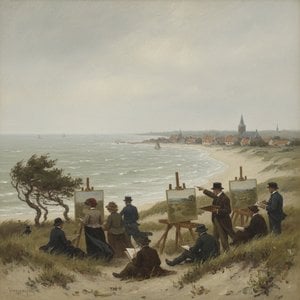
Bengt Nordenberg: A Life in Swedish Genre Painting
Early Life and Education
Bengt Nordenberg was born on April 22, 1822, in Jämshöga, a small village in southern Sweden. He experienced a childhood marked by poverty, which undoubtedly shaped his later artistic focus on everyday life. He began his artistic journey as an apprentice to a painter in Sölvesborg, gaining foundational skills before pursuing formal training.
In 1843, Nordenberg moved to Stockholm to study at the prestigious Royal Swedish Academy of Arts. This marked a crucial step in his development, providing him with access to academic instruction and exposure to contemporary artistic trends.
Düsseldorf Period and Influences
A pivotal moment in Nordenberg’s career came in 1851 when he traveled to Düsseldorf, Germany. This city was a major center for the Düsseldorf School of Painting, known for its realistic depictions of genre scenes and landscapes.
- He initially studied under Theodor Hildebrandt, but later came under the significant influence of Adolph Tidemand.
- Tidemand’s emphasis on portraying Norwegian rural life resonated deeply with Nordenberg, shaping both his style and subject matter.
- For a period, Nordenberg even worked as an assistant to Tidemand, creating reproductions of his paintings – a valuable learning experience.
Artistic Development and Themes
Nordenberg’s artistic development was characterized by a commitment to realism and a deep interest in portraying the lives of ordinary people. While initially influenced by Tidemand, he gradually developed his own distinct style.
- His early works focused on scenes from Dalarna, Skåne, and Blekinge – regions of Sweden known for their unique cultural traditions and picturesque landscapes.
- He skillfully captured the essence of rural life, depicting everyday activities, customs, and social interactions with sensitivity and detail.
- Later in his career, Nordenberg also painted portraits of middle-class and upper-class individuals, as well as religious paintings and altarpieces, demonstrating his versatility.
Travels and Later Life
In 1856, Nordenberg received a travel grant from the Swedish state, allowing him to broaden his artistic horizons.
- He studied with Thomas Couture in Paris for a year and a half.
- He made brief returns to Düsseldorf before settling there permanently in 1858.
Düsseldorf became his home for the rest of his life, where he continued to paint and exhibit his work until his death in 1902.
Major Achievements and Historical Significance
Although not as widely recognized today as some of his contemporaries, Bengt Nordenberg was a significant figure in Swedish art during the 19th century.
- His genre paintings provide valuable insights into the social and cultural life of Sweden during this period.
- He successfully blended elements of realism with romantic sensibilities, creating works that are both visually appealing and historically informative.
- Notable works include Rowing to the Church, Dalarna (1854), The Veterans (1882), and Leaving Home (1876).
Nordenberg’s legacy lies in his ability to capture the spirit of Swedish life with authenticity and artistic skill, making him a notable representative of the Düsseldorf School and a valuable contributor to Swedish art history.
Pitanja i odgovori
Gde je i kada je rođen/a Bengt Nordenberg?
Bengt Nordenberg je rođen/a u gradu Jämshöga godine 1822.
Gde mogu da pogledam sva dela umetnika Bengt Nordenberg?
Sva dela umetnika Bengt Nordenberg na ovaj sajt možete pregledati na njegovoj/njenoj stranici sa Sva umetnička dela.
Koje je boje Bengt Nordenberg najčešće koristio/la?
Genom palete umetnika Bengt Nordenberg je stranica koja predstavlja koloristički profil celokupnog umetničkog dela ovog autora.