
A Vibrant Echo of Urban Life: Exploring Kandinsky’s “Moscow”
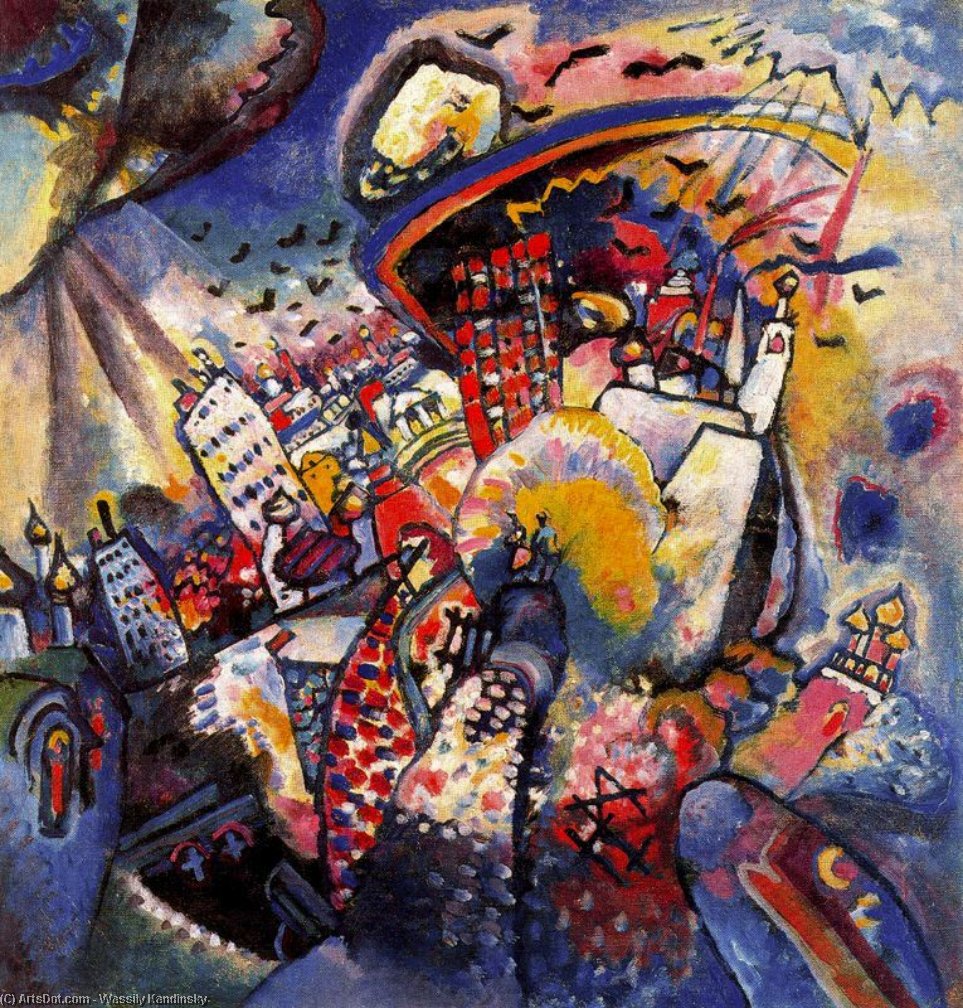
Wassily Kandinsky's "Moscow" is more than just a cityscape; it’s a dynamic and emotionally charged interpretation of early 20th-century Russia, rendered with the pioneering spirit that would define his contribution to abstract art. This painting encapsulates a pivotal moment in both the artist’s journey and the evolution of modernism itself.
Subject & Composition: A City in Motion
The artwork presents a bustling urban scene, teeming with abstracted buildings, figures, and birds. Unlike traditional cityscapes focused on realistic representation, Kandinsky prioritizes conveying the *feeling* of Moscow – its energy, its chaos, and its vibrant life force. The composition is deliberately fragmented and dynamic, utilizing strong diagonal lines that propel the viewer’s eye through the canvas. A prominent clock tower serves as a focal point, subtly hinting at the relentless passage of time within this urban environment.
Style & Technique: Embracing Expressionism
“Moscow” is firmly rooted in the principles of Expressionism, an artistic movement that sought to depict subjective emotions and experiences rather than objective reality. Kandinsky employs a bold palette of clashing colors – reds, blues, yellows, and browns – applied with thick, impasto brushstrokes. This technique creates a textured surface and enhances the painting’s emotional intensity. The forms are distorted and abstracted, moving away from representational accuracy towards a more symbolic language.
Oil on canvas was Kandinsky's preferred medium for this period, allowing him to build layers of color and texture that contribute to the artwork’s depth.
Historical Context: A Turning Point in Art History
Painted around 1916, “Moscow” reflects a time of significant upheaval in Russia – on the cusp of revolution. Kandinsky had already begun his exploration of abstraction, influenced by encounters with artists like Matisse and Picasso during a trip to Paris. He returned to Moscow briefly during World War I but soon found himself at odds with the emerging Soviet aesthetic. This painting represents a transitional phase in his work, bridging representational elements with the burgeoning abstract style that would become his signature.
Symbolism & Interpretation: Decoding the Urban Landscape
While Kandinsky increasingly moved towards non-objective art, traces of symbolism remain within “Moscow.” The towering structures could be interpreted as representations of power or societal constraints, while the swirling patterns and abstracted figures evoke a sense of collective energy.
The birds often symbolize freedom or spiritual aspiration, adding another layer of meaning to the composition. Ultimately, the painting invites viewers to project their own emotions and interpretations onto the scene.
Emotional Impact & Legacy: A Lasting Resonance
“Moscow” evokes a complex range of emotions – excitement, anxiety, disorientation, and perhaps even alienation. It’s a powerful expression of urban life's inherent contradictions: its vibrancy alongside its anonymity, its energy coupled with its potential for chaos. Kandinsky’s innovative use of color and form profoundly impacted the development of abstract art, inspiring generations of artists to explore new ways of representing inner experience.
Exploring Further
- Discover related works by Wassily Kandinsky, such as “Woman in Moscow” and “Moscow. Zubovskaya Square. Study.”.
- Delve deeper into the world of Expressionism and its key figures.
- Consider how “Moscow” might complement a modern or contemporary interior design scheme, adding a touch of artistic sophistication and historical significance.
This painting is not merely a depiction of a city; it’s an invitation to experience the world through the eyes – and emotions – of a true visionary.



































