The Genesis of a Vision: Context and Early Influences
Wassily Kandinsky’s “Abschied” – or “Farewell,” as it’s often translated – isn't merely a depiction of a scene; it’s a distillation of the artist’s evolving worldview, a visual embodiment of his burgeoning abstraction. Created in 1903, this black and white drawing emerges from a period of profound transformation for Kandinsky, a man who deliberately abandoned a promising legal career to pursue the uncharted territories of art. His journey began not with an immediate passion but with a series of pivotal encounters – a captivated response to Claude Monet’s “Haystacks,” and a deeply moving experience witnessing Wagner's opera "Lohengrin" – events that ignited within him a relentless desire for artistic expression.
Early influences played a crucial role in shaping Kandinsky’s nascent style. He was profoundly affected by Russian folk art, particularly the vibrant color palettes and symbolic imagery found in its traditional designs. This fascination with color wasn't simply aesthetic; it stemmed from an ethnographic expedition to the Vologda region of Russia, where he witnessed houses and churches adorned with shimmering hues that evoked a sense of entering another realm. This experience, combined with his study of Wagner’s music – which he saw as a parallel form of expression – laid the groundwork for his later exploration of color's psychological power. The drawing itself reflects this early interest in conveying emotion through visual elements, hinting at a deeper spiritual intent.
A Composition Steeped in Symbolism
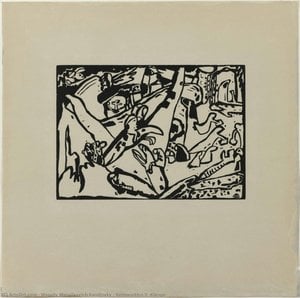
“Abschied” is rich with symbolic details that invite interpretation and suggest a narrative beyond the literal depiction of a woman and a horse. The central figures – a woman holding a spear or similar weapon – immediately evoke themes of departure, transition, and perhaps even sacrifice. The horse, positioned on the left, could represent steadfastness, loyalty, or even the burden of the past. Notice the two birds in the upper right corner; they often symbolize freedom, hope, or messengers between worlds. The clock in the top left corner speaks to time’s passage and the inevitability of change, while the bowl at the bottom right might signify nourishment, completion, or a final offering.
The inclusion of these seemingly disparate elements – the spear, the birds, the clock, the bowl – creates a complex tapestry of meaning. Kandinsky wasn’t simply illustrating a scene; he was constructing a visual allegory, inviting the viewer to engage in a dialogue with the artwork and decipher its hidden symbolism. The drawing's overall mood is one of quiet contemplation, tinged with melancholy and anticipation.
The Dawn of Abstraction: A Revolutionary Approach
“Abschied” stands as a crucial bridge between Kandinsky’s early expressionistic works and his later explorations into pure abstraction. While retaining elements of representational imagery, the drawing demonstrates a growing detachment from direct imitation of reality. The simplified forms, the emphasis on line and shape, and the deliberate use of negative space all point toward a move away from traditional artistic conventions. This shift reflects Kandinsky’s belief that art should transcend mere representation and communicate directly with the soul.
It's important to note that this wasn’t an abrupt departure but a gradual evolution, driven by Kandinsky’s intense intellectual and spiritual investigations. He sought to create a visual language capable of expressing inner realities – emotions, ideas, and spiritual truths – independent of external appearances. “Abschied” exemplifies this ambition, offering a glimpse into the nascent stages of his revolutionary approach to art.
A Legacy in Color and Spirit
Wassily Kandinsky’s “Abschied” is more than just a drawing; it's a testament to the power of artistic vision. It represents a pivotal moment in the history of modern art, marking the beginning of abstraction and paving the way for countless artists who followed. Reproductions of this evocative work offer a unique opportunity to experience Kandinsky’s groundbreaking ideas firsthand, inviting viewers to contemplate the profound connections between color, form, and the human spirit.



 Kupi ručno naslikanu sliku
 Pošalji
 Podeli
 Detalji o delu

 Преузми
 Slični predmeti
 Slajdovi
 Stats
Stats


 Pročitaj više






































 Opcija sa staklom dostupna je samo za dimenzije manje od 110 cm